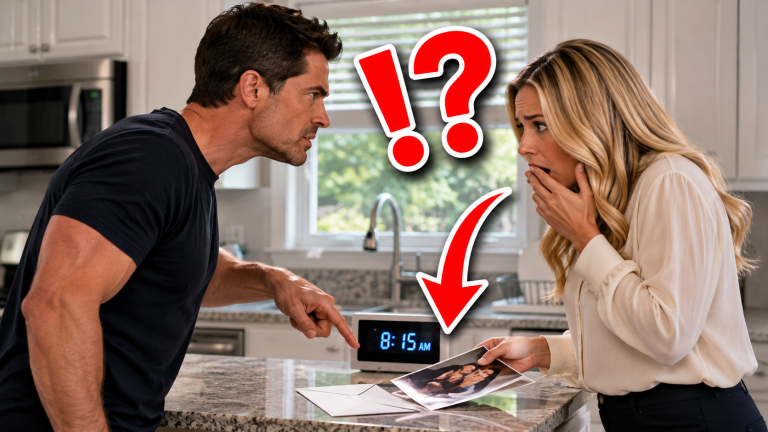
The envelope containing the acknowledgment had been stored with unrelated financial documents.
A notation on the back made her suspicious.
She hired Miriam to investigate before approaching Connor.
A genetic test later confirmed he was Sophie’s father.
I felt sick imagining a child growing up with a story about being unwanted that might never have been true.
“How is Hannah handling this?” I asked.
“She’s angry, and she has every right to be.”
Connor looked directly at me.
“She’s also trying to protect Sophie from becoming the center of a fight between adults.”
I nodded.
“I hope she succeeds.”
He studied my face for a moment.
“You sound different.”
The observation frightened me because I wanted it to mean more than it did.
“I’m trying to stop making everything about me,” I said.
Connor did not smile.
“That’s a good thing to try.”
We sat in silence until our coffee cooled.
Then he closed the folder and stood.
“I wanted you to hear the facts from me,” he said.
“Thank you.”
He hesitated.
“Lauren, I know the divorce hurts.”
I looked up.
“It does.”
“But I’m not asking you to wait for me.”
I forced myself to hold his gaze.
“I understand.”
I wanted to tell him that I would wait anyway.
Instead, I let him leave without making another promise he had not requested.
The following week, I met with a divorce attorney named Rebecca Sloan.
She explained the paperwork, the likely timeline, and the difference between what I feared and what the documents actually required.
Our house would not vanish overnight.
Our joint accounts would need careful review.
We could negotiate a settlement without turning every memory into a battle.
Rebecca asked what outcome mattered most to me.
I said I wanted to be fair to Connor even if I could not save the marriage.
She looked at me for a long moment.
“Fairness includes protecting your own legitimate interests,” she said.
I nodded.
“I don’t want to punish him for leaving.”
“Then we’ll focus on a reasonable agreement.”
That afternoon, I began sorting our shared documents.
I found utility bills, insurance policies, and receipts from repairs Connor had handled without asking for praise.
Every page reminded me of work I had once considered ordinary.
I had not noticed how many quiet decisions kept our household running.
I also found evidence of my own contribution.
There were records of mortgage payments I had made during Connor’s job transition and receipts from the months when I had cared for his father after surgery.
The marriage had not been entirely one-sided.
Remembering that did not erase my betrayal.
It did keep me from rewriting our entire history as a simple story about a perfect husband and a worthless wife.
We had been two flawed people who built a life together.
I had damaged that life through choices that were mine alone.