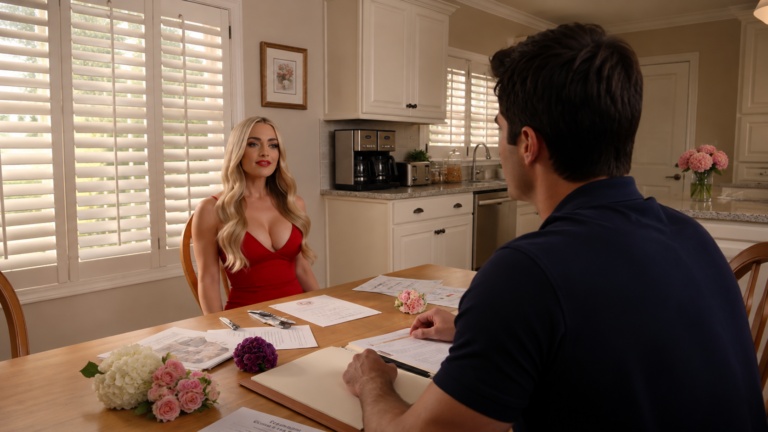
Two days later, Connor called and asked whether I could meet him at Miriam’s office.
He sounded exhausted.
I said yes without asking whether Sophie would be there.
I had learned that being useful did not entitle me to enter every part of his life.
Miriam’s office occupied the second floor of a brick building near downtown.
Connor was already waiting when I arrived.
He wore a navy sweater and the same watch I had given him for our fifth anniversary.
Seeing it on his wrist brought a sharp, unreasonable burst of hope.
Then he stood and greeted me with the courtesy of a man meeting an old friend.
I understood that the watch meant nothing about his intentions.
Miriam introduced a second attorney named Daniel Reeves, who specialized in family matters.
They had arranged the meeting because an original copy of the disputed letter had been found among Sophie’s mother’s records.
The paper carried a date from twelve years earlier.
It included Connor’s former address, his employer’s name, and a signature acknowledging that he had received notice of a pregnancy.
The address was correct.
The employer was correct.
The signature was wrong.
Connor stared at the page for a long time before speaking.
“I never saw this letter.”
Miriam nodded and pointed to the notarial acknowledgment.
The stamp bore Evelyn Marsh’s name and an expiration date.
Daniel explained that they had located an old state record confirming her commission.
That did not prove she had personally witnessed the signature.
They had also discovered that the letter’s stated delivery date fell during a week when Connor was working at a job site in another state.
He had time sheets and hotel receipts to support the trip.
I looked at the page again.
“Someone could still have mailed it to his home,” I said.
“Yes,” Miriam replied.
“But this form claims he signed in person at a local office on a particular afternoon.”
Connor reached into his bag and placed an old travel itinerary on the table.
He had been in North Carolina that afternoon.
I could see his name on the hotel invoice.
The evidence did not answer who had forged the signature, but it made the document much harder to trust.
Miriam asked me to describe the handwriting features I had noticed.
I explained the rightward tilt and the distinctive last stroke in Connor’s surname.
I also told them I was his estranged wife and not a handwriting expert.
Daniel thanked me for being precise about that limitation.
He said they would seek an independent examiner if the dispute reached court.
Connor looked at me across the table.
“I appreciate you coming,” he said.
I nodded because speaking would have revealed how badly I wanted to hear more.
After the meeting, we walked toward the parking lot together.
The afternoon sun reflected from the windshields in bright, uncomfortable flashes.
Connor stopped beside his car.