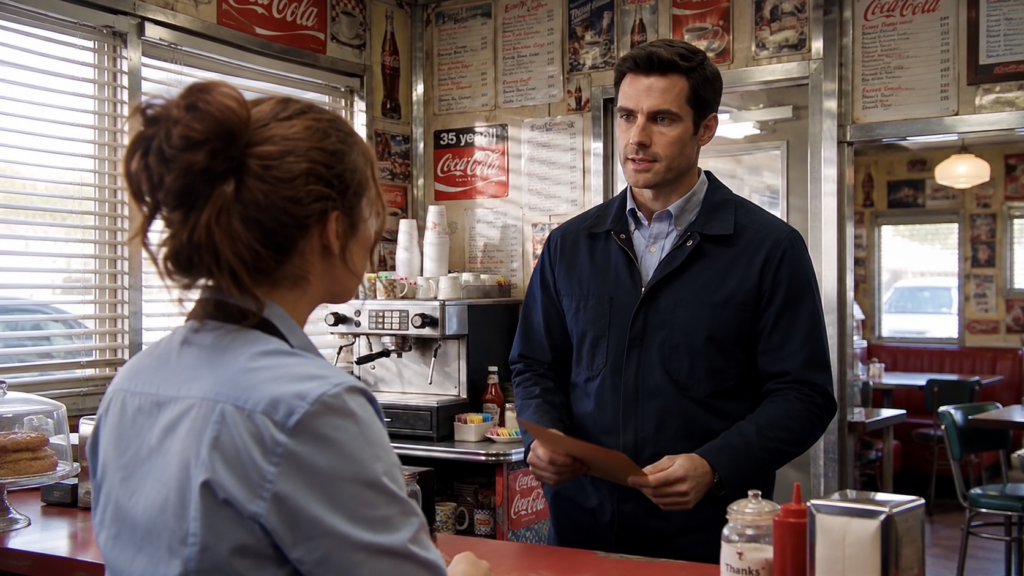
CHAPTER ONE: THE WINDOW TABLE
Nora Bennett noticed the man’s injured arm before she noticed his face.
The sling was gray, and its strap had rubbed a raw red mark against his neck.
He sat at the window table in the Briar Street Cafe, trying to hold a plate still with his elbow while his right hand worked a butter knife through a stack of pancakes.
Every attempt sent the plate sliding across the polished tabletop.
Nora had already carried two coffee pots and a tray of eggs past him when she finally stopped.
“Would you mind if I helped?” she asked.
The man looked up with the embarrassed expression of somebody who had spent his entire life avoiding that question.
“I should be able to manage breakfast,” he said.
“Breakfast shouldn’t require a wrestling match,” Nora replied.
His mouth twitched, and he nodded.
She placed a folded napkin beneath the plate, cut the pancakes into manageable pieces, and loosened the syrup cap.
She stayed long enough to make sure he could reach his coffee without twisting his injured shoulder.
He watched her work with a peculiar concentration.
“What’s your name?” he asked.
“Nora.”
“Nora what?”
“Bennett.”
The knife stopped in his hand.
Nora mistook his expression for pain.
“Does your arm hurt?”
“Only when I forget what happened to it.”
She waited, but he offered no explanation.
From behind the counter, supervisor Denise Calder called her name sharply.
Nora saw three customers waiting at the register.
“I have to get back,” she said.
“You’ve already done more than enough.”
She returned to the register without arguing when Denise complained that kindness did not pay the cafe’s electricity bill.
The man finished slowly and approached the counter carrying his empty syrup cup.
He thanked Nora with a seriousness that made her uncomfortable.
Then he reached inside his coat.
“I don’t need a tip,” Nora said.
“That wasn’t what I was reaching for.”
He withdrew a photograph with worn white edges.
For one instant, Nora saw a woman standing beside a large wooden cabinet and a boy holding a bright yellow kite.
The man studied the photograph, then slipped it back into his pocket.
“Have a good day, Nora Bennett,” he said.
Nora watched him leave through the glass door.
She did not know that somebody across the street had been waiting for him.
CHAPTER TWO: THE FIRST SENTENCE
The next morning, a man in a dark work jacket entered the cafe shortly after seven.
He had the same pale eyes as the elderly customer, but his posture suggested a man who expected trouble before he opened his mouth.
“My father ate here yesterday,” he told Nora.
“The gentleman with the sling?”
“Yes.”
“Is he all right?”
“He’s frightened, and he refuses to explain why.”
The stranger placed a sealed envelope beside her coffee pot.
“My name is Caleb Mercer.”
Nora looked toward Denise, who was busy counting receipts.
“My father insisted you receive this personally,” Caleb continued.
“He said you would recognize the photograph.”
Nora opened the envelope with a thumbnail.
The photograph showed the same woman,
cabinet, and child she had glimpsed yesterday.
A handwritten letter lay behind it.
The first sentence read, “Nora Bennett, the woman in this photograph is the person who saved my son, and the town has spent twenty years thanking the wrong man.”
Nora read it twice.
“My mother?” she whispered.
Caleb’s expression changed.
“Your mother is the woman in the picture?”
Nora touched the image with one finger.
The woman’s face was younger, but the slight tilt of her smile was unmistakable.
Her mother, Ruth Bennett, had died when Nora was sixteen.
Ruth had worked as a cleaner, a school lunch assistant,
and a seamstress who repaired strangers’ coats after midnight.
She had never mentioned saving anybody’s son.
“What does this mean?” Nora asked.
Caleb shook his head.
“My father says the photograph proves that a famous rescue story was staged afterward.”
“Which rescue story?”
“The day the children were trapped in the winter exhibition hall.”
Nora knew the story.
Every December, the town of Alder Falls celebrated the day businessman Grant Voss had supposedly led twelve children out of a collapsing exhibition building.
A bronze plaque stood in the square, and a scholarship carried his name.
Nora had walked past that plaque hundreds of times.
Caleb leaned closer.
“My father was one of those children.”
Nora glanced at the photograph again.
The boy with the kite had Caleb’s eyes.
“Why send this now?”
“Because they’re demolishing the hall on Friday.”
Caleb lowered his voice.
“And because someone tried to push my father down the stairs yesterday.”
CHAPTER THREE: THE WOMAN IN THE PHOTOGRAPH
Nora asked Denise for ten minutes, and Denise responded by pointing at the line of customers.
Caleb waited near the entrance while Nora finished the breakfast rush.
Every time the door opened, he looked up sharply.
At nine, Denise finally let Nora step into the alley.
The air smelled of wet cardboard and frying oil.
Caleb unfolded a small paper map of the old exhibition grounds.
“The hall wasn’t an ordinary building,” he said.
“It was a temporary indoor market built around a central demonstration room.”
“Why does that matter?”
“Because the official story says Voss opened the main doors and led everyone out.”
“Didn’t he?”
“My father says those doors were chained from the outside.”
Nora felt her stomach tighten.
“Who chained them?”
“That’s the question he wouldn’t answer until yesterday.”
Caleb showed her a close photograph of the old structure taken during demolition preparations.
A brick annex still stood behind the exhibition hall.
Its upper windows were covered in boards.
“My father wants you to meet him there at noon.”
“Why me?”
“He thinks your mother left something unfinished.”
Nora studied Caleb’s face.
“You didn’t know her name before you walked into the cafe.”
“No.”
“Then how did your father know mine?”
Caleb hesitated.
“He recognized the way you held his plate.”
Nora almost laughed.
“That makes no sense.”
“I know.”
“He recognized a person from the way she held a plate?”
“He said your mother did the same thing when he was little.”
Nora remembered Ruth sliding a folded towel beneath an uneven kitchen table leg.
Her mother had always solved small practical problems before discussing them.
Caleb noticed the recognition on her face.
“Please come,” he said.
Nora looked back at the cafe’s rear door.
She needed the wages, and Denise had already threatened to reduce her shifts.
Then she looked at the letter again.
The last line was written in a trembling hand.
“I am tired of letting the wrong person stand beneath her name.”
Nora folded the letter and slipped it into her apron pocket.
“I’ll be there.”
CHAPTER FOUR: THE BUILDING THAT REMEMBERED
The exhibition hall stood behind a row of new parking spaces near the riverfront shopping district.
Workers had removed its decorative roof panels, leaving the steel framework exposed against the pale sky.
A temporary fence surrounded the property.
Caleb met Nora outside the gate with his father.
The old man wore the same gray sling.
“My name is Walter Mercer,” he said.
“I know,” Nora answered.
Walter looked at her for a long moment.
“You have your mother’s eyes.”
“Everybody says that.”
“Not everybody knew her.”
A demolition foreman approached them carrying a clipboard.
He wore a yellow vest with the name PAUL embroidered over the pocket.
“You can’t enter an active site without authorization,” he said.
Walter held up a visitor pass.
“I asked permission to see the old loading room.”
Paul inspected the pass and frowned.
“You have fifteen minutes.”
The three visitors followed him through a side entrance.
Inside, the air smelled of dust, old timber, and damp plaster.
Walter stopped at a narrow corridor with faded green tiles.
“This was the children’s craft room,” he said.
Nora examined the corridor.
One wall had been opened, exposing a cavity packed with yellow insulation.
Walter pointed toward a metal door at the far end.
“That’s where we were told to wait.”
Caleb looked confused.
“You never told me that part.”
Walter’s hand trembled against the sling.
“Grant Voss told us there was a surprise waiting in the demonstration room.”
“What kind of surprise?” Nora asked.
“A winter lantern show.”
Walter closed his eyes.
“Someone turned off the lights, and then we smelled smoke.”
The foreman glanced at his watch.
Walter continued.
“The grown-ups had gone to a ceremony outside, and the door behind us wouldn’t open.”
“Was my mother working here?”
“She was cleaning the service corridor.”
Walter walked toward the old metal door.
“She heard us before anybody else.”
Nora followed him.
“Then why does the plaque say Voss saved everyone?”
Walter looked at the cracked floor.
“Because he arrived after she had already done the dangerous part.”
The foreman raised his hand.
“That’s enough for today.”
A man in a charcoal overcoat stood in the doorway behind them.
“I agree,” the stranger said.
“Mr. Mercer has had quite enough excitement.”
Walter went visibly pale.
Caleb stepped between his father and the stranger.
“Who are you?”
“Elliot Voss.”
The man smiled without warmth.
“Grant Voss was my father.”











