CHAPTER 10: THE WAGON AT DAWN
Before sunrise the overseer assembled the people named in the sale order near the outer gate.
Ruth carried Mercy against her shoulder, and the child cried when she saw the waiting wagon.
Josiah stood among the stable hands, listening for any sound from the house.
Elias appeared with Mercer and demanded the final roll.
The overseer began calling names.
Ruth answered only when her own name was spoken.
When Mercy’s name followed, she asked why a child was listed as a separate shipment.
Elias told her to be quiet.
Josiah took one step forward before Abel caught his sleeve.
The old man reminded him that the entire family could suffer if he gave Elias an excuse for violence.
Mercer opened the ledger and stopped at a column with crossed-out figures.
He whispered something to Elias.
Elias demanded that he continue.
Mercer said the entries had not been reconciled with the trust’s transport account.
The two men argued beside the gate while everyone else waited.
A carriage approached from the parish road.
The older guest from dinner stepped down with Thomas Bell, the dismissed bookkeeper.
Bell carried a small bundle of account copies tied with twine.
The guest said he had asked Bell to explain the irregularities before any transaction took place.
Elias accused them of interfering with his lawful business.
Bell answered that the estate had invoiced the same freight service for people listed under different names.
He warned that the double entries could expose the landowners and creditors to competing claims.
Elias cared far more about his debts than about family separations.
For that reason, Bell’s warning finally made him hesitate.
Mercer proposed a delay until the figures could be checked.
The wagon driver protested that he would lose his fee.
Elias paid him to leave without passengers.
Ruth held Mercy tighter as the empty wagon rolled away.
Josiah knew the delay was fragile.
Still, for that morning, no one from the list had been carried through the gate.
CHAPTER 11: WHAT ISABELLA HAD NOT SAID
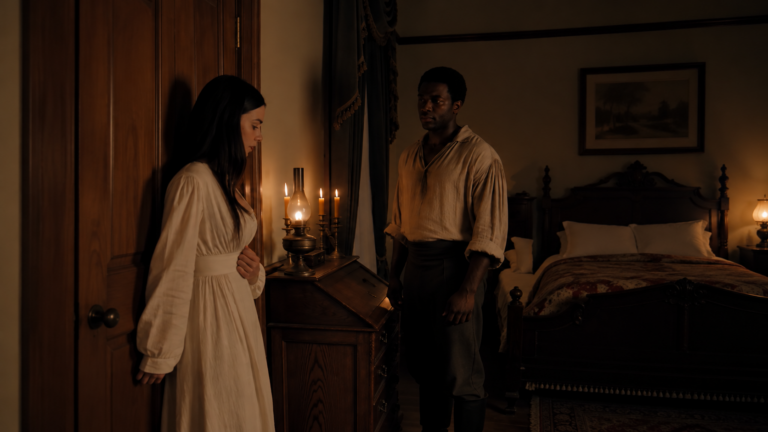
Isabella found Josiah outside the stable later that day.
She looked exhausted and carried a bruise on her wrist where Elias had gripped her during the argument.
Josiah offered no comfort and asked whether the sale was canceled.
She told him it was only delayed.
Elias intended to find another buyer once the accountants agreed on a defensible set of books.
Isabella said she could leave Oakwood and seek protection from relatives in Baton Rouge.
Josiah asked whether she meant to go alone.
Her silence supplied the answer.
He told her that fleeing the house without leaving evidence behind would make her confession useless to Ruth and the others.
Isabella said she feared what Elias might do if she remained.
Josiah acknowledged her fear without confusing it with the danger faced by people Elias legally claimed to own.
“You can take a carriage away from this place,” he said.
“My sister cannot.”
Isabella looked down.
She said the trust account included payments to a boarding house in New Orleans.
The proprietor, Mrs. Delphine Laurent, had once received women fleeing dangerous households.
Isabella suspected that Elias’s aunt had quietly financed passages out of Louisiana.
Josiah asked why the entries used false names.
Isabella said secrecy could have protected people from being returned.
She also admitted that Elias might have captured the trust after his aunt’s death and used its routes for profit.
The same records might therefore contain both genuine assistance and later exploitation.
Josiah asked for the address of the boarding house.
Isabella wrote it on a narrow slip and gave him the dates of two payments.
She did not ask him to trust her.
He did not promise to forgive her.
The distance between those positions remained necessary as they began pursuing the same facts.