The Whitcomb estate stood twelve miles outside the fictional town of Harrow Glen, in a low valley bordered by pine ridges.
The year was 1851, and every road leaving the estate passed through a toll gate or a neighbor’s land.
Silas Whitcomb owned the fields, the barns, and the people forced to work them.
He also owned a reputation for careful accounting that he guarded more fiercely than his health.
His wife Lenora had learned to live inside that reputation like a prisoner inside a beautiful house.
Isaiah had worked at the weighing house for five years.
He knew how a wagon settled when it carried corn,
how it rattled when it carried iron, and how it leaned when the load was uneven.
He could hear a bad wheel before it crossed the yard.
He also knew which noises men made when they wanted a wagon’s contents kept secret.
Three weeks earlier, a wagon had rolled into the yard after midnight with its canvas drawn tight.
Isaiah had been summoned to unload it.
The driver, a white overseer named Curtis Vale, ordered him to keep his eyes on the ground.
Isaiah obeyed until a metallic knock sounded beneath the canvas.
A woman inside the wagon had whispered a single word.
“Please.”
Isaiah had looked up before he could stop himself.
Curtis struck the side of the wagon with his cane.
“It’s machinery,” Curtis said.
“Machinery does not ask for help,” Isaiah replied.
Curtis made him unload six crates while the wagon stood in darkness.
The crates were filled with small wooden blocks, each cut with a different groove.
Their shapes meant nothing to Isaiah that night.
He noticed that the wagon’s left wheel was coated with pale clay.
The estate’s roads held red mud, and the nearest pale clay lay beyond the abandoned brickworks.
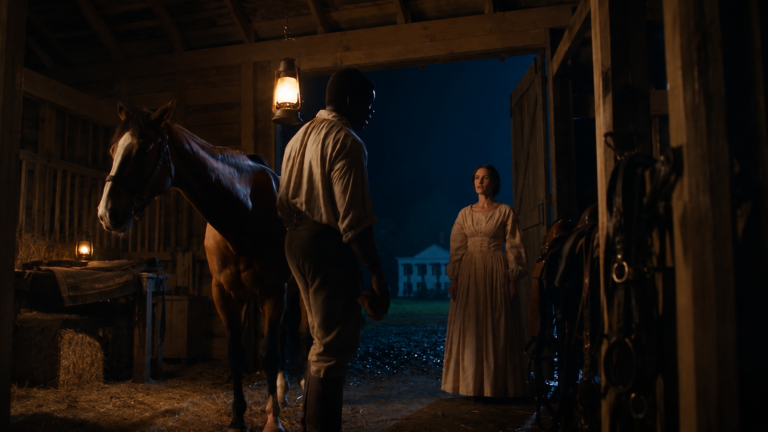
When the crates were unloaded, Curtis took the wagon toward the back pasture.
No one heard it return.
By breakfast, Curtis said the wagon had departed for the county market before dawn.
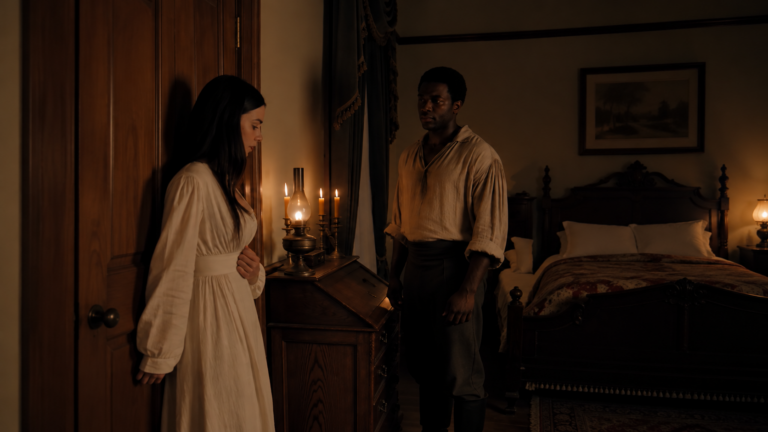
Lenora had summoned Isaiah for the first time that evening.
She asked whether he had seen a woman in the wagon.
Isaiah told her he had heard a voice.
She asked whether he could recognize it.
He told her that a whisper was not a face.
She threatened to sell his sister Esther if he repeated the conversation.
The next night she demanded to know about the clay on the wheel.
On the third night she asked about the six crates.
Every answer led to another locked door.
Isaiah had begun to understand that Lenora was not investigating the wagon.
She was trying to discover how much of its journey he could prove.
His sister Esther worked in the sewing room, where she repaired clothing for the household and cut heavy sacks for the harvest.
She was twenty-six and had a son named Micah, who had recently learned to whistle through a gap in his front teeth.
Isaiah knew that Lenora’s threat was not empty.
A sale could separate Esther from Micah before either had time to say goodbye.
He had spent three weeks learning which people were being watched,
which doors remained unlocked, and which noises the mansion could not conceal.
That evening he had decided to stop answering questions and begin asking them.
He had chosen the wagon because Lenora feared it more than she feared her husband.
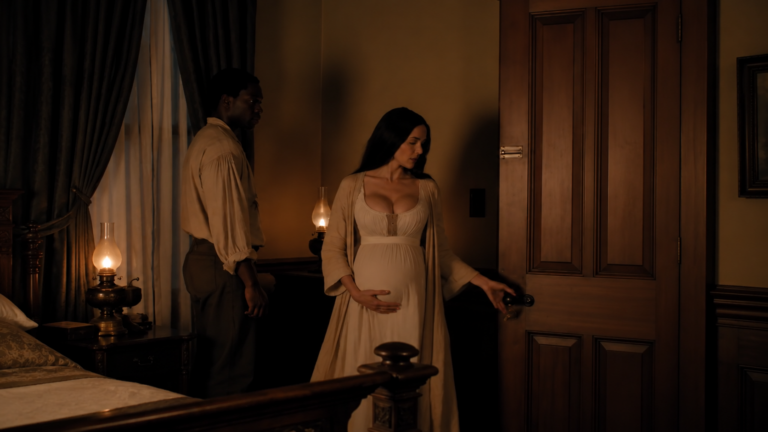
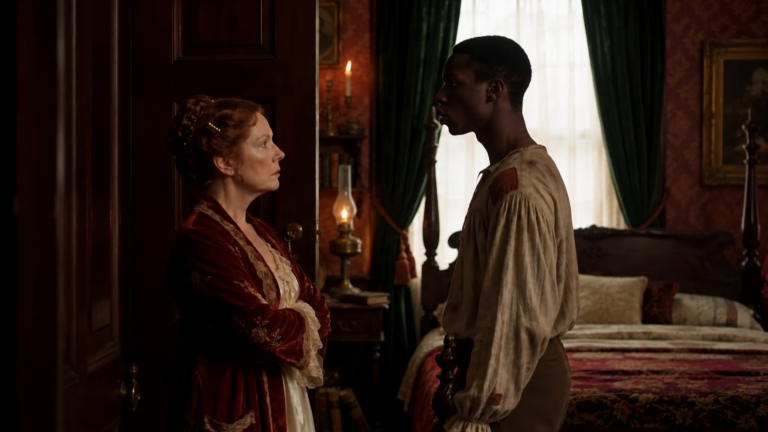
Now, in the locked bedroom, she stared at him with the brass weight in her hand.
“What do you know?”
Isaiah looked at the weight.
“I know the wagon is still on this property.”