CHAPTER 4: THE LEDGER ROOM
Elias Hargrove returned before the sun had cleared the cypress trees.
He arrived in a carriage with mud on the wheels and an unfamiliar man seated beside the driver.
The stranger introduced himself as Charles Mercer, a commercial clerk sent to reconcile estate accounts.
His polished shoes did not match the road, and his leather case remained locked against his knee.
Elias greeted the household as though nothing unusual had happened.
He ordered breakfast served at once and instructed the overseer to keep the stable hands available.
Josiah heard the order from the yard and understood that the planned sale had moved closer.
That morning he watched Mercer carry his case upstairs to Elias’s office.
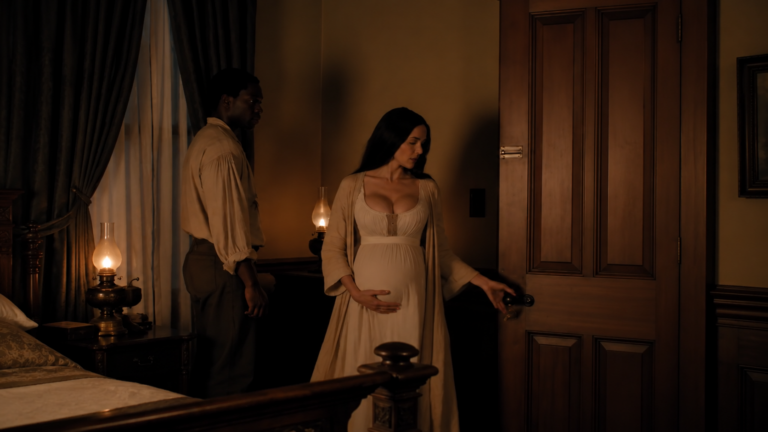
He also watched Isabella refuse her husband’s offered arm at the foot of the staircase.
Elias noticed the refusal, but he waited until the guests were gone before speaking to her.
Through an open window Josiah heard his voice rise above the dishes.
“You signed what I put before you,” Elias said.
“You do not get to change your mind because you have finally read it.”
Isabella replied in a voice too low to hear.
Elias struck the table, and the sound sent a servant hurrying from the room.
Josiah turned away before anyone could catch him listening.
Later, the cook quietly told Ruth that Elias had dismissed his usual bookkeeper.
The bookkeeper had questioned a line of figures showing payments for people who were supposedly still at Oakwood.
Ruth passed the news to Josiah while they filled a water trough.
The discrepancy suggested that the sale order belonged to something larger than one cruel decision.
Josiah had no reason to believe a financial irregularity would protect anyone.
People with money could dispute one another’s claims while the people named in those claims remained trapped.
Still, the ledger might establish who had been taken,
when, and under whose authority.
Josiah began to think of the office not as a place containing a rescue but as a place containing evidence of a pattern.
Evidence could travel farther than a plea, provided someone survived to carry it.
CHAPTER 5: ABEL AT THE RIVER ROAD
Abel lived in a narrow cabin where the plantation road bent toward the river.
His hair had gone white, and an old injury made his left hand stiff.
He listened while Ruth explained what Josiah had read.
Abel knew the clerk’s surname before Josiah mentioned it.
“Mercer,” he said, and his voice turned bitter.
He remembered Charles Mercer from a previous estate transfer conducted after a planter died without a clear will.
A dozen families had been moved before the heirs settled their dispute.
The books later showed that several of those people had been counted twice.
Abel had once carried a shipment list for the estate and seen the duplicate entries himself.
Nobody in authority had asked what became of the missing names.
Josiah asked whether Abel knew where the former bookkeeper lived.
Abel said the man had rented a small room over a store in the parish town.
His name was Thomas Bell,
and he owed money to Elias.
That debt made him afraid to contradict his former employer.
Ruth asked whether Bell possessed copies of the entries.
Abel thought the man might have kept calculations because he was proud of being precise.
He warned them that precision and courage were different qualities.
A careful man could still decide that his own safety mattered more than theirs.
Josiah asked Abel to remember the names on the list.
Abel repeated them until he could say each one without looking at Josiah’s scrap.
Ruth added the kinship ties that the ledger had omitted.
The old man listened closely whenever she named a child.
“The books count bodies,” Abel said.
“We will count families.”
The distinction did not bring freedom closer that afternoon.
It did give their effort a purpose beyond proving that Elias had lied about his accounts.