CHAPTER 8: A MEAL INTERRUPTED
Elias held a supper for Mercer and two neighboring landowners on the night before the sale.
Josiah was assigned to prepare a carriage horse and remained outside the dining room.
Inside, the men spoke freely about prices, freight, and the difficulty of keeping families from learning their destinations.
One guest remarked that the trade had become less predictable since newspapers began printing stories of people who escaped.
Elias answered that every problem could be solved by moving quickly.
Mercer argued that haste created mistakes in the books.
The disagreement was sharp enough to reach the yard.
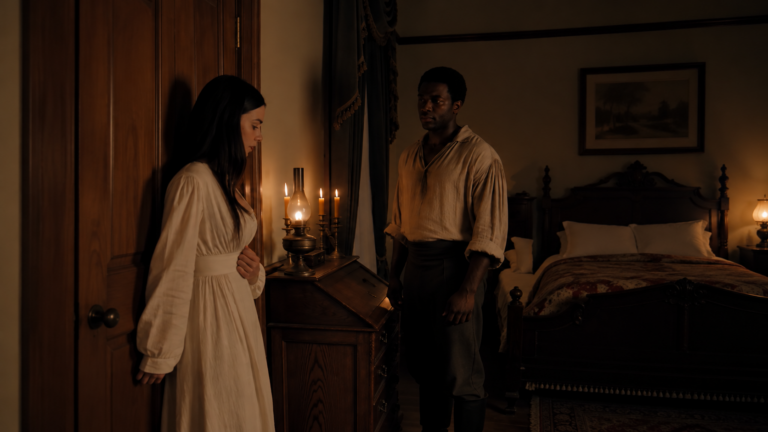
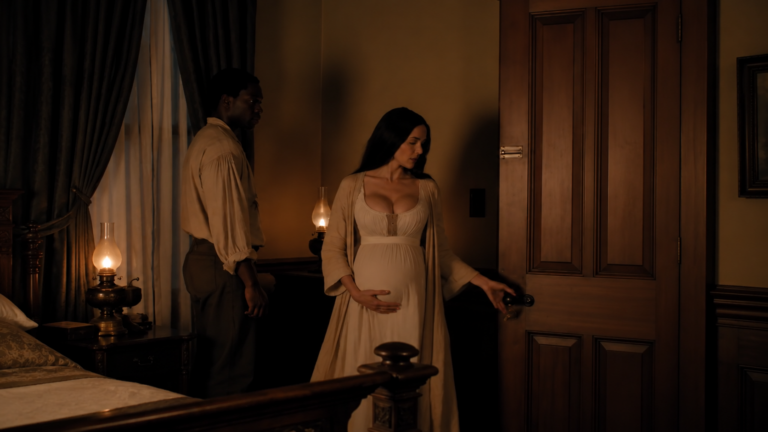
A servant brought out a tray of dishes and told Josiah that Isabella had refused to join the meal.
She had locked herself in her sitting room after an argument with Elias.
The servant also said Mercer carried a second ledger in his travel case.
Josiah asked no further questions because questions could endanger her.
He returned to the stable, where Ruth was waiting with news from Abel.
A boy hired to tend the river landing had seen an empty wagon prepared for twelve passengers.
The driver expected to leave before the usual breakfast bell.
Josiah felt the hours closing around them.
Ruth asked whether he had decided on a plan.
He told her that a document alone would not stop armed men from loading a wagon.
They needed the sale delayed while someone outside Elias’s authority examined the disputed entries.
Ruth said Bell might be willing to challenge the arithmetic if the claim came from Isabella rather than from them.
Josiah hated the injustice of that assessment, but he knew she was right about the risk.
He asked Ruth to speak with Isabella before the supper ended.
Ruth refused to be sent as a messenger without being told the purpose.
Josiah explained that they needed Isabella to confront Mercer with the account discrepancies in front of witnesses.
Ruth considered the proposal and agreed to deliver it in her own words.
“She will have to stand where people can hear her,” Ruth said.
“She cannot whisper her way out of this.”
Josiah watched his sister return to the house, knowing that the next hour might decide whether Mercy woke in the same room as her mother.
CHAPTER 9: THE ACCOUNTING ERROR
Isabella entered the dining room while the guests were discussing river freight.
She carried the trust account in one hand and her written statement in the other.
Elias told her that the conversation concerned business and asked her to leave.
She did not move.
She asked Mercer why an account created for a dead woman’s charitable work had paid freight charges after the woman’s death.
Mercer looked toward Elias before answering.
He said he had only processed instructions submitted by the estate.
Isabella asked who had submitted those instructions.
One of the guests set down his glass.
Mercer replied that he could not discuss private books in a social setting.
Isabella read aloud the date of a payment that matched a disputed transfer.
Elias stood so abruptly that his chair struck the wall.
He ordered her to be silent and accused her of embarrassing the household.
Isabella admitted she had signed the sale order without understanding it.
She stated that she now withdrew her cooperation and wanted the records independently reviewed.
Elias laughed at her assumption that she could withdraw a completed signature.
The older guest asked Mercer whether the accounts were actually disputed.
Mercer said several entries required clarification.
It was a small concession, but everyone at the table heard it.
Elias demanded an explanation.
Mercer answered that a careful review could protect the estate from future claims.
The man spoke of claims rather than people, and Josiah heard the difference from the darkened hallway.
The dinner broke apart without agreement.
Elias ordered the guests away and threatened to have Isabella confined to her rooms.
The older guest left with the troubling account dates written in his pocket notebook.
Josiah did not know whether the man would act on them.
He did know that the sale could no longer be presented as a routine transfer witnessed by men who had heard no objection.