CHAPTER 2: A NAME WRITTEN TWICE
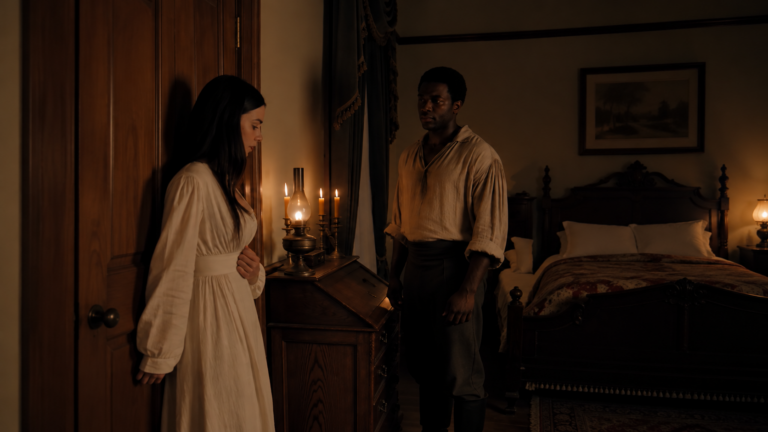
Isabella unfolded the sheet while Josiah kept a careful distance.
The document was a copy of a transfer order, and several names had been written in two different hands.
Josiah recognized Ruth’s name beside the name of an unfamiliar estate in Mississippi.
The names of two children appeared beneath hers without their mother’s surname.
He traced the words with his eyes but did not reach for the page.
Ruth had been born at Oakwood, and she had never crossed the river alone.
She had a small daughter named Mercy who slept beside her in the quarters.
The paper included Mercy as property to be moved separately.
“Who wrote this?” Josiah asked.
“My husband’s clerk prepared it,” Isabella said.
“And who signed it?” he asked.
She looked at her own signature near the bottom.
Josiah stepped back as though the ink had become hot.
Isabella explained that Elias had told her the order concerned supplies and livestock.
She claimed she had not looked closely until the afternoon.
Josiah could not know whether she was lying.
He knew only that her hand had helped authorize the sale.
“You are not asking me to trust you,” he said.
“You are asking me to repair something you did.
”
Isabella nodded without defending herself.
“Yes,” she admitted.
A horse stamped in the next stall.
Josiah thought of his mother, who had vanished into a sale wagon six years earlier.
The family had received no letter, address, or proof that she was alive.
He had promised Ruth that he would never let the same silence swallow her.
Promises did not change an owner’s power, but they still shaped a person’s choices.
“Bring no one into this stable again,” he said.
Isabella looked startled.
“Will you help?” she asked.
“I will decide what helps my family,” Josiah answered.
He told her to leave the paper where it was and return to the house.
Isabella hesitated, then obeyed.
After her footsteps faded, Josiah copied every name onto a scrap hidden inside the wooden handle of a brush.
He had learned long ago that paper could be taken, but a remembered name was harder to steal.
CHAPTER 3: RUTH KNOWS
At dawn Josiah carried a pail of water past the cookhouse and found Ruth kneading cornmeal beside the stove.
Her daughter sat on a low stool with a wooden doll balanced on her knees.
Josiah waited until the other workers stepped outside before speaking.
He told Ruth that a sale order named both her and Mercy.
Ruth held the edge of the table so tightly that flour marked her wrists.
She asked whether Elias had finally decided to send her away because she had refused the overseer’s request to work while ill.
Josiah told her the document had been prepared before her illness.
Ruth stared at the door for a long moment.
“Then he planned it while Mercy was still calling him sir in the yard,” she said.
Josiah could not answer.
The plantation had a habit of placing ordinary mornings beside unbearable decisions.
Ruth asked where he had seen the order.
Josiah explained enough about Isabella’s visit to make the danger clear.
Ruth’s expression changed when she heard the mistress’s signature was on the page.
“Do not let her make herself the hero of this,” Ruth warned.
Josiah said he had no intention of doing so.
Ruth began counting the people named in the order and recalling who might have relatives beyond the parish.
She had spent years listening to stories at the wash line and knew which families had been separated before.
She remembered that a man called Abel had once worked for a neighboring planter who kept copies of disputed purchases.
Abel now lived in the quarters near the river road.
Ruth suggested they speak to him before they trusted a single page produced in the big house.
Mercy looked up from her doll and asked why everyone was whispering.
Ruth knelt beside her and straightened the child’s ribbon.
“Because grown people are making plans they should have told us about,” she said.
Mercy accepted the answer without understanding its weight.
Josiah watched Ruth return to the stove.
She was frightened, but fear had not emptied her of judgment.
He realized that whatever came next could not be arranged around Ruth without Ruth deciding what she wanted.