CHAPTER 6: THE SECOND NIGHT
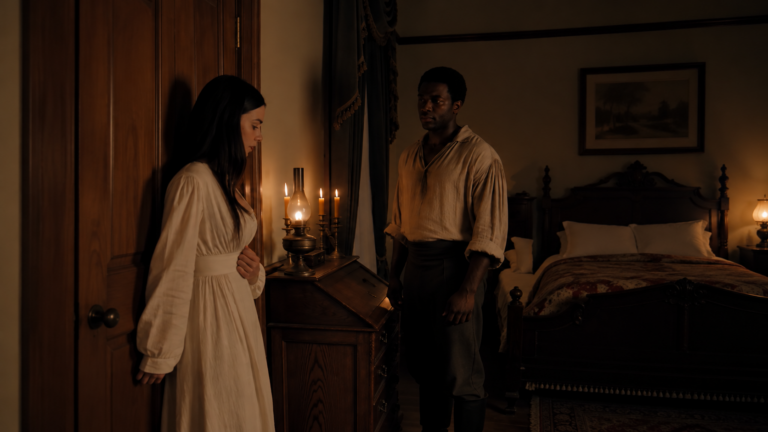
Isabella returned to the stables after supper with no lantern of her own.
Josiah had asked her not to return, and her presence made him angry before she spoke.
She said Elias had moved the sale forward to the next morning.
Mercer intended to leave with the signed papers at first light.
Josiah demanded to know why she had come rather than simply destroying the order.
Isabella answered that Elias had duplicate papers and witnesses ready to certify them.
A missing sheet could be replaced, but the office ledger contained dates that no new signature could easily change.
She said she could leave the office door unlatched for a few minutes during the household’s evening meal.
Josiah refused the proposal.
He could not safely enter the house, and he would not sacrifice another worker to make her plan seem courageous.
Isabella pressed her lips together.
“What can I do?” she asked.
Josiah told her to write a statement explaining exactly what she had signed and what Elias had told her.
He wanted her to identify the witnesses, the date, and the clerk who prepared the order.
He also wanted her to say plainly that the people named had not consented and had not been informed.
Isabella said no judge would care about their consent under Louisiana law.
Josiah looked at her until she stopped talking.
“Then make the record show what your husband counts on everyone ignoring,” he said.
Isabella promised to write it.
Josiah did not thank her.
He told her that no one at Oakwood owed her reassurance for telling the truth late.
She accepted the rebuke and turned toward the door.
Before leaving, she said the ledger contained a separate account called the Widow’s Trust.
Josiah had heard the name only once, years before, when his mother was taken away.
He asked what the trust had funded.
Isabella admitted she did not know.
For the first time, Josiah wondered whether the records might explain the disappearance that had haunted his family longer than Ruth’s impending sale.
CHAPTER 7: THE WIDOW’S TRUST
The next afternoon Isabella gave Ruth a sealed packet through the kitchen’s rear window.
Ruth did not open it until the cook agreed to watch the doorway.
Inside were Isabella’s signed statement and an old account page bearing the heading Widow’s Trust.
The account listed recurring payments to a transport company operating along the river.
Several payments coincided with dates when people had disappeared from Oakwood without ordinary sale announcements.
One payment matched the month their mother had been taken away.
Ruth held the page close to the light and examined the cramped handwriting.
She could not read every word, but she recognized the date Josiah had recited to her for years.
Their mother had left on a Tuesday in early September.
The household had been told that a buyer upriver required an experienced seamstress.
The page recorded her transfer under a different name.
Ruth whispered that the account made it look as though their mother had been sent to a woman rather than a plantation.
Josiah found a second column describing maintenance and passage.
He did not know whether those words represented shelter, transport, or another kind of captivity.
A new possibility opened, and he refused to mistake possibility for hope.
The packet also contained a note from Isabella explaining that the trust had belonged to Elias’s widowed aunt.
The aunt had died four years earlier, but the payments had continued.
Someone was using her account after her death.
Josiah studied the entries and noticed that Mercer had approved the most recent one.
He told Ruth that their immediate task remained stopping the sale.
Ruth agreed but placed the account page beneath her apron.
“When we have a chance to find her, we take it,” she said.
Josiah promised they would search for the truth, whatever it turned out to be.
Neither of them knew whether their mother was alive.
Both knew they had finally encountered a trace that could be followed.