CHAPTER 28: THE ROOM MIRIAM KEPT
The morning after their reunion, Josiah woke before the sun and listened to unfamiliar floorboards settling around him.
Miriam’s house stood beside a narrow orchard, and the wind pressed against its wooden shutters with the patient sound of someone asking to enter.
He expected for one confused instant to hear the bell at Oakwood and the overseer ordering men into the fields.
Instead, he heard Ruth speaking softly to Mercy in the adjoining room.
The difference brought him no sudden peace.
He lay still until he could trust the silence.
At breakfast Miriam placed three bowls on the table and carried a fourth from the shelf.
She hesitated before setting it down.
Josiah noticed that the bowl had a chipped green rim and had clearly been used many times.
“Who used to sit there?” he asked.
Miriam sat opposite him and folded her hands.
“A woman named Esther lived here until last winter,” she said.
“She helped me understand where I was when I first arrived.”
Miriam explained that Esther had found work washing linens and had rented the back room before marrying a cooper in the next township.
The two women had watched over each other when employers delayed wages or strangers asked questions about their histories.
They had promised to leave a place at the table for anyone who came looking for family.
Ruth touched the chipped bowl without picking it up.
“You didn’t know whether we were alive,” she said.
“No,” Miriam answered.
“I did not know whether hoping would make the next day harder.”
Mercy asked why Miriam had never traveled back to Oakwood.
Miriam looked toward the window rather than toward her granddaughter.
She explained that her freedom depended on papers issued in another state and that returning south could have placed her in the hands of people who claimed she belonged to them.
She had written whenever she found a person willing to carry a letter.
Some letters had been returned unopened, and others had disappeared without an answer.
“I was afraid you would think I had chosen to leave,” Miriam said to Ruth.
Ruth shook her head so fiercely that Mercy reached for her sleeve.
“You were taken,” Ruth replied.
“There is nothing to forgive in that.”
Josiah did not interrupt their conversation.
He noticed the small marks on the kitchen wall where Miriam had measured the height of children who belonged to her neighbors.
A woman’s patience had filled this house with other people’s milestones while she waited for her own family.
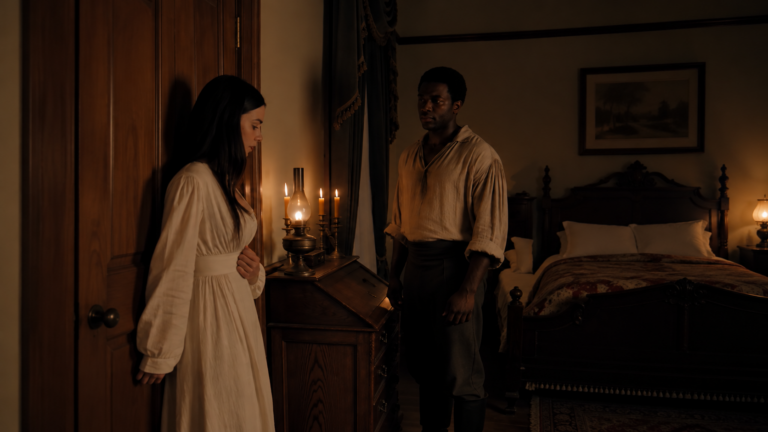
When breakfast ended, Miriam showed him the back room.
A narrow bed stood against one wall, with quilts folded on its footboard.
A shelf held several books, a tin of needles, and a shallow wooden box filled with letters.
Many envelopes carried addresses that had been crossed out and rewritten.
“These are the roads I tried to find you on,” Miriam told him.
Josiah lifted the box carefully.
He could not recover the time those letters represented, but he could read the names of the people who had helped his mother survive it.
He asked her to tell him about every one of them.
Miriam pulled a chair beside the window.
For the first time since their reunion, she began at the beginning rather than the end.