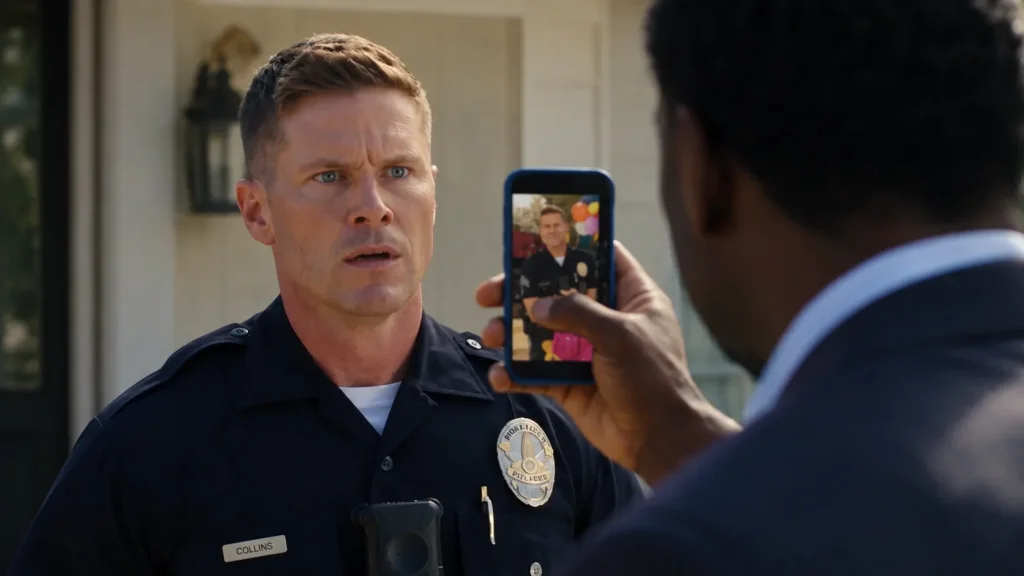
Michael Johnson did not say the name loudly.
He spoke it almost gently, as though the children beside him were sleeping instead of trembling beneath wet towels.
Elias Ward.
Daniel Mercer stopped moving.
For the first time since Michael had pulled into the driveway, the officer looked less like a man issuing orders and more like someone who had heard a door unlock in an empty house.
The second officer, a younger patrolman named Aaron Bell, glanced between them.
Who is Elias Ward, he asked.
Michael kept his eyes on Mercer.
He was the man who disappeared after telling investigators what happened at the Riverbend warehouse.
Mercer swallowed.
You have no idea what you are talking about.
Michael looked down at his son.
Marcus had pressed a wet washcloth against his face, but his hands were shaking so badly that the cloth kept slipping.
Kayla sat beside him with her arm around their youngest guest, a little girl named Tessa who had arrived that afternoon carrying a birthday present wrapped in blue paper.
The present was still on the patio table, untouched beside the ruined cake.
Michael felt the familiar anger rising through his chest.
He had spent years learning how to hold anger steady enough to make decisions, but nothing in his professional life had prepared him to see his children frightened inside their own home.
He turned toward Bell.
Call medical assistance for these children and notify your supervisor that there has been a use of force involving minors.
Mercer stepped forward.
You do not get to direct an investigation.
Michael answered without raising his voice.
I am directing you to get help for children who were sprayed on private property.
Bell reached for his radio.
Mercer caught his wrist.
I already handled the scene.
Bell stared at the hand gripping his sleeve.
Then you will not mind if I report what happened.
Mercer released him.
Michael saw the small exchange and understood that the younger officer had not yet decided whose account he believed.
That uncertainty mattered because the first version of a story often became the version everyone else had to fight.
Michael had learned that lesson three years earlier.
He pulled a chair closer to the children and knelt in front of Marcus.
Look at me, buddy.
Marcus raised his red eyes.
You did nothing wrong by telling the truth.
Marcus tried to answer, but his voice broke.
I told him we lived here.
I know you did.
He said we were lying.











