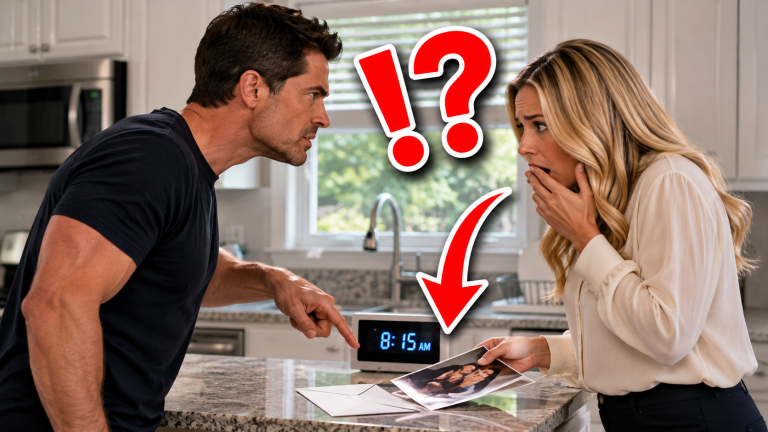
She wore a dark hoodie and held one arm close to her chest.
Lauren had opened the rear door to let her inside.
The woman crouched on the floor behind the front passenger seat.
When the ramp cleared, Lauren drove down two levels and stopped beside a convenience store.
The woman got out without giving her name.
Before leaving, she placed a small envelope in the cup holder.
“Where is the envelope?” I asked.
Lauren shook her head.
“I thought she took it back.”
“You thought?”
“I was trying to get away.”
“Did you tell the police about her?”
“No.”
I stood up.
“We have to call Reyes.”
Lauren caught my sleeve.
“Please listen first.”
“I’ve been listening all night.”
“The woman said she knew your father.”
I stopped.
“What?”
“She said he saved her life.”
The words hung between us.
I remembered my father helping neighbors with broken appliances and refusing payment.
I remembered him driving through snow to fix my aunt’s furnace.
I had never heard him mention saving anybody’s life.
“Did she give you a name?”
“She said her name was Nora.”
“Nora what?”
“She wouldn’t tell me.”
“What did she look like?”
“About forty, maybe younger.”
“Did she say where she was going?”
“No.”
“Did she tell you why someone was after her?”
Lauren hesitated.
“She said the people following her wanted a list.”
“What list?”
“The names of patients who were never supposed to be transported.”
I sat down again.
My father had worked in manufacturing.
Lauren worked in medical transport.
A hidden phone had displayed my name.
And now a stranger was connecting both of them to records of patients who apparently did not exist.
The story was becoming too complicated to dismiss and too dangerous to investigate alone.
I called the number Reyes had left and reported the additional passenger.
He asked why Lauren hadn’t disclosed it earlier.
I told him she was frightened and wanted to correct her statement.
He arranged to speak with her again after sunrise.
When I ended the call, Lauren whispered, “You’re angry.”
“Yes.”
“Do you hate me?”
“No.”
“Do you believe me?”
I considered the question.
“I believe you’re scared.”
She looked away.
“That’s not the same thing.”
“No,” I said, “it isn’t.”
At seven, sunlight began slipping through the kitchen blinds.
The world outside looked offensively normal.
A school bus stopped at the corner.
Our neighbor carried a trash bin toward the curb.
Somebody walked a golden retriever past our driveway.
I wanted to step outside and pretend the previous night had never happened.
Instead, I opened my laptop and searched for Hawthorne Patient Services.
The company’s website displayed smiling drivers beside clean white vans.