Chapter Nine: The Child’s Shoe
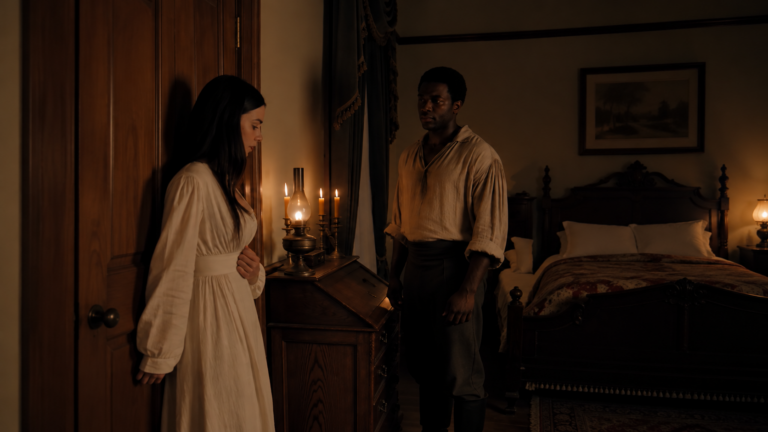
Before the guests left, Samuel went to the spinning shed to bring fresh blankets.
He found the room empty.
Both cots had been stripped, and the little stove stood cold near the door.
The wooden tags were gone from the crate beside the wall.
Pike had moved Ellis and Ruth early.
Samuel searched the floor and found a single small shoe wedged behind the baseboard.
The leather was dark with dirt, and one lace had been tied with a knot too difficult for a child to loosen alone.
Ruth had hidden it.
Samuel recognized the act as a message before he understood its meaning.
She had left proof that she had been there.
He carried the shoe beneath his coat and hurried toward the stables.
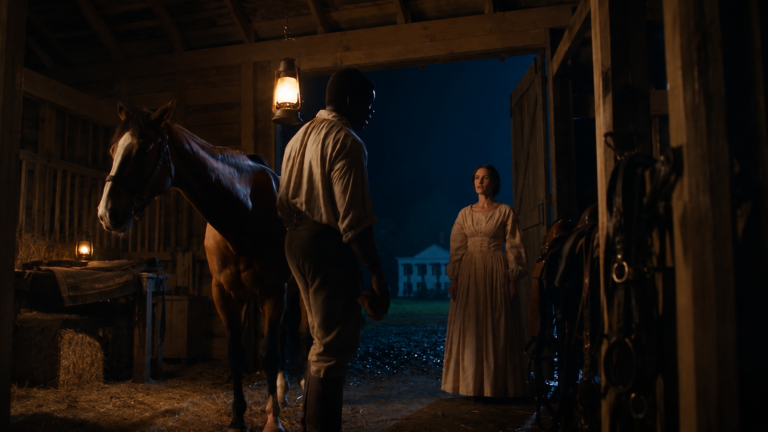
The stable boy, Amos, was currying a horse in the back stall.
“Did the wagons leave?” Samuel whispered.
“One went toward the road.”
“When?”
“Just after supper.”
“Who was in it?”
“Pike and the doctor.”
“Did you see the children?”
Amos shook his head.
“The wagon had a canvas cover.”
Samuel turned toward the gate.
“You cannot catch them on foot,” Amos said.
“Then tell me which road.”
“They took the east lane, but the bridge is washed out.
”
Samuel stopped.
“The east lane?”
“Yes.”
“They cannot cross the bridge.”
“That’s what I told Pike.”
“What did he say?”
“He said there was another way.”
Samuel knew the east lane well because he had repaired the fence along it the previous spring.
A wagon could turn toward the old brick kiln and circle behind the plantation, but the route ended at a locked gate near the boundary.
Only one man had the key, and that man was the overseer.
The wagons had not gone to town.
They had moved the children somewhere within reach of the house.
Samuel realized that Pike wanted them out of sight before the dinner guests departed.
He handed the little shoe to Amos.
“Take this to Nettie,” he said.
“Tell her where it was found.”
“What will you do?”
“I’m going to look at the kiln.”
Amos caught his arm.
“Pike keeps dogs there.”
“I know.”
“They’ll hear you.”
“Then I need something louder.”
Samuel looked at the horses, their breath rising in the cool night.
“Can you make the stall doors rattle?”
Amos stared at him, then understood.
“If the horses panic, someone will come running.”
“Only if you let them panic.”
“I can knock the feed barrel over.”
“Do that when you hear the church bell.
”
“We don’t have a church bell.”
Samuel pointed toward the small handbell hanging near the tack room.
“We have that.”
Amos looked at the bell and began to smile despite his fear.
“I can hear that from the road.”
Samuel nodded.
They had no guarantee that the noise would draw Pike away from the kiln.
They had only the possibility that it might.
For the first time in months, Samuel was making a choice that did not begin with Mrs. Harrow’s footsteps.
Chapter Ten: The Kiln
The old brick kiln crouched behind a stand of pines beyond the eastern fields.
Samuel approached through wet grass, keeping the moon behind the trees.
The building had not been used for years, but smoke rose from a small pipe near its rear wall.
He heard a man’s voice and the soft scrape of a wagon wheel.
Samuel crouched beside a pile of broken bricks.
Pike stood near the entrance with a lantern.
Dr. Wren was speaking to someone inside the building.
“The boat will not wait through another delay,” Wren said.
“The river road is impassable tonight,” Pike answered.
“Then we must reach it at dawn.”
“Harrow expects a visit from the county assessor tomorrow.
”
“Harrow expects what I tell him to expect.”
Samuel shifted closer.
Behind the canvas wagon cover he heard a muffled cough.
Ruth was there.
He searched the building with his eyes and saw a narrow window near the roof.
A wooden shutter hung from one hinge.
The kiln’s rear entrance was blocked by stacks of unused bricks, but a gap ran along the wall where years of rain had worn away the mortar.
Samuel remembered helping an older mason repair the outer arch as a boy.
The back wall had been unstable then.
It would not support a great deal of weight now.
He needed to open the wagon without drawing the men toward the children.
A bell rang faintly across the fields.
The sound was followed by a crash from the direction of the stables.
Pike swore and turned toward the road.
“What are they doing at the house?”
Wren stepped outside.
“Ignore it.”
“Those horses are worth money.”
“The children are worth more.”
Pike hesitated.
Samuel heard the naked calculation in that pause.
The overseer finally thrust the lantern toward Wren.
“Keep your eyes on the road,” he said.
He mounted his horse and rode back toward the house.
Wren stood listening until the hoofbeats faded.
Then he returned inside the kiln.
Samuel crept around the rear wall and reached the wagon.
He lifted the canvas cover just enough to see Ruth’s face.
She sat beside Ellis and a woman with a bandaged hand.
“It’s me,” Samuel whispered.
Ruth stared at him.
“The bolt?” she asked.
“There isn’t one on this wagon.”
“They tied the back.”
Samuel felt along the canvas and found the rope knotted through a metal ring.
He pulled his small knife from his pocket.
The blade slipped against wet hemp before cutting through.
Ellis moved toward the opening.
“Where is my mother?” he whispered.
“We are going to find people who know where she is.”
The woman with the bandaged hand watched him carefully.
“Who sent you?”
“Nobody.”
Her expression changed.
“Then we need to move quickly.”
Samuel opened the rear flap and helped Ruth climb down.
Ellis followed, trembling.
The woman stepped out last, holding her injured hand against her chest.
“Can you walk?” Samuel asked.
“I can run if I have to.”
They moved into the shadow of the wall.
Inside the kiln, Wren shouted a question to someone who did not answer.
Samuel realized too late that the physician had expected another person to be guarding the children.
A figure emerged from the doorway carrying a shotgun.
It was not Pike.
It was the man from the dinner table who had raised his glass to the coming child.
He recognized Samuel immediately.
“Put those people back in the wagon,” he ordered.
Samuel stood between the man and the children.
The shotgun lifted.
The woman with the bandaged hand stepped forward.
“You promised my husband I would be allowed to keep my children,” she said.
The man blinked.
“You misunderstand the arrangement.”
“Then explain it to me while the gun is pointed at my face.”
His expression sharpened.
“Get back.
”
Samuel felt Ruth’s fingers clutch the back of his shirt.
He had no weapon that could stop a gun.
He had only the crumbling wall, the wet ground, and the time it would take the man to decide whether to shoot.
A second bell rang from the far fields.
Then voices answered from the darkness.
Chapter Eleven: The Witnesses
Nettie emerged from the pines with Nell and three men from the quarters.
They carried lanterns and farm tools, not because those tools made them safe but because darkness had ceased to be an advantage.
The man with the shotgun swung toward them.
“You have no business here!” he shouted.
Nettie kept walking.
“Those children have families,” she said.
“Stand back.”
“Their families are standing behind us.”
Samuel looked beyond the lanterns and saw more people approaching through the grass.
Some had been waiting for word about missing relatives for weeks.
Others had come because Nettie had told them that a wagon was leaving before dawn.
The crowd did not give Samuel certainty.
It gave him witnesses whom Pike could not easily pretend had seen nothing.
Wren stepped out of the kiln, his expression furious.
“This is an unlawful gathering,” he declared.
Nell laughed once, without humor.
“You have spent the year moving children in the dark, and now you object to people standing where they can see.”
The physician ignored her.
He pointed toward Samuel.
“That man has stolen property.”
The woman with the bandaged hand lifted her chin.
“I am not a stolen thing,” she said.
The man with the shotgun tightened his grip.
Samuel expected the weapon to fire.
Instead, a new voice sounded from the road.
“Lower that gun.”
Mr. Harrow rode into the clearing with Pike beside him.
Mrs. Harrow followed in a carriage driven by Amos.
Harrow dismounted, looking from the gathered workers to the open wagon.
“What is happening here?” he demanded.
Wren stepped forward immediately.
“Your household has suffered a dangerous misunderstanding.”
“I asked you a question,” Harrow said.
Mrs. Harrow climbed down from the carriage without waiting for help.
Her dress caught on the wheel, and she pulled it free with an impatient movement.
She looked at Ruth, Ellis, and the injured woman.
Then she looked at her husband.
“These are the people Wren has been moving through the nursery passage,” she said.
Harrow stared at her.
“What passage?”
“The one I ordered Samuel to repair.”
The physician interrupted.
“Madam, you should not speak while distressed.”
“I have been distressed for months,” she answered.
“That has not made me unable to see.”
Harrow turned on Wren.
“You told me you were arranging trained household staff.”
“That remains true.”
“These are children.”
Wren spread his hands.
“They are dependents accompanying their mothers.”
Nell stepped forward.
“Ellis’s mother is still on your south acreage.”
Harrow turned toward her.
“Who are you to contradict the doctor?”
“I am the person who helped raise Ellis after his father died,” Nell answered.
“You could ask his mother, but nobody has allowed her to know where he is.”
Harrow looked at Samuel.
“Did you bring these people here?”
“The doctor did, sir.”
“Why did you leave the house without permission?”
Samuel looked at the children beside him.
“Because the wagon was leaving before they could speak to their families.”
Harrow’s jaw hardened.
“You had no right to interfere.”
Mrs. Harrow stepped between them.
“He interfered because I would not.”
The words left the clearing suddenly quiet.
Harrow stared at his wife.
“What did you say?”
“I knew the children were being moved.”
“You told me they were nurses and attendants.”
“That is what Wren told me.”
“And you believed him?”
“I chose not to ask enough questions.”
Wren tried to speak, but she raised her voice.
“I had Samuel work at night so you would not see the passage.”
Harrow looked as if she had struck him.
“Why?”
“Because I wanted you to believe the doctor was helping us have a child.”
Her hand moved to her stomach.
“He was taking money for a treatment that did not produce this pregnancy.”
Wren’s face went white.
Harrow stared at the physician.
“Is that true?”
“There is no way to establish such a thing here,” Wren answered.
“Then you can explain what the money purchased.”
Wren glanced toward the man with the shotgun.
The man lowered the weapon slightly.
Samuel understood that the powerful men were beginning to measure the danger to themselves instead of the danger to the children.
That was not justice.
It was an opening.
He needed it to remain open long enough for Ellis to reach his mother.