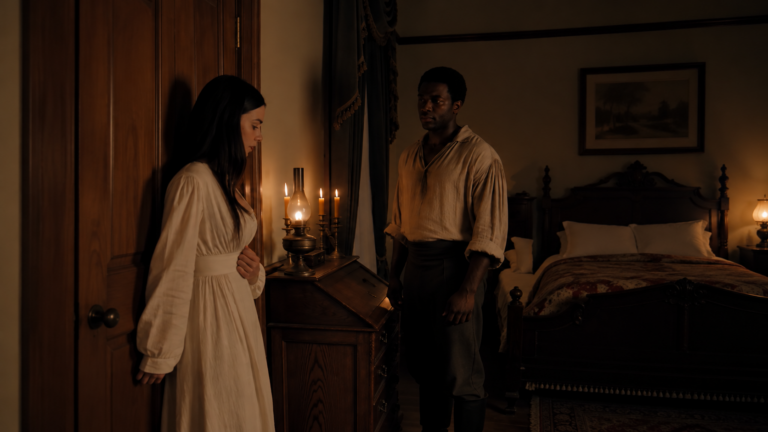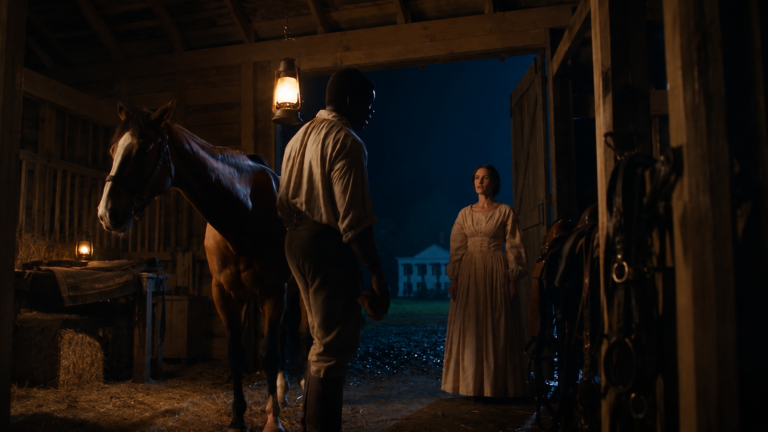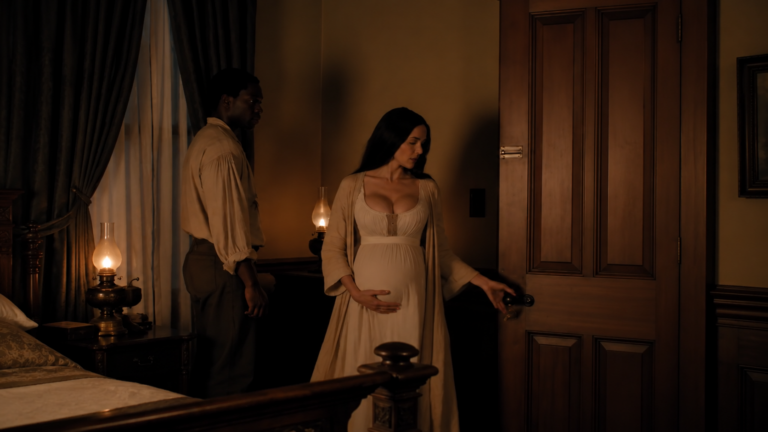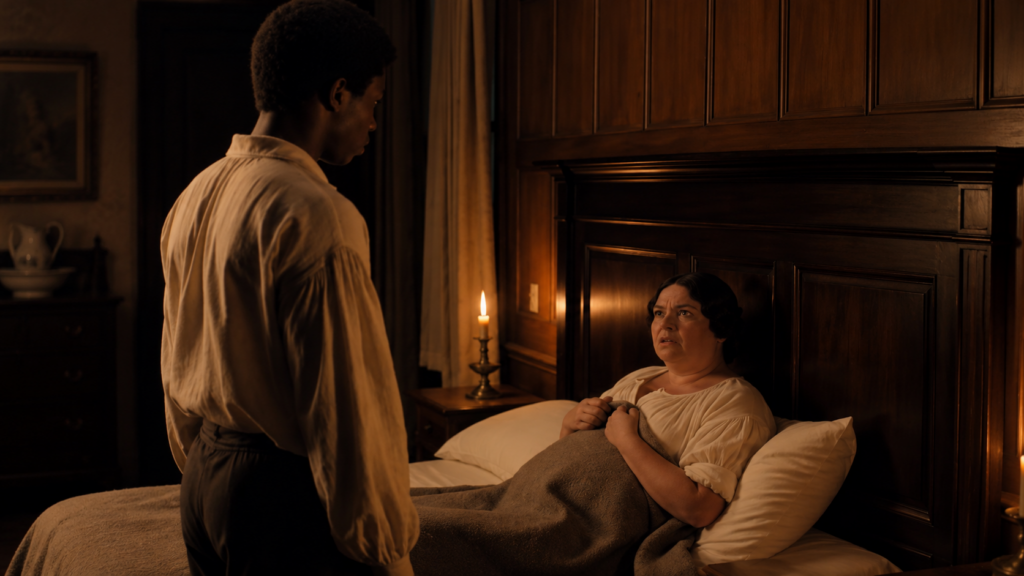
Samuel Reed learned the sound of Mrs. Harrow’s shoes before he learned the sound of her voice in darkness.
The heels made three quick knocks on the gallery boards, followed by a pause near the rain barrel.
He heard them on nights when the sky was clear and on nights when thunder rolled along the Yazoo River.
By October of 1852, he had begun counting the intervals between those footsteps instead of counting his own hours of sleep.
Sometimes she sent a house servant with a candle.
Sometimes she stood outside the quarters herself and spoke through the door.
“You will come when I call,
” she told him on the first night.
He had asked what work needed doing, and she had answered by looking toward the overseer’s cabin.
That was enough.
A man who belonged to another man’s books did not possess the ordinary freedom to refuse a request.
Samuel had been born on the place twenty-seven years earlier, and he knew exactly how quickly a request could become an accusation.
He also knew that the Harrows had started sending people away without warning.
A mother could return from the fields and discover that her daughter had been taken to a neighboring property.
An old carpenter could spend thirty years building a house and be sold from its front steps in the space of an hour.
The danger was not theoretical, and it did not grow smaller merely because Mrs. Harrow spoke softly.
That evening the air smelled of damp cotton and wood smoke.
Samuel was repairing a cracked handle beneath the quarters porch when Nettie Bell knelt beside him.
She was a cook in the main house, and her sharp eyes noticed what everyone else pretended not to see.
“You look like you haven’t slept in weeks,” she whispered.
“I sleep enough,” Samuel said.
“You dropped a plate yesterday and called it a bucket.”
“I was tired.”
“You were frightened.”
Samuel pushed the blade through the soft wood and did not answer.
Nettie glanced toward the house, where light shone behind the upstairs shutters.
“Is she making you hurt somebody?”
“Don’t ask me that.”
“Then tell me what I can do.”
He put down the handle and looked at his hands.
The cuts along his fingers had reopened in the cold.
“Keep your little sister away from the back steps after sundown,” he said.
Nettie stared at him.
“What do the back steps have to do with anything?”
A bell rang from the main house before he could answer.
The overseer, Pike, came out with a lantern and a coil of rope over his shoulder.
“Reed,” he called.
Samuel stood.
Pike looked at the unfinished handle and smiled without warmth.
“Mrs. Harrow needs the nursery ready again.”
“Yes, sir.”
“You understand that her husband expects quiet.”
“Yes, sir.”
“Then you understand what happens if he hears something he should not.”
Samuel walked past Nettie without another word.
The nursery had stood empty since the Harrows arrived three years earlier.
It was a broad room beyond the wife’s private chamber, with a white ceiling, shuttered windows, and a painted wooden horse left by a former family.
Samuel had spent his first nights there moving furniture.
Later he had been made to carry baskets of linens and nails.
Then the work changed.
Mrs. Harrow ordered the old wardrobe pulled away from the western wall, exposing a narrow service door that had been covered with wallpaper.
A carpenter had built the passage decades earlier to let servants carry coal without crossing the public rooms.
Nobody in the present household used it because the staircase was steep and rotten.
Mrs. Harrow made Samuel repair it.
He worked after midnight while she stood with a candle, listening for her husband’s footsteps.
He replaced three treads and strengthened the railing with iron salvaged from a broken gate.
He was told to remove every trace of sawdust before morning.
Then he began carrying things through the passage.
At first they were ordinary things, such as quilts, bread, soap, and sealed water jugs.
One night the basket moved against his chest.
Samuel stopped on the landing.
A child’s small hand emerged between two blankets.
Mrs. Harrow came down behind him and pressed the cloth closed.
“Keep walking,” she said.
He had carried the basket to a room behind the abandoned spinning shed.
There were two women waiting there, neither of whom he recognized.
One held a little girl whose bare feet were wrapped in linen.
The other woman looked at Samuel with a despair so controlled that it seemed older than her face.
Mrs. Harrow told them they would leave before dawn.
The next morning the women and the child were gone.
Three days later the overseer announced that a woman named Dinah from the eastern quarters had been transferred to another property.
Samuel did not know whether the woman in the shed was Dinah.
He did know that the small girl had been too young to understand the instruction not to cry.
He also knew that none of the people taken through the service passage ever returned.
Chapter Two: The Empty Nursery
By November, Mrs. Harrow no longer bothered to explain the work.
She gave Samuel a list of objects and expected him to know where they belonged.
A low cot was to be built against the eastern wall of the spinning shed.
A bolt was to be fitted on the outside of its rear door.
A second door needed hinges that could be removed without tools.
Samuel asked why the bolt belonged outside.
“Because travelers do foolish things when frightened,” Mrs. Harrow replied.
“A person locked in that room cannot escape a fire.”
“There will be no fire.”
“Nobody can promise that.”
She looked at Pike, who was waiting outside the window.
The overseer tapped the butt of his riding crop against his boot.
“You have become fond of opinions, Reed.”
Samuel lowered his gaze.
His skill with tools had been useful to the plantation since boyhood, and that usefulness had occasionally protected him.
It had not protected the people he cared about.
He finished the cot but left the rear bolt loose enough to pull free with a hard twist.
He told himself it was a small act that might matter one day.
He did not tell himself it made him brave.
The next night he was called again, and this time the person in the basket was a boy nearly twelve years old.
The child was too large to hide beneath blankets.
Pike marched him through the lower passage with a scarf tied across his mouth.
The boy wore a torn blue coat and one shoe.
Samuel recognized the coat from a family he had seen picking cotton on the distant south acreage.
The boy looked at Samuel, and Samuel recognized something else.
The boy expected an adult to help him, even here.
Samuel held the door while Pike pushed him into the shed.
Pike told the boy to sit on the cot.
“Where is my mother?” the boy asked when the scarf came off.
“You’ll see her when you are told,” Pike answered.
Mrs. Harrow appeared with a wrapped loaf of bread.
“Give him this,” she instructed Samuel.
The boy took the bread without eating.
“My name is Ellis,” he whispered.
Samuel looked at the open doorway, then at Pike.
“I heard you,” Samuel said.
“Tell her my name,” Ellis pleaded.
“She knows your name,” Pike interrupted.
Mrs. Harrow’s expression hardened.
“That will be enough.”
Later, while the others climbed toward the house, Samuel noticed a strip of blue cloth snagged beneath the cot.
He folded it into his sleeve.
He wanted something that proved the boy had been real.
The thought frightened him because the plantation had trained him to doubt what he witnessed whenever powerful people ordered silence.
He had seen a woman taken away on a Tuesday and heard her name omitted from the work list on Wednesday.
He had watched a child learn to stop asking for a father because every answer brought punishment.
The cloth would not protect Ellis.
It might protect Samuel’s memory of him.
Near midnight, he reached the main hall and heard laughter from the dining room.
Mr. Harrow was hosting two men from the county, and their glasses shone in the candlelight.
“My wife insists on a nursery renovation,” he told them.
“She has always been determined about these matters.”
One visitor raised his glass.
“A child will make this place respectable.”
Mr. Harrow smiled.
“I have every confidence that it will happen.”
Samuel moved along the gallery with a bucket of plaster.
The visitors did not notice him.
Mrs. Harrow appeared at the top of the stairs and beckoned urgently.
When he reached her, she looked past his shoulder toward the dining room.
“You must never let my husband see the rear stair,” she said.
“He lives in this house.”
“He does not know every door in it.”
“He will discover it eventually.”
Her fingers tightened around the candleholder.
“Then we must finish before he does.”
Samuel looked at the nursery door and wondered what finishing meant.
He had spent too many nights carrying people from one place to another without knowing their destination.
That night he decided ignorance could become its own kind of obedience.