“Did your dad help?”
“Yes. He made the small model.”
“Was he good at making things?”
Lily looked at the model, at its neat little stop and its hand-painted boat. “He was careful,” she said. “That’s a kind of being good.”
Outside, the afternoon light moved across the library steps. Daniel offered to drive Lily back to the station, but she wanted to walk. She took the long route past the old theater, now fenced for demolition. Its marquee was blank, and the doors were closed, but the mural of the paper boat remained on the wall for the moment.
She stopped to look at it. She had arrived in Bellweather believing the address in the envelope would lead to a secret about her family. Instead it had led to people whose lives had been tangled by an avoidable choice, and to the patient work of untangling it without pretending the damage had never occurred.
Lily took a photograph of the mural for her mother. Then she continued toward the station, where the evening train was already waiting.
18. THE TABLE BY THE WINDOW
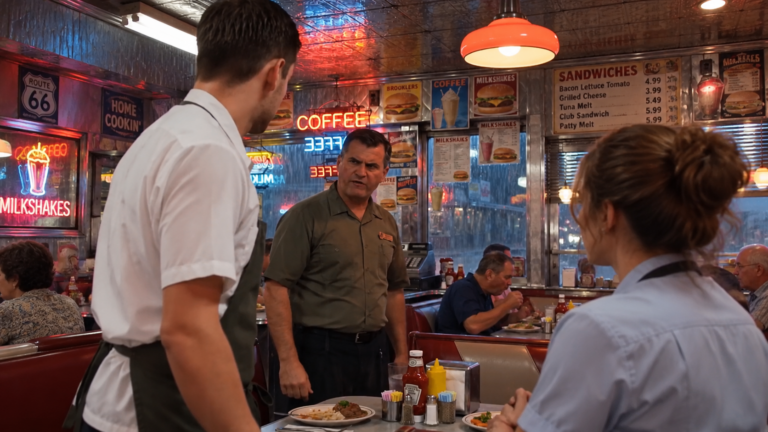
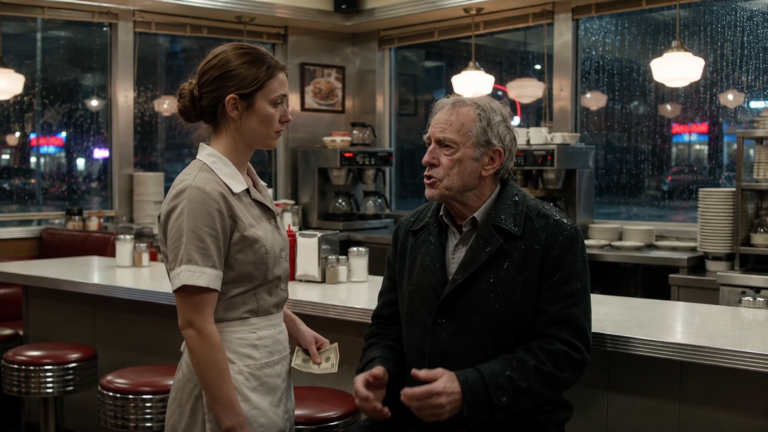
Before leaving Bellweather, Lily visited a café across from the station. She had an hour before her train and ordered eggs, toast, and coffee. The waitress was a teenager with a pencil behind one ear, moving between tables while an impatient man at the register complained that his order was taking too long.
At the window sat an older customer trying to unfold a paper map with stiff fingers. The waitress noticed, set down a pitcher, and held one corner of the map while he pointed to a street. The gesture took less than a minute. The man at the register complained anyway.
Lily watched the waitress return to work. She wanted to say something about the diner back home, Walter, and the unexpected journey that had followed a small act of attention. But the girl did not need a speech from a stranger. She needed room to finish her shift.
When Lily paid, she left a generous tip and wrote two words on the receipt: Thank you. The waitress looked up, surprised, and smiled.
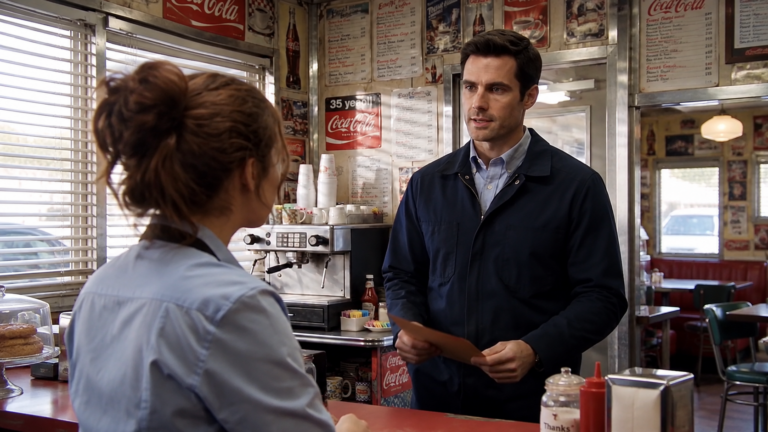
At the station Lily called Rosa to confirm her schedule at the new café. Rosa said they were planning to replace several heavy mugs with lighter ones because customers had asked for them. She wanted Lily’s opinion on which cups felt comfortable to hold. Lily promised to test the samples when she returned.
The train arrived with a long squeal of brakes. Lily climbed aboard and found a seat beside a window. In her bag were the old photograph, the paper star, and a copy of the exhibit label. None of them offered a shortcut to a better life. She still had bills to pay, an uncertain work schedule, and a mother she needed to visit more often. But she knew something about her father that had been missing from the family stories: he had been frightened, had acted anyway, and had refused to call an unsafe machine safe merely because people wanted the show to continue.
As the train pulled out, her phone buzzed with a message from Benjamin. Iris had asked to build a model theater for her school project. She wanted to make the walls stay still and let the stars move instead.
Lily laughed softly and typed back that her father would have liked that solution. Then she put away the phone and watched the painted mural disappear behind the buildings.
23. THE PHOTOGRAPH AGAIN
Three weeks later, a parcel arrived at Lily’s apartment. Inside was a copy of the original photograph, now mounted beside a newer picture taken in the theater workshop. In the new image June stood with Benjamin, Walter, Daniel, Nessa, and Lily. Behind them the painted moon leaned safely against a wall, waiting for transport.
A short note from June explained that the old model would be displayed in the Bellweather library with a label naming every craftsperson who had worked on it. Lily’s father would be credited for the child-sized model and for the actions he took during the accident. Walter had insisted that the account also describe his own failure to speak up. Arthur had signed a statement acknowledging the unauthorized change.
Lily read the note twice, then placed the photographs side by side on her kitchen table. The older one had brought her to a place she barely remembered. The newer one showed people who had finally stopped pretending that a terrible afternoon could be explained by a broken machine alone.
Her mother called that evening. Marianne said she had found another ticket stub in a cookbook, along with a photograph of Lily sitting on her father’s shoulders beneath a painted ceiling.
“You were laughing,” Marianne said. “He wanted you to remember the show that way.”
“I remember some of it.”
“I know.”
They spoke for a while about ordinary things: Marianne’s work, Lily’s new café, the weather turning cooler. Before they hung up, Lily told her mother about the paper star.
“Keep it somewhere you can see it,” Marianne said.
Lily placed it in a little frame beside the photographs. The next morning she carried her lighter travel mug to work, unlocked the café door, and switched on the lights.
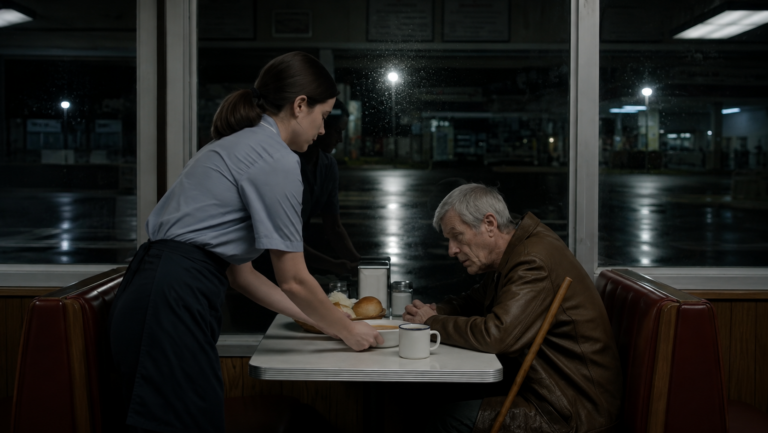
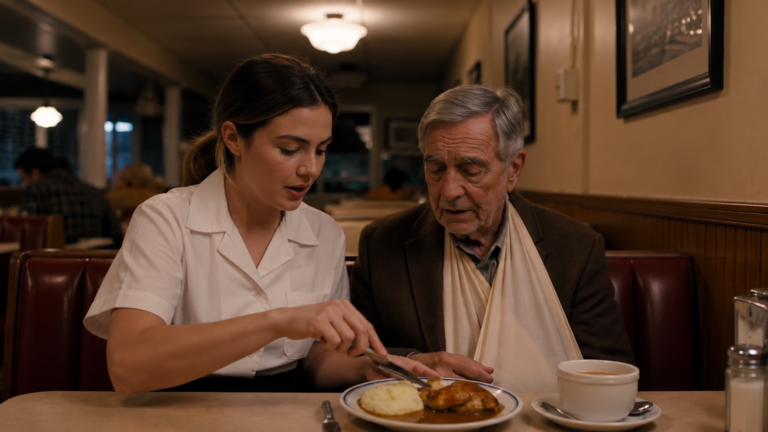
A customer entered just after seven, moving slowly with a cane. Lily brought him a menu and waited while he settled into the chair.
“Take your time,” she said.
Outside, morning traffic passed the window. Inside, the coffee was fresh, the tables were ready, and nobody hurried him to order.
The End.