The man with the briefcase waited until Grant Hale stopped smiling.
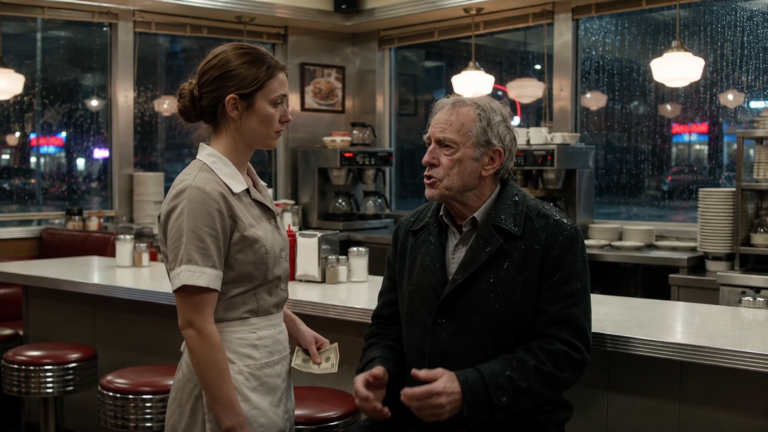
Emily Carter stood beside the cash register with her final paycheck still folded in her hand.
Outside, twelve black SUVs filled the wet parking lot like a row of silent barricades.
The elderly man she had fed the previous night stood beneath a black umbrella, watching through the glass.
Grant looked at the suited visitor and attempted a laugh.
“I think there’s been some misunderstanding,” he said.
“My question was straightforward,” the visitor replied.
“Which one of you fired her?”
Grant glanced at Emily as though she had arranged the entire spectacle.
“I made a staffing decision,” he said.
“Then you are the person I need,” the visitor answered.
He opened the briefcase and removed a laminated photograph of the diner.
Emily recognized the building immediately, but the picture showed the rear service lane instead of the front entrance.
A yellow school bus stood beside the dumpster in the photograph.
There was no school bus in the lane now.
“Where was this taken?” Emily asked.
“At five forty this morning,” the man replied.
Grant reached for the photograph.
The visitor drew it back before his fingers touched the plastic.
“My name is Adrian Vale,
” he said.
“I coordinate an independent evacuation service for the twelve families whose vehicles are outside.”
Emily looked through the window again.
She had assumed the men in dark coats were bodyguards.
Now she noticed women and children sitting behind several tinted windows.
A girl pressed her palm against the glass of the fourth vehicle.
The old man came inside with his cane and stopped at Emily’s side.
“I am Samuel Rook,” he told her.
“I owe you an apology for returning like this.”
“You don’t owe me anything,” Emily said.
“I owe you the truth,” Samuel replied.
Grant folded his arms.
“I don’t allow private meetings on company property,” he said.
Samuel turned toward him.
“You allowed a private contractor to use your back lot before dawn,” he said.
Grant’s face changed.
Emily saw it happen in the same instant that Adrian closed the briefcase.
“I didn’t know there were people inside that bus,” Grant whispered.
Samuel gripped his cane with both hands.
“Then we have less time than I hoped,” he said.
Chapter Two: The Road Behind the Diner
Emily had worked at the diner for eleven months without once seeing a school bus in the service lane.
The lane led to an abandoned weigh station and a county road that disappeared into the hills.
Grant had always told employees to keep the rear door locked after midnight.
He claimed that delivery trucks sometimes mistook the diner for the nearby fuel depot.
Now he moved toward that same door with a speed Emily had never seen from him.
Adrian stepped between Grant and the handle.
“You can explain the bus from here,” he said.
Grant stopped.
“A driver asked to park for twenty minutes,” he answered.
“He said the passengers were going to another shelter.”
“What shelter?” Samuel asked.
Grant stared at the floor.
“He didn’t tell me.”
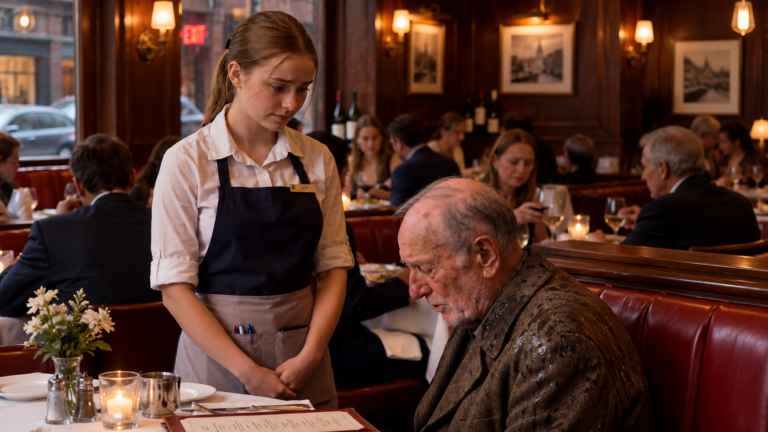
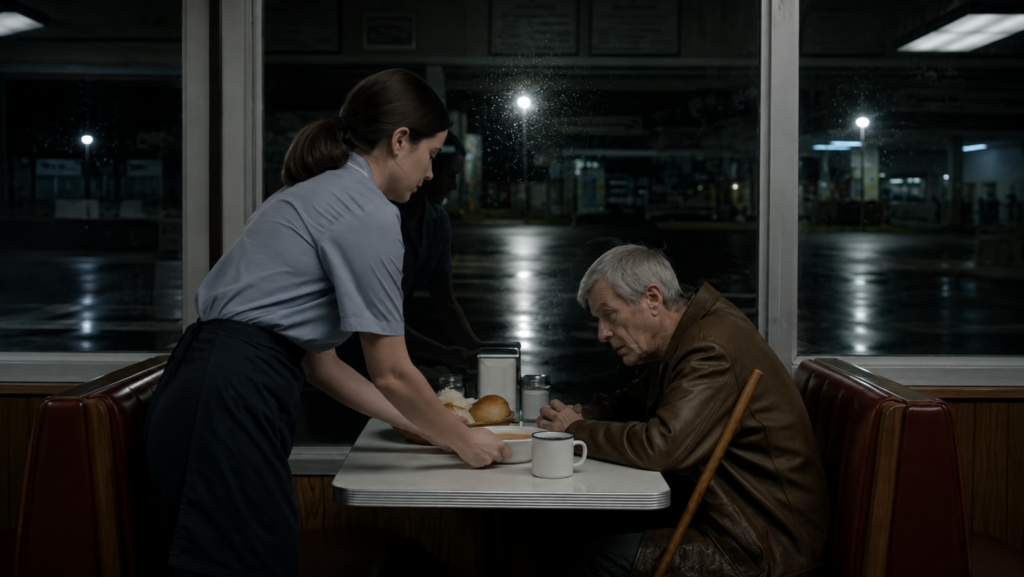
Emily remembered the old man’s hands trembling over his soup the previous night.
She remembered the way he had looked toward the rear hallway every time the freezer motor started.
“You were waiting for that bus,” she said.
Samuel nodded.
“I was trying to learn whether it would stop here.”
“Why didn’t you tell me?”
“Because I had no right to pull you into a dangerous matter without your consent.”
Grant let out a bitter laugh.
“That’s convenient,” he said.
“You came here pretending to be broke, and now you arrive with a convoy.”
Samuel looked directly at him.
“I was broke when I walked in,” he said.
“My wallet was stolen at the station,
and I had spent the day walking because my phone was dead.”
“Then whose cars are those?” Grant demanded.
“They belong to families who refused to leave their neighbors behind,” Samuel replied.
A woman entered from the parking lot, carrying a boy whose shoes were tied together by their laces.
“Samuel, the northern road is blocked again,” she said.
“The barricades went up while we were waiting.”
The boy looked at Emily and asked whether the diner had hot chocolate.
Emily reached instinctively for a mug.
Grant caught her wrist.
“You don’t work here anymore,” he said.
Emily pulled away.
“Then I can give him my own drink,” she answered.
She took the mug from the shelf and filled it at the dispenser.
The woman watched Emily with a tired, suspicious expression.
“Who is she?” she asked Samuel.
“The person who fed me when I couldn’t pay,” Samuel replied.
“And the person this manager dismissed for doing it.”
The woman looked toward Grant.
“We don’t have room for another argument,” she said.
“We need a road that is still open.”
Chapter Three: Twelve Families
Samuel asked Emily to come outside for five minutes.
She followed him beneath the awning while rainwater ran from the roof in silver sheets.
The twelve vehicles were not identical after all.
One had a dented rear bumper, another carried a cracked taillight, and the last had a child’s drawing taped inside its window.
A woman in the second SUV rolled down her window and asked Samuel whether the hospital had called.
“Not yet,” he said.
Emily counted the people she could see.
There were grandparents, young parents, children, and two teenagers who seemed to be keeping watch at the entrance.
Adrian stood beside the first vehicle and spoke quietly into a handheld radio.
“They are not a security team,” Samuel told Emily.
“They are people from Bellwether Court.
”
Emily knew the name.
Bellwether Court was a housing complex beyond the eastern industrial district.
The local news had described a chemical odor there three nights earlier.
Officials had assured residents that the smell came from harmless cleaning work.
“They were told to remain indoors,” Samuel said.
“Then someone began moving residents in small groups before dawn.”
“Why would that be dangerous?” Emily asked.
“Because no one will say where those groups are going.”
A teenager approached carrying a paper grocery bag full of medicine bottles.
“Mr. Rook, Mrs. Flores can’t find her insulin,” he said.
Samuel turned toward the vehicles.
“Ask Nadia to check the cooler,” he replied.
The teenager ran back.
Emily noticed that Samuel moved slowly but issued no commands that the others seemed afraid to question.
He listened when a woman challenged his route, and he changed his plan when a driver reported a closed bridge.
“What do you need from me?” Emily asked.
Samuel pointed toward the diner’s rear windows.
“You worked here at night,” he said.
“Did you ever see anyone loading passengers behind the building?”
“No,” Emily answered.
“But I heard a bus engine around four this morning.”
Samuel stopped walking.
“Were you still here?”
“Grant made me clean the kitchen before he let me leave,
” she said.
“I was outside waiting for a ride when I heard it.”
“Did you see which direction it went?”
Emily closed her eyes and reconstructed the sound.
She remembered a rattling engine, a squeal of brakes, and a long reverse warning.
Then she remembered something else.
“It didn’t leave by the county road,” she said.
“It turned toward the old loading platform.”
Adrian heard her and came closer.
“That platform ends at a locked fence,” he said.
“Not anymore,” Emily replied.
“Grant had a contractor remove the fence last week.”
Samuel looked toward the service lane.
“Show us,” he said.
Chapter Four: The Missing Gate
The rear lane smelled of diesel and wet cardboard.
A shallow puddle reflected the diner’s red sign upside down.
Emily led Samuel and Adrian past the dumpster to the place where a chain-link gate had stood for years.
Only two concrete posts remained.
Beyond them, a fresh strip of gravel cut through a patch of scrub grass toward the disused weigh station.
“I thought the county was repairing the drainage ditch,” Emily said.
Adrian crouched and examined the gravel.
Deep tire marks crossed the surface.
One set was wide enough to belong to a bus.
Samuel leaned on his cane and looked down the road.
“Who owns the weigh station?” he asked.
“The county used to,” Emily replied.
“I don’t know who has it now.”
Grant appeared at the back door.
He had brought his phone, but his hand shook so badly that he nearly dropped it.
“You need to leave,” he shouted.
“The man who rented that space is coming back.”
“Who is he?” Adrian asked.
Grant looked from one face to another.
“He said his name was Mercer,” he answered.
Samuel inhaled sharply.
“Describe him,” he said.
“Tall, gray jacket, shaved head,” Grant replied.
“He had a silver ring on his left hand.”
Samuel’s expression became unreadable.
“That is not his name,” he said.
A motor sounded beyond the weigh station.
Adrian raised his radio.
“All drivers, stay inside your vehicles,” he said.
“Do not follow anyone who claims the route has changed.”
Emily looked at Samuel.
“Who is that man?”
“Someone who used to arrange transport for the complex,” Samuel said.
“He was dismissed after families complained that people were being moved without their medication.”
The engine grew louder.
A white utility van appeared beyond the gravel and stopped when its driver saw them.
For several seconds, nothing moved.
Then the van reversed behind the weigh station.
“He’s leaving,” Grant said.
“He is warning someone,” Adrian replied.
Samuel turned to Emily.
“You can walk away now,” he said.
“I would understand.”
Emily thought of the little boy holding a hot chocolate mug with both hands.
She thought of the missing school bus and the road hidden behind the diner.
“I can show you where the gravel ends,” she said.
“But we need to tell the families what we’re doing first.”
Samuel nodded.
“That is exactly right,” he answered.