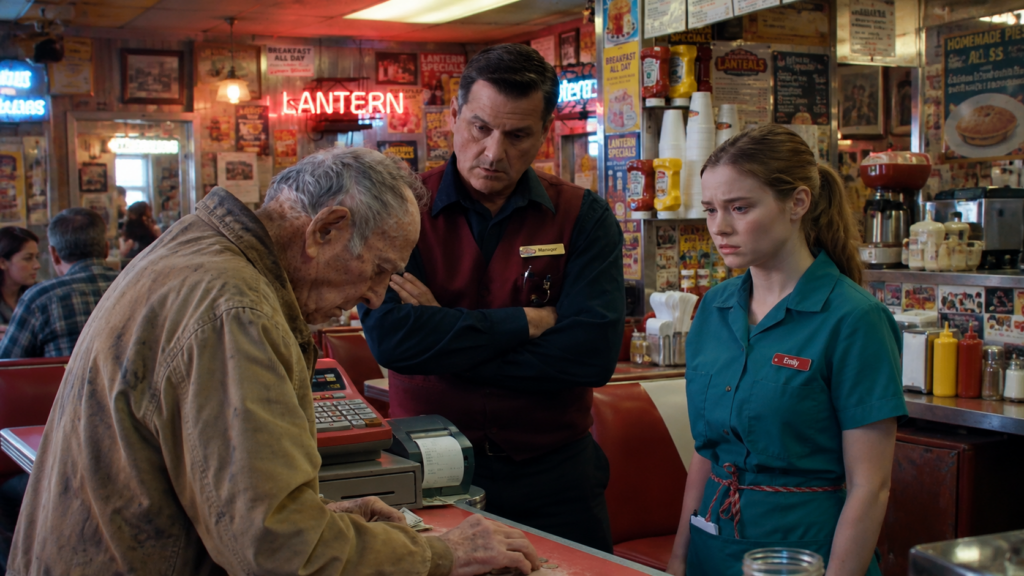
The old man counted his money twice before he looked at the bill.
Three dollars and twenty cents lay on the table beside a cold cup of coffee.
The bill came to eleven dollars and forty cents.
Dale Fletcher planted both hands on the counter and watched him from the other end of the Lantern.
“You can pay, or I call the sheriff,” Dale said.
Maren Bishop had been carrying two plates toward a booth when she heard him.
The elderly customer did not argue.
He folded his hands around the coins as though he might make them worth more by holding them tightly.
“I thought the lunch plate was cheaper,” he said.
“You read an old sign,” Dale answered.
“Then I made a mistake.”
“A mistake doesn’t pay the bill.”
Maren knew every scrape in the long yellow counter and every place where the red vinyl seats had cracked.
She also knew that the man had eaten slowly, as if he were remembering a meal he had not tasted in years.
The wind outside carried October rain across the road.
He wore a coat with a frayed cuff and clean, carefully polished shoes.
When Dale lifted the telephone receiver, Maren set down her plates and crossed the room.
“It’s on me, Dale. Ring it up.”
He turned toward her with the delight of someone who had found a second person to punish.
“You’ve got money to throw around now?”
“I’ve got enough for one lunch.”
“Then use your employee meal allowance.”
“You suspended that last month.”
Dale’s eyes sharpened.
He knew she was right, and he did not like her saying so in front of customers.
Maren took a folded ten-dollar bill from her apron and placed it beside the register.
She added two singles from a small roll she had meant to save for the bus.
“Keep the change for the tax,
” she said.
The old man stood halfway before she stopped him with a raised hand.
“Please finish your coffee while it’s still warm.”
“It’s already cold,” he said.
For the first time all afternoon, his mouth bent into something close to a smile.
Maren carried the cup to the machine and returned with fresh coffee.
Dale watched without moving.
He waited until the old man had left before he summoned her behind the swinging kitchen door.
“That cost me a room full of people thinking we hand out free food,” he said.
“He didn’t get free food. I paid.”
“You made me look cruel.
”
“You were threatening to call the sheriff over eight dollars.”
Dale pointed to the schedule clipped above the sink.
Three thick black lines crossed her name for the following week.
“Those shifts are gone.”
“Dale, I was already down to three.”
“Then you should have protected them.”
Maren felt the familiar pressure building beneath her ribs.
Rent was due Friday.
Her mother had started rationing an inhaler because the refill was more expensive than the co-pay they had expected.
Maren worked evenings at a grocery deli whenever she could persuade its supervisor to call her first.
The Lantern’s breakfast shifts were supposed to cover the rest.
“I need those hours,” she said.
“Everybody needs something.”
A cook named June Rivas stopped chopping onions.
She had worked under three managers, and she knew when Dale was waiting for an argument he could use as an excuse.
Maren removed the pencil from her apron pocket.
“I’ll finish my shift,” she said.
“You’ll finish it without another performance.”
She walked back to the dining room before anger could make her say something irreversible.
At the window, the elderly man stood beneath the green awning.
He looked through the glass and lifted a hand in apology.
Maren did not wave.
She could not decide whether to be angry at him, at Dale, or at herself for calculating the price of an inhaler while someone else counted pennies.
She took the next order and asked a customer how she wanted her eggs.
The woman asked whether everything was all right.
“The kitchen’s a little busy,” Maren replied.
When her shift ended, June followed her into the narrow back corridor.
“I saw what he did.”
“Everybody saw.”
“That doesn’t mean everybody will remember it the same way.”
June pressed a wrapped biscuit into Maren’s hand.
“Eat something before the bus.”
Maren slipped it into her coat and walked out beneath a sky the color of dishwater.
She had a voicemail from the pharmacy before she reached the corner.
Her mother’s prescription was ready, but a manufacturer change had increased the amount due.
Maren listened twice and deleted neither the message nor the fear that followed it.
At home, her mother was sitting upright in the living room with a paperback open on her lap.
Lucille Bishop could read a person’s face faster than any printed page.
“They cut your hours again,” she said.
“Three shifts.”
“Because you fed that man?”
Maren stopped by the coat hooks.
“How did you know?”
“June called.”
“She shouldn’t have worried you.
”
“She knows worrying me is difficult to avoid.”
Lucille set down the paperback and patted the cushion beside her.
Maren sat, and for several minutes they listened to the radiator click.
“When your father lost his job,” Lucille said, “he spent a month trying to make sure we didn’t know he was frightened.”
“Did that work?”
“Not for a minute.”
Maren leaned her forehead against her mother’s shoulder.
“I don’t want you skipping medication.”
“And I don’t want you thinking a decent choice has to become an apology.”
“The landlord won’t accept decent choices.”
“Then tomorrow we find a practical answer.
”
Maren nodded, although she did not yet know where to find one.
CHAPTER TWO – THE MAN IN THE GREEN COAT
The staff of the Lantern arrived at nine the next morning to find the front door locked.
Dale had summoned everyone for what he called a mandatory ownership announcement.
The servers gathered beside the newspaper stand while the cooks waited near the pass.
Maren almost stayed home.
She had no scheduled shift, and Dale had specifically told her not to expect paid time for the meeting.
June had insisted she come anyway.
“If they’re going to tell us we’re all fired,
” June had said, “I would rather hear it before I start marinating chicken.”
A delivery driver stood beside an unfamiliar gray sedan.
Behind the driver’s seat sat a wooden crate with a brass handle.
Maren wondered whether another interior designer had arrived to announce a renovation nobody could afford.
Dale opened the doors at nine thirteen.
“Everybody inside and quiet,” he said.
A man in a dark suit stood near the coffee urn.
He introduced himself as Malcolm Price, the attorney coordinating the transfer of the Lantern’s operating company.
Dale clasped his hands as though the announcement belonged to him.
“The owner has sold the business,” he told the room.
“Some of us have been informed about the plan for months.”
June muttered that some people had apparently been informed too well.
The private door beside the old office opened.
The elderly diner stepped through wearing the same green coat.
Maren recognized the shoes before she recognized his face.
“Walt?” she said.
Dale swallowed hard.
Price stepped aside.
“This is Walter Benton, the new owner of the Lantern.”
The room went very still.
Walt walked past Dale without looking at him and stopped beside the booth where he had eaten the previous day.
“I owe you all an explanation,” he said.
“Especially Maren.”
He reached into his pocket and set three dollars and twenty cents on the nearest table.
“In 1969, I came into this restaurant with exactly that amount.”
“The meal cost more than I had.”
“A waitress named Eleanor paid the difference, and she brought me fresh coffee after the manager complained.”
He looked at the original tin lantern hanging over the pass.
“Two years later, I married her.”
“We bought the Lantern in 1974, when the owner decided to retire.”
“We worked the grill for thirty years, and we raised our family above the storage room.”
A murmur moved through the staff.
Several of the older employees had heard the name Eleanor but believed she belonged to the restaurant’s distant history.
Walt let the room settle.
“After Eleanor died, I sold the place because I couldn’t bear to stand at the grill without her.”
“The people who bought it eventually sold it again.”
“The most recent owners planned to close before winter and sell the equipment in lots.”
“I purchased the business and the building because I could not watch it disappear without trying something else.”
Dale found his voice.
“You could have told us you were coming.”
“I wanted to eat in the dining room,” Walt said.
“I wanted to see whether anyone still knew why this place mattered.”
Maren stiffened.
She did not like the thought that yesterday’s desperation had been an audition conducted by someone who could afford to pay any bill.
Walt noticed.
“You didn’t know who I was,” he said to her.
“No, sir.”
“That’s the part I cannot forget.”
“But I was in trouble yesterday whether I looked important or not, and my actions cost you work.”
Dale gave a tight cough.
“Her shifts were reduced because of a scheduling issue.”
June crossed her arms.
“You crossed them out in front of me.”
Walt looked toward the schedule board.
“We’ll discuss that after this meeting.”
He returned his attention to the staff.
“When Eleanor was alive, she said a restaurant wasn’t the walls or the grill.”
“It was the people who came back after a bad day because they expected somebody to remember them.”
“I bought this building back to keep that possible.”
“But I am seventy-eight years old.”
“I am not going to pretend I can run a busy diner six days a week.”
He glanced at Maren.
“I want it to belong to the people who actually keep it alive.”
Dale smiled for the first time since Walt entered.
“That sounds like an employee bonus arrangement.”
“It may be something considerably harder than that,” Walt replied.
Price took a stapled packet from his briefcase.
“Mr. Benton’s proposal is to create a worker-owned operating cooperative with a phased purchase of the restaurant assets.”
The word cooperative seemed to hang above the counter.
The youngest dishwasher whispered a question to June.
Dale interrupted before she could answer.
“That’s not realistic.”
“I didn’t ask for your approval,” Walt said.
“I asked for everybody to listen.”
Maren raised a hand.
“How much would we have to pay?”
Walt looked pleased by the question.
“That is why I brought Malcolm.”
Price explained that ownership could not be a gift made with a speech and a handshake.
The restaurant owed suppliers, its equipment needed repairs, and members would have to approve a structure for earning ownership over time.
Walt would provide a purchase option at a fixed price, subject to an independent valuation and agreed terms.
He would remain responsible for the existing property mortgage until the transaction was complete.
The employees would need to decide whether they wanted the risk.
Maren asked whether anyone could decline without losing a job.
“That has to be protected,” Price said.
“Otherwise you have coercion, not a cooperative.”
Dale stepped forward.
“I have run this business for seven years.”
“And I have reviewed your schedule changes,” Walt answered.
“We need to talk privately.”
Dale’s smile vanished.
Maren looked around the room at the people who knew the kitchen better than she knew her own apartment.
A gift could be accepted with thanks.
What Walt had put on the table would require arguments, calculations, trust, and the possibility of failure.
She was frightened by how much she wanted it.











