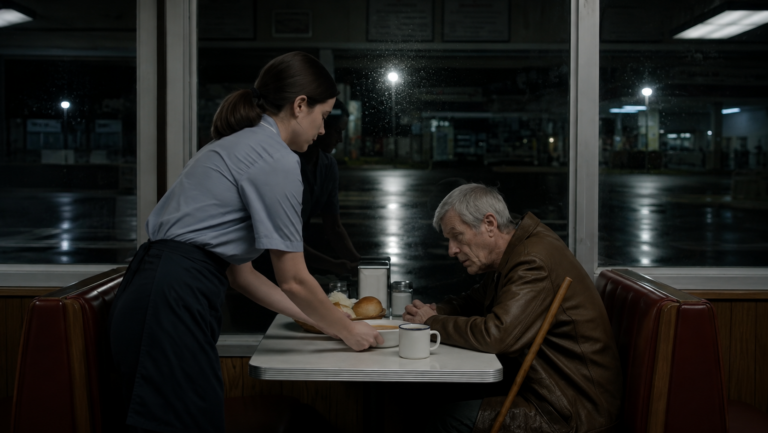
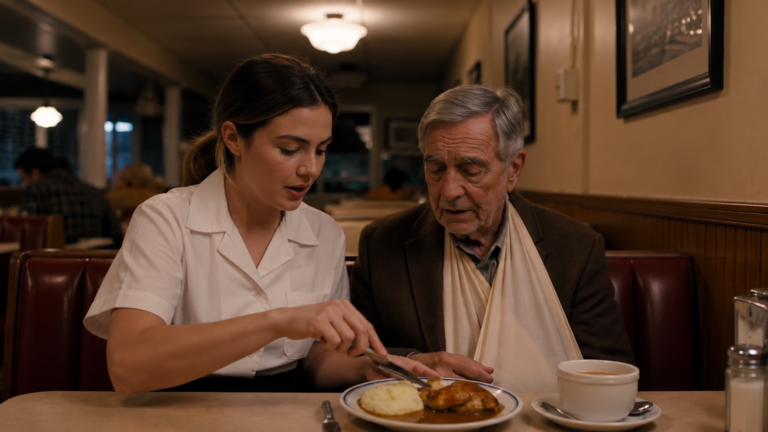
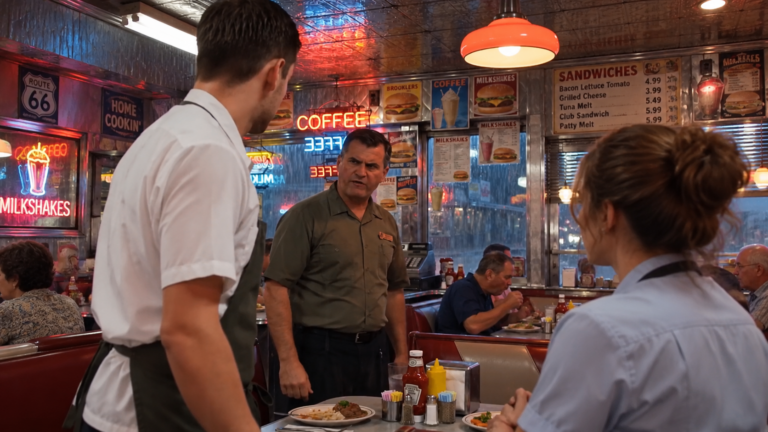
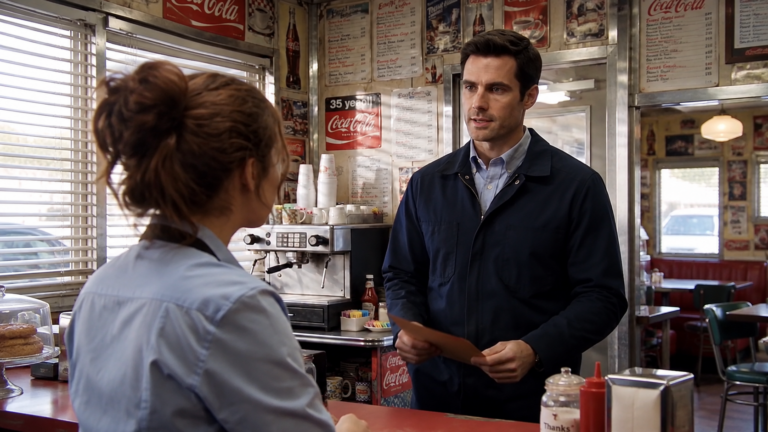
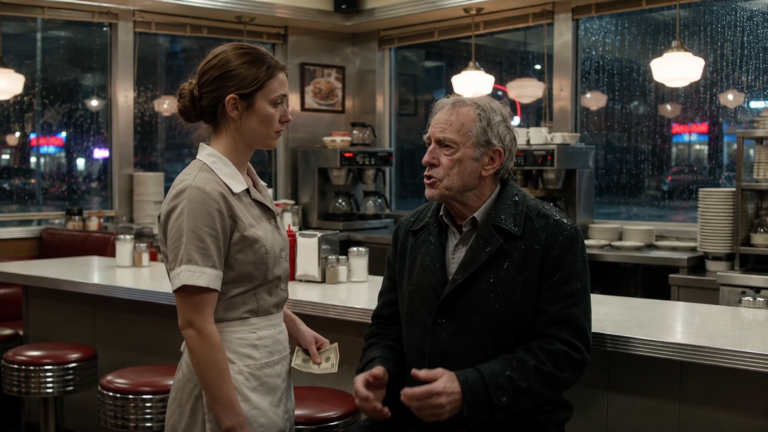
“I’ll finish today’s shift,” she said. “After that, I’m looking for somewhere else.”
“You think another diner will let you spend ten minutes cutting one man’s breakfast?”
“I think another diner might understand why it matters.”
Colin laughed and walked away. Lily tied her apron and went to table three. A mother with two small children ordered pancakes. A truck driver asked for extra toast. A woman in a blue coat requested tea and a quiet corner.
Near noon Daniel called. Walter’s hand was healing, and June had found a school interested in the stationary scenery. Benjamin had agreed to visit the library exhibit when it opened, but only if the account of the accident was written plainly. Lily promised to read the draft before it went up.
That afternoon she interviewed at a small café two streets away. The owner, a woman named Rosa, asked why she was leaving her old job.
“I don’t think serving people well should count as wasting time,” Lily answered.
Rosa studied her for a moment. “Can you start Thursday?”
19. THE PEOPLE BEHIND THE PAINT
Before the exhibit opened, Lily returned to Bellweather for one more weekend. June had asked her to help identify a collection of painted objects found in the theater’s costume loft. The items filled six boxes: cardboard fish, paper telescopes, cardboard waves, and a bundle of little wooden stars. Each had been handled by children who were now adults with jobs, families, and complicated memories of the place.
The library had offered a room for volunteers to sort everything. Lily expected a quiet morning of labeling. Instead, twenty people arrived, many carrying their own photographs. A retired music teacher remembered the chorus rehearsing in the hallway because the auditorium had been too cold. A former costume assistant described sewing sleeves on a borrowed machine after midnight. A man who had once played a sailor brought a photograph of his mother painting clouds while he slept under the worktable.
Lily had been thinking of the Blue Lantern as a place defined by one terrible afternoon. These stories made it harder to see it that way. The theater had contained hundreds of afternoons, most of them ordinary and happy, and those memories deserved room beside the truth about its closing.
June asked Lily to read the proposed exhibit label. It began with the year of the theater’s founding, listed the people who built the moving room, and described the accident without melodrama. Lily noticed that it called the safety stop ‘defective.’
“It wasn’t defective,” she said. “It was removed.”
The librarian hesitated. “That wording might upset people.”
“The wrong wording will upset Benjamin,” Lily answered. “And it won’t tell visitors what actually happened.”
June crossed out the word with a red pen. She wrote ‘deliberately removed during a design change’ in the margin. The librarian read it, nodded, and accepted the correction.
During the afternoon Benjamin arrived with his teenage daughter, Iris. She had never seen the room and knew only fragments of her father’s childhood. He showed her the painted paper boat, then the photograph of himself in a sailor’s cap. She laughed at the oversized hat. Benjamin laughed too, a little cautiously.
Iris asked why the show had stopped. Benjamin explained it in plain language, without trying to frighten her or protect her from every detail. He told her that people sometimes made decisions because they wanted something beautiful to happen quickly, and that beauty was no excuse for ignoring a danger. Then he showed her the small wooden stop on the model.
“This little thing mattered?” Iris asked.
“It mattered because the adults knew what it was for,” he said.
Later, while the volunteers packed the boxes, Benjamin thanked Lily for calling him. He said he had expected to feel like a child again when he returned. Instead, he had found himself explaining the room to his own daughter. The experience had not erased his fear, but it had given him a different place to stand.
Lily told him she had nearly refused the trip. “I thought a photograph and a key were the beginning of some impossible family mystery.”
“They were the beginning of a very ordinary mystery,” Benjamin said. “Why people find it so difficult to admit what they did.”
20. THE PRICE OF AN HONEST SIGN
The following Monday the developer’s representative called June. The company was willing to donate a section of the old scenery to the library, but only if the exhibit removed the paragraph describing the unauthorized modification. They preferred language about ‘an unfortunate mechanical incident.’
June invited Lily to listen on speakerphone. Elena Brooks attended as an observer, careful to explain that the city could not force the developer to donate the materials. The representative spoke politely about reputational concerns and the importance of celebrating local heritage in a positive spirit.
“The history is positive,” June said. “Hundreds of children learned to perform here. People built extraordinary things with very little money. But the accident is part of the history too.”
The representative suggested displaying the model without mentioning the moving room’s safety problems. Lily asked whether the company was willing to sign a statement saying the description was inaccurate. He declined.
“Then we’re not discussing accuracy,” she said. “We’re discussing convenience.”
The company withdrew its offer. For a few hours it seemed that the library would receive only photographs. June was furious, though she tried to hide it while cataloging props. Lily found her in the workshop standing beside the stationary moon.
“I should have accepted the donation,” June said. “The children would have liked seeing it.”
“They can still see the model.”
“The model is small. The moon is beautiful.”
“It is. But it shouldn’t cost you the truth.”
Nessa arrived with unexpected news. The moon was not part of the developer’s collection after all. The theater had commissioned the painted surface from a local arts collective that had retained ownership of several movable pieces. Nessa had contacted the collective while tracing the inventory, and its surviving members were willing to lend the moon to the library.
June demanded to see the agreement. Nessa showed her the inventory identification and the collective’s confirmation. There was no dramatic confrontation, just a careful exchange of phone calls and signatures. By Friday the moon was being wrapped in protective cloth for transport.
Arthur heard about the dispute and telephoned June. He offered to pay for the display case himself. June said the library had already found a sponsor and suggested that if he wanted to contribute, he could volunteer for the tedious work of cleaning old hardware. Arthur arrived the next morning with a toolbox and spent four hours removing rust from brackets that would never move again.
Lily worked at the next table, sorting screws by size. They barely spoke. At noon Arthur looked at the row of cleaned brackets and admitted that he had always preferred designing a show to maintaining one. Lily said maintenance was the part that made it possible to have another show tomorrow.
He did not argue.
21. AN ORDINARY SATURDAY
On the day the library exhibit opened, a line formed before the doors were unlocked. Former performers brought their children. Old neighbors recognized themselves in rehearsal photographs. People who had never visited the theater came because they were curious about the enormous painted moon visible through the library windows.
The exhibit did not have moving walls. Visitors could turn a hand-operated model, but a clear guard kept fingers away from its gears. The mechanical stop was marked in yellow. A second display explained how the emergency system should have worked and why the original alteration had defeated its safety margin.
Benjamin stood beside the model when a boy asked whether the machine had hurt anyone. He answered honestly, then showed the child how the little wall stopped against its block. The boy tried it several times, satisfied by the simple click.
Walter attended with Daniel. His hand had healed enough that he could hold a cup without spilling it, though he still used a light one. He approached Benjamin and asked whether they could talk. Benjamin agreed to walk with him around the library garden. They returned twenty minutes later without any visible transformation. They were simply two men who had spoken about something painful and would need time to decide what came next.
June made a short speech thanking the volunteers. She mentioned Lily’s father, Walter’s admission, Arthur’s cooperation, and the importance of showing both the artistry and the mistake. She did not turn the afternoon into a trial. The people in the room already knew what had happened. They had come to see what could be saved and what could be learned.
After the speeches Lily found a small girl studying the photograph of Walter and June beside the painted moon. The girl pointed at the older picture and asked whether those two people had built the room.
“They helped,” Lily said. “A lot of people did.”