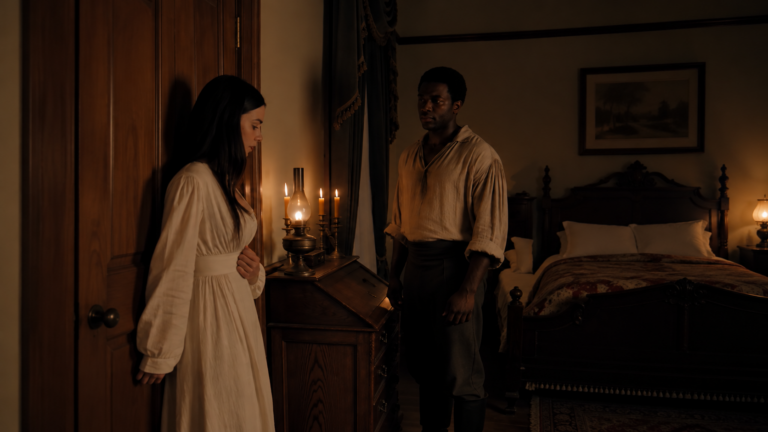
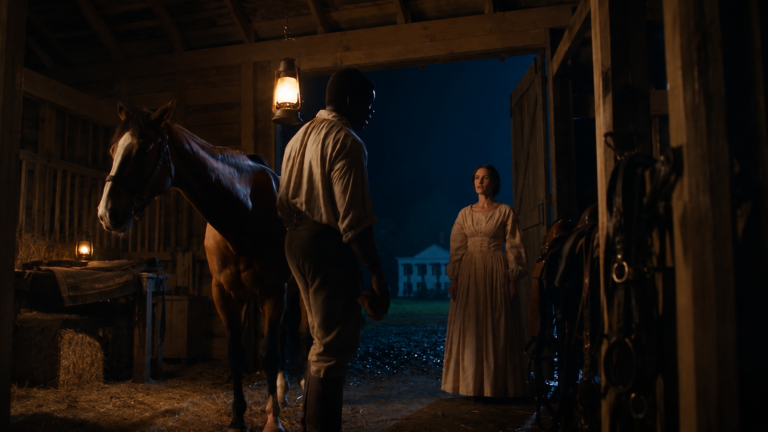
CHAPTER TWELVE — THE ROAD THAT BELONGED TO NO ONE
Ruth listened to Samuel describe the supper while Liza set food beside him.
The quarters were quiet, but not asleep.
People had heard enough about the evening to know that the danger was not over.
“Julian says I go south tomorrow,” Samuel told them.
Ruth nodded.
“Then we plan for tomorrow, not for the victory you had tonight.”
Liza took a folded scrap from her apron.
“Ida’s cousin works at a boarding house on the road to Fredericksburg.”
Samuel looked at her.
“What does that mean?”
“It means there are people who might shelter you if you reach them.”
Ruth raised a hand.
“Don’t mistake a possibility for a safe road.”
They spoke until the fire burned low.
Samuel knew the habits of the stable watchman and the timing of the night patrol.
Liza knew which servants would be sent to the laundry before sunrise.
Ruth knew how quickly questions could lead to punishments that reached beyond one person.
They had to decide whether Samuel should attempt flight alone, whether Liza would try to go with him, and how to protect Ruth if they disappeared.
Samuel wanted to take both women.
Ruth refused to let his fear make the decision for her.
“I cannot travel as you can,” she said.
“Then I won’t leave you.”
“You may have to.”
“I won’t pretend that is easy.”
“I am not asking you to pretend.”
Liza stared into the coals.
“I can walk farther than anyone in this house thinks.”
Samuel knew that was true.
As children they had raced the farm dogs along the creek bank, and Liza had nearly always won.
Yet childhood speed would not settle what happened on a watched road in 1854.
Ruth made them count what they actually possessed.
There were a few coins, an old coat, two knives for work,
some bread, a pair of shoes that still needed mending, and the names of people who might offer help.
There was no magical passage through the night.
Every mile demanded luck, judgment, and the assistance of people who would be taking risks of their own.
At last Samuel said, “I will not let Julian decide where I disappear.”
Liza gripped his hand.
“Then we choose our own road.”
Ruth studied their faces.
“Choose it while you can still think clearly.”
She told them she would remain and keep the others informed.
Samuel argued until she placed her hand across his mouth.
“I have lived here long enough to understand what staying costs,” she said.
“I am choosing it with my eyes open.”
Before they could settle the details, a knock sounded against the doorframe.
Ida stood outside wearing her travel cloak.
“I’ve come with news,” she said.
“Julian’s steward has been sent to arrange a wagon at daybreak.”
Samuel nodded.
“We know.”
“There’s more.”
Ida closed the door behind her.
“Martin Kersey has left Vale House.”
Liza leaned forward.
“Where did he go?”
“To Alder Creek, where he has rented a room under his own name.”
Samuel waited.
Ida continued.
“He wants to speak to you.”
Ruth’s answer was immediate.
“Absolutely not.”
Ida did not disagree.
“He says he can stop the transfer.”
Samuel looked toward the door.
“Can he?”
“Maybe.”
“Then why didn’t he stop the plan before supper?”
Ida met his eyes.
“That is what you should ask him.”
CHAPTER THIRTEEN — MARTIN’S OFFER
Martin returned to Vale House before dawn, not in Julian’s carriage but on foot from the road.
He waited beside the stable and asked the watchman to send Samuel out.
Samuel stepped into the yard with a lantern in one hand.
Ida remained within sight near the kitchen gate.
Martin had mud on his boots and dark circles beneath his eyes.
“I have been to the county office,” he said.
Samuel did not move closer.
“Why?”
“To find out whether Julian has arranged your transfer already.”
“And?”
“He has.”
Martin glanced toward Ida before continuing.
“The wagon is ordered for sunrise, but the receiving agent has not yet signed the agreement.”
Samuel heard the careful wording.
“What do you want from me?”
Martin looked ashamed.
“I want to repair some of what I’ve done.”
“Can you give back the night I spent waiting to be accused?”
“No.”
“Can you return the years I have spent working here?”
“No.”
“Then speak plainly.”
Martin swallowed.
“I can pay to purchase you from Julian, and arrange for your manumission.”
Samuel felt a strange, painful surge of hope.
Then he looked at the house.
“Would you purchase Liza too?”
Martin hesitated.
“I might be able to negotiate.”
“And Ruth?”
“Samuel, I cannot promise everyone.”
Samuel set the lantern on the ground.
“You came here believing I would be grateful for whatever part of my family you could afford.”
Martin’s expression tightened.
“I am trying to help.”
“You are trying to make yourself bearable to yourself.”
The gentleman lowered his gaze.
Samuel continued.
“If you can speak to Julian about a price,
you can speak in front of witnesses about the statement he ordered.”
“I already admitted my part in the photograph.”
“Then say what he planned to do afterward.”
Martin looked toward the house.
“He could ruin me.”
“He has already tried to ruin me.”
Ida walked closer.
“Mr. Kersey, you cannot purchase your way out of speaking the truth.”
Martin drew a long breath.
“I could write a statement.”
“Words on paper have a way of disappearing,” Ida said.
“We need you where other people can hear.”
The watchman began moving toward them from the carriage shed.
Martin lowered his voice.
“Julian is sending Samuel to be sold through a broker in the south.”
Samuel felt Liza’s name rise in his throat, but he held it back.
Martin went on.
“He intends to say Samuel confessed to approaching Catherine.”
“And my sister?” Samuel asked.
“Liza is to remain here.”
“Ruth?”
Martin nodded.
Samuel looked at Ida.
That was the leverage Julian expected to keep him obedient.
If Samuel ran, the people he loved could be punished for what the master called his ingratitude.
If he stayed, Julian could send him away and preserve the lie.
“There is one more thing,” Martin said.
“The broker expects the transfer papers at noon.”
Samuel looked toward the stable yard, where the wagon was already being prepared.
The night was ending.
They had fewer hours than anyone had hoped.
Ida spoke first.
“Then at noon we must be somewhere Julian cannot conduct business in silence.”
CHAPTER FOURTEEN — THE MARKET SQUARE
By midmorning a crowd had gathered near the courthouse in Alder Creek.
The county editor had printed a short notice announcing a public explanation of a disputed photographic commission.
He had not printed Samuel’s name.
Ida insisted on that condition before she would bring anyone to the square.
The notice attracted curiosity because several prominent dinner guests had already spread conflicting versions of the previous evening.
Some said Catherine had exposed a trick.
Others claimed she had interrupted her husband in a fit of jealousy.
Nobody agreed about the figures in the photograph.
Julian intended to take advantage of the confusion.
He arrived with Pritchard and two hired men, demanding that the editor withdraw his notice.
The editor refused.
He was a small man with red cheeks and a habit of rubbing ink from his fingertips.
“People have been talking since breakfast,” he told Julian.
“I would rather hear one account plainly.”
“You will print what I authorize,” Julian said.
The editor stepped back.
“That is a very expensive misunderstanding.”
Across the square Ida stood beside Frost and Greer.
Catherine arrived separately, wearing a plain gray traveling dress.
She carried no bundle of letters.
She had chosen to leave them at the house because the private words between Julian and Martin were not the evidence the gathering needed.
Samuel came in the back of a wagon with Pritchard’s driver.
He had been told that he was going to the broker’s office.
Instead, Ida had asked the driver to stop beside the square so the witnesses could see him before the transfer was completed.
The driver agreed only because the editor promised to record that he had followed his route as instructed.
Samuel stepped down beneath the gaze of people who rarely saw an enslaved man address a public gathering.
He felt a terrifying urge to run.
Then Liza appeared on the edge of the crowd.
Ruth had insisted she travel with Ida’s laundry wagon rather than remain at the house.
The sight of his sister gave Samuel courage, but it also reminded him of the cost of every word.
Julian pushed through the gathering.
“Samuel, return to the wagon.”
Samuel remained where he was.
“Mr. Vale, I have been asked to speak.”
“By whom?”
“By the people who intend to repeat what I say.”
Julian reached for his arm.
Martin stepped into the space between them.
“Don’t,” Martin said.
The crowd fell quiet.
Julian stared at him with an expression of disbelief.
“You choose him over me?”
Martin shook his head.
“I choose to stop lying.”
He turned to the editor.
“I helped arrange a photograph that was intended to suggest Catherine Vale had behaved improperly with Samuel.”
The editor raised his notebook.
“Were either of those people shown in the image?”
“No.”
“Who posed?”
“Two hired models.”
“Did you tell Mr. Vale this would be used against his wife?”
“Yes.”
“Did you know Samuel would be threatened afterward?”
Martin looked directly at Samuel.
“Not at first.”
“Later?”
“Yes.”
A woman near the front covered her mouth.
The editor looked at Julian.
“Sir, would you like to answer?”
Julian’s voice was low and furious.
“This entire gathering is an insult to my household.”
Catherine stepped forward.
“You have made the household’s honor depend on the silence of people you can punish.”
Julian turned on her.
“Do you wish to destroy us both?”
“No,” she said.
“I wish to stop you destroying Samuel.”
The editor looked toward the transfer broker, who had emerged from his nearby office.
“Have you accepted this man’s sale?”
The broker shook his head.
“Not without proper completion of the agreement.”
Martin reached into his coat and removed a purse.
“I am prepared to purchase Samuel and his sister and release them from my claim.”
Samuel’s heart lurched.
But before he could speak, Liza stepped beside him.
“We won’t be separated,” she said.
The broker glanced between them.
“Neither of you sets the terms.”
Ida answered steadily.
“Then let the public hear the terms before any of us agrees they are just.”