CHAPTER THREE — THE PHOTOGRAPHER’S PRICE
By midday Julian Vale returned from Richmond carrying a new riding whip and smelling of tobacco and expensive soap.
He kissed Catherine’s cheek in the entrance hall without looking at her face.
Martin Kersey arrived an hour later in a hired coach.
The two men greeted each other with careful formality before disappearing into Julian’s study.
Samuel watched from the far end of the carriage yard as their luggage was carried indoors.
Martin had brought only one valise.
For a gentleman who claimed he intended to spend the month at the estate, that seemed remarkably little.
Mr. Pike spent the afternoon preparing the schoolroom.
He carried plates of glass from one table to another, mixing liquids with a precision that warned Samuel not to touch them.
The photographer wore ink-stained cuffs and had the nervous manners of a man who expected his employer to change instructions without paying for the inconvenience.
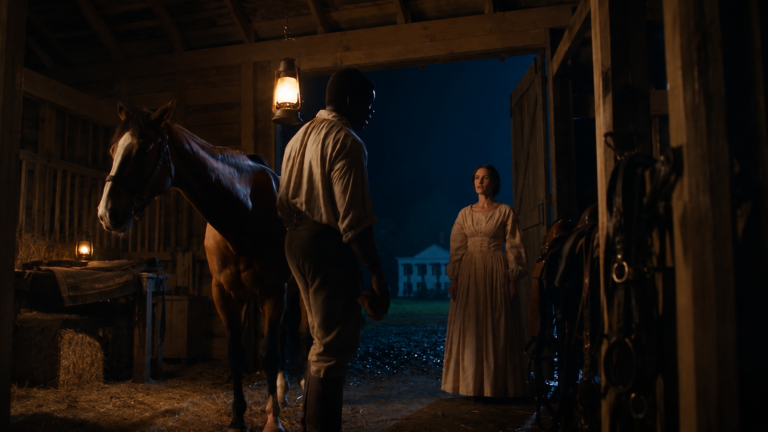
Late in the afternoon, Samuel was ordered to bring a riding horse to the side gate.
He found Martin waiting beside a hitching rail.
“Does Mr. Vale require a carriage tonight?” Samuel asked.
Martin studied him.
“Your name is Samuel.”
“Yes, sir.”
“You were born on this property?”
“Yes,
sir.”
“Then you know better than anyone how old grudges can grow around a house.”
Samuel held the reins without replying.
Martin reached for the saddle horn, then stopped.
“Has Mrs. Vale approached you lately?”
“She has spoken to me.”
“About what?”
“The injured mare.”
Martin’s eyes moved toward the stable.
“Be careful whom you trust.”
Samuel remembered the letter in Catherine’s hand.
“I am careful, sir.”
Martin mounted, but he did not ride away.
“You might be asked to help Mr. Pike with an ordinary arrangement.”
“Will I be told what it is?”
“I expect so.”
“If I do not understand the arrangement,
may I refuse it?”
Martin looked down at him for a long moment.
“You know the answer to that.”
He spurred the horse before Samuel could say another word.
Samuel watched him travel toward the orchard, where Julian was already walking between the trees.
The two men met beyond the last row, out of sight of the house.
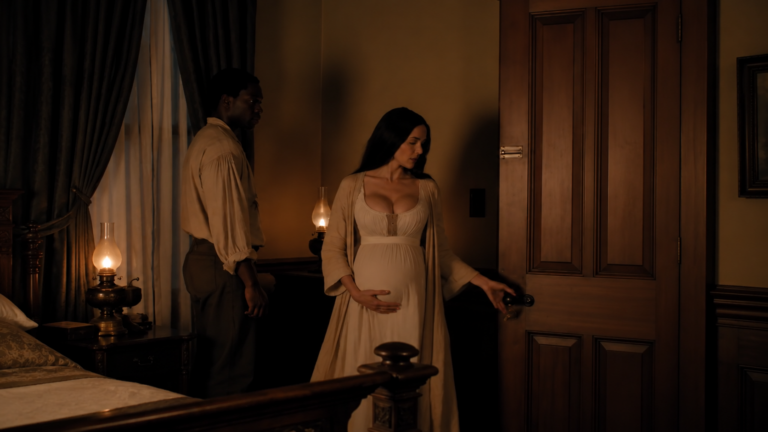
A little later Catherine came down the back steps carrying a book she had not opened.
She stood beside Samuel while he watered the other horses.
“Did he speak to you?” she asked.
“Yes.”
“What did he say?”
“He wanted to know whether I trust people.”
Catherine folded the book against her chest.
“I’ve been thinking about what you said last night.”
“Then think about this too.”
Samuel pointed to the schoolroom.
“If they put a picture in front of twenty people, those people will repeat whatever the picture seems to show.”
“I know.”
“If I say it never happened, whom will they believe?”
She answered too quickly.
“They will have to listen if I speak.”
“Then you have never noticed how easily people stop listening to you.”
Catherine fell silent.
The remark was sharper than he had intended, but he refused to apologize for its accuracy.
She watched the photographer carry a wooden screen into the building.
“Mr. Pike has demanded another fifty dollars,” she said.
“For what?”
“He says the first arrangement failed.”
“What failed?”
“I heard Julian shouting that a face was too visible.”
Samuel felt a chill despite the warmth of the afternoon.
“Whose face?”
“I don’t know.”
“Ask.”
Catherine gave a bitter laugh.
“I cannot simply walk into Julian’s study and demand explanations.”
“You walked into my stable after midnight and demanded a child.”
She looked at him as if he had struck a bell within inches of her ear.
Then she lowered her eyes.
“You are right.”
Samuel did not congratulate her for admitting it.
He led the horse back inside.
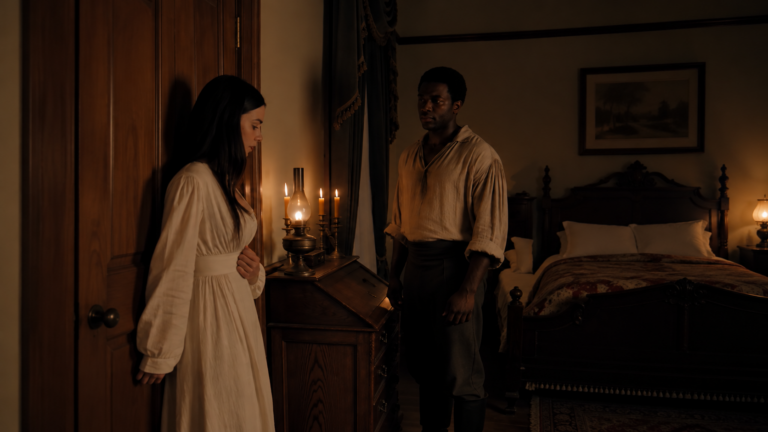
That evening Liza discovered an unfamiliar blue cloak laid across the sewing table.
The fabric was cheap wool, dyed almost the same shade as Catherine’s expensive garment.
The silver braid had been stitched on crookedly, using thread from the kitchen stores.
Liza turned it over and found a small square of paper pinned beneath the collar.
The writing said, in Julian’s hand, FOR THE WINDOW.
She pulled the paper loose and put it into her shoe.
Then she took the false cloak to Samuel.
“This isn’t hers,” she said.
Samuel touched the rough wool.
“Then somebody else is going to wear it.”
Liza held the garment at arm’s length.
“Or nobody will have to wear it at all.”
From the kitchen, a bell announced that the Vales had sat down to dinner.
Samuel understood what she meant.
If the picture showed only the cloak and a man’s shadow, the audience might supply the rest of the story themselves.
At that moment, the danger ceased to be a vague threat from a stolen letter.
It became a room, a costume, and a photographer paid to make falsehood look permanent.
CHAPTER FOUR — THE WOMAN IN THE WINDOW
The next morning Catherine entered the schoolroom while Mr. Pike was eating breakfast.
The black curtains made the air smell stale and chemical.
At the center stood a chair beneath a painted arch, with a tall wooden frame arranged to resemble a window.
A narrow strip of blue wool hung over the chair’s back.
Catherine had never owned such a cheap garment.
She touched it with two fingers.
Then she noticed a pair of boots placed behind the screen.
One had a broken strap on the right side.
Samuel’s stable boots had the same defect,
although hundreds of working men in Virginia wore boots in similar condition.
“What are these doing here?” she asked.
Mr. Pike came in carrying a saucer of toast.
He stopped when he saw her.
“Mrs. Vale, this room isn’t suitable for visitors.”
“Neither is a portrait made without its subject.”
“I cannot discuss my commission.”
“I live in the house that pays your commission.”
“Your husband pays it, ma’am.”
Catherine looked again at the boots.
“Who is supposed to wear those?”
“A gentleman’s servant.”
“And the cloak?”
“That was provided with the instructions.”
Catherine walked toward the camera.
Mr. Pike moved to intercept her.
“Please do not touch the apparatus.”
“Then answer me plainly.”
He set down the toast.
“I have been hired to produce a study for a private family discussion.”
“A study of whom?”
“Of circumstances.”
She stared at him.
“That is a strange word for an accusation.”
The photographer looked toward the doorway as though expecting help.
Instead, Ida Bell entered carrying a stack of clean linen.
“Your towels, sir,” Ida said.
She laid them neatly on a table and looked at the arrangement without appearing to look at anything.
Mr. Pike demanded that both women leave.
Ida did not hurry.
She pointed to a bucket beneath a shelf.
“Will you need that water replaced?”
“No.”
“Then I won’t trouble you further.”
As she passed Catherine, Ida spoke so quietly that the photographer could not hear.
“Don’t threaten the machine.”
Outside, Catherine followed her into the laundry yard.
“How do you know what I was considering?”
“Because you were looking at it the way frightened people look at a locked door.”
Catherine began to protest, then stopped.
Ida set down the empty linen basket.
“If you destroy his work before anyone has seen it, your husband can say you were jealous,
unstable, or guilty.”
“He already intends to say those things.”
“Then don’t help him.”
“What would you have me do?”
“Find out where he intends to show it.”
Catherine looked toward the house.
“Julian has invited twenty guests for supper tomorrow.”
“Anyone important?”
“Two magistrates, the rector, three neighboring families, and the editor of the county newspaper.”
Ida’s expression changed.
“He isn’t arranging a private conversation.”
“No.”
“He’s arranging an audience.”
Catherine felt the truth settle on her with humiliating clarity.
Julian did not need to prove anything in a court of law if every influential neighbor could be made to whisper the same accusation.
The picture would serve as an occasion for their whispers, not a perfect piece of evidence.
“My husband thinks this will protect his standing,” she said.
Ida folded her hands.
“His standing is his concern.”
“Samuel’s life is ours.”
Ida regarded her steadily.
“Samuel’s life belongs to Samuel, whatever the law insists.”
Catherine looked away.
It was the second time in two days that someone had refused to accept the language she had inherited.
Then Ida said, “There may be another photograph.”
Catherine turned back.
“Of what?”
“Of the room before they arrange the lie.”
“Would that help?”
“Not by itself.”
Ida lifted the basket.
“But it might tell us how much they expect the guests to notice.”
CHAPTER FIVE — A DINNER INVITATION
Julian spent the day preparing for his supper as if nothing in the household were unusual.
He inspected the silver, corrected the placement of chairs, and ordered the best wine brought up from the cellar.
In the kitchen, the cook worked beside two assistants who had been awake since before dawn.
No one asked whether Samuel had eaten.
He spent the morning repairing a carriage wheel that had been damaged on Julian’s Richmond journey.
The wheel itself was sound, but its iron rim had begun to separate from the wood.
He worked slowly, using the proper tools, because the steward had already accused him of wasting time.
At noon Liza came to the carriage shed.
“They brought the picture into the upstairs sitting room,” she said.
“Did you see it?”
“It was wrapped in velvet.”
“Who carried it?”
“Mr. Pike and Mr. Pritchard.”
She paused, then produced the small paper taken from the false cloak.
Samuel read FOR THE WINDOW and gave it back.
“Keep it hidden.”
“It isn’t proof of anything by itself.”
“No.”
“But it tells us they dressed somebody.”
Samuel set the wheel against the shed wall.
“Have they asked about me?”
“Pritchard wants you in the house tomorrow night.”
“For what reason?”
“He said every servant must appear when called.”
Samuel looked at his sister.
“Then you should stay away from the stairs.”
Liza shook her head.
“They can order me wherever they please.”
“Then at least don’t let them put you into that cloak.”
Before she answered, footsteps sounded outside.
Pritchard entered and surveyed the tools.
“Samuel, you’ll come to my office at sunset.”
“Yes, sir.”
“Mr. Vale has something important to discuss.”
Pritchard studied Liza.
“Your work is upstairs.”
She picked up her sewing basket and went out.
Pritchard waited until she was gone.
“You have been spending too much time talking.”
“I have been repairing the carriage, sir.”
“Repairs don’t require a committee.”
Samuel bent to lift the wheel.
“I’ll be at your office at sunset.”
Pritchard left without another word.
At sunset Samuel found Julian and Martin waiting in the steward’s office.
The desk was cleared, and a single chair stood against the far wall.
Julian did not invite him to sit.
“I understand my wife has been behaving strangely,” he said.
Samuel kept his hands still.
“I can’t speak for Mrs. Vale.”
Martin stood beside the window with his hat under one arm.
Julian continued.
“She has become fixated on her failure to provide a child.”
Samuel said nothing.
“She may have made inappropriate suggestions to you.”
Samuel met his gaze.
“She came to the stable.”
“Did she ask you to enter the house?”
“Yes, sir.”
Julian looked at Martin as if confirming a prediction.
“Did she touch you?”
“No, sir.”
“Did she offer you anything?”
“She asked for help with her marriage.”
The silence that followed was not the silence of surprise.
It was the silence of two men deciding how to use an answer.
Julian walked behind the desk.
“You will tell the guests tomorrow that my wife approached you with a shameful proposal.”
Samuel’s throat tightened.
“I cannot testify to words she didn’t speak.”
“Then testify to what she did speak.”
“Those words do not mean what you intend people to hear.”
Julian’s expression hardened.
“Your opinions are not required.”
Martin moved a little closer to the door.
Samuel noticed.
Julian opened a drawer and took out a folded paper.
“This is a statement prepared for you.”
Samuel knew what would happen if he signed it or made a mark beneath its sentences.
The statement would become his own account, even though he had never been allowed to choose its meaning.
“I cannot read every word of that paper, sir,” he said.
Julian laid it on the desk.
“Then Mr. Kersey will read it aloud.”
Martin did not reach for the document.
Julian waited.
At last Martin said, “Perhaps this is unnecessary.”
Julian turned sharply.
“We agreed on the arrangements.”
“We agreed to leave.”
Samuel kept his face expressionless.
Neither man noticed that the phrase had been spoken in front of him.
Julian pushed the statement toward Samuel.
“You will be called tomorrow after supper.”
“And afterward?” Samuel asked.
“Afterward, your future will be decided.”
Samuel looked at Martin.
The gentleman’s eyes had dropped to the floor.
“That is all,” Julian said.
Samuel left without touching the paper.
Outside, the air smelled of fallen leaves and distant woodsmoke.
He had not escaped anything.
He had merely discovered the room in which they intended to decide his fate.