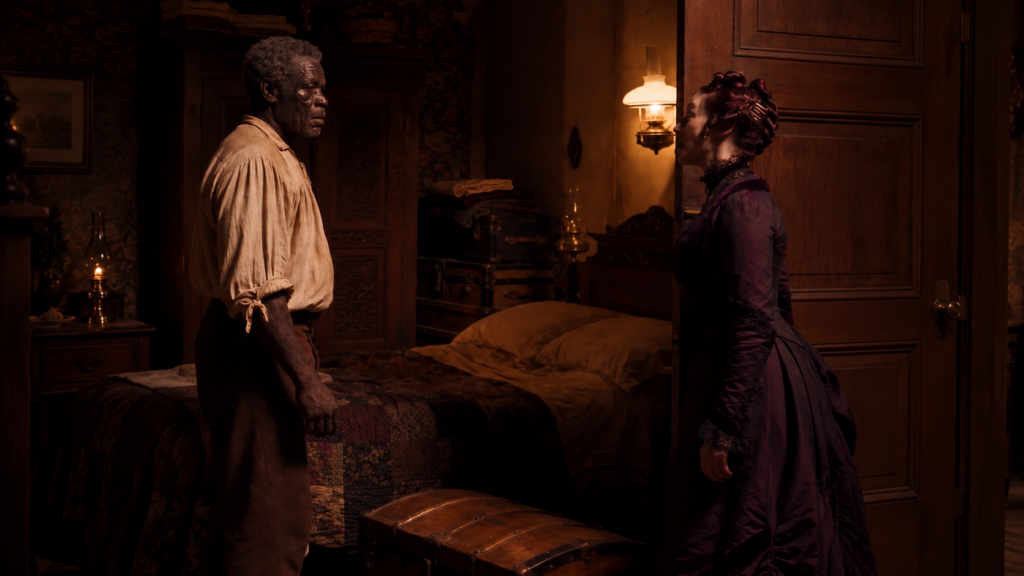
Daniel Carter carried two heavy trunks up the narrow staircase and into Lady Catherine’s bedroom because she had ordered him to.
The evening light made red squares on the carpet, and rain threatened beyond the magnolia trees.
He set the trunks beside the bed and straightened his back without looking at her dressing table.
The lock clicked behind him.
Catherine stood between Daniel and the door, with one pale hand resting on the brass key.
“Set them closer,” she said.
Daniel moved the trunks another foot and stepped away.
“I have finished, ma’am.”
“You don’t have to leave yet.”
She had summoned him privately before,
always for tasks that could have been done by anyone.
Sometimes she asked him to carry a book from a table within her reach.
Sometimes she kept him waiting while she chose which trunk to open.
Daniel had learned to answer in as few words as possible, because even an innocent misunderstanding could ruin him.
“I came to carry the trunks,” he said.
“And you think that is all I wanted?”
Her voice was gentle enough to make the threat worse.
Daniel watched the door rather than her face.
“Please unlock it.”
Catherine’s expression hardened.
“If you refuse me, I can say you entered this room without permission.
”
A silver hairpin lay beside an open trunk, carefully positioned where someone entering would notice it.
Daniel had never seen a trap assembled so quietly.
“You must know what that accusation would mean,” he said.
“Then perhaps you should remember who can make it.”
He kept both hands visible.
He had no safe answer that would make her honest, and no argument that could make the locked door less real.
“Open the door,” he repeated.
Catherine stared at him long enough for the rain to begin tapping the windows.
Then she unlocked it and turned away as though he had disappointed her over some ordinary household task.
Daniel walked into the corridor without touching anything else.
At the servants’ staircase, he found Ruth Bell holding a basket of folded sheets.
Ruth was thirty-two, observant, and experienced at keeping her expression still when powerful people demanded it.
She saw his face and stepped aside without speaking.
Daniel reached the bottom of the stairs before he allowed himself to breathe normally.
He spent the remaining hours helping Amos bring the horses in from the rain.
He did not tell anyone about the bedroom.
He feared that saying the wrong words aloud would make them into evidence against him.
By breakfast,
Catherine announced that a diamond brooch and two gold bracelets had vanished from her dressing room.
She said Daniel had entered the room the previous evening without permission.
Master Gideon Whitcomb stopped cutting his ham and looked toward the kitchen door.
“Bring Carter here,” he told the butler.
Daniel was summoned with flour still on his sleeve from carrying grain sacks.
Catherine sat perfectly upright at the table, dressed in blue silk.
“Did you go upstairs yesterday?” Gideon asked.
“Mrs. Whitcomb ordered me to carry two trunks.”
Catherine raised her eyebrows.
“He was dismissed after he placed them on the landing,
but he followed me inside.”
Daniel felt the other servants listening from beyond the dining room.
“That is not what happened, sir.”
Gideon pushed his chair backward.
“Do not contradict my wife unless you intend to prove it.”
“I did not take her jewelry.”
Catherine pressed a handkerchief to her mouth.
“I don’t know what else he might have done if I hadn’t made him leave.”
A silence followed that was colder than any shouted order.
Gideon ordered Daniel confined to the tack room until the plantation overseer returned.
Daniel walked there between two men who did not meet his eyes.
Across the hall, Ruth set down her basket and remembered what she had seen the evening before.
She had passed Catherine’s open doorway after Daniel left.
The mistress was kneeling beside the trunk, holding the missing jewelry and lifting a strip of lining with a small sewing knife.
Ruth had moved away before Catherine noticed her.
At breakfast, the silence of that hallway returned to Ruth with painful clarity.
She had seen the truth, but telling it could endanger her husband, their daughter, and every person who might be suspected of helping her.
She was not ready to speak.
Then a carriage arrived with three strangers,
and the household learned why a missing brooch was suddenly more dangerous than it seemed.
Chapter Two: The Visitors
The first stranger wore a dark frock coat with a narrow collar and carried a wooden case containing folded cards.
His name was Silas Dent, and he described himself as an auction organizer from Fredericksburg.
The second was a clerk called Oliver Pike, who had fingers stained with ink.
The third was an older woman named Mrs. Vale, who traveled with Dent to inspect clothing and household possessions offered for sale.
Gideon welcomed them into the sitting room with more hospitality than he had shown anyone in months.
From behind a swinging door, Ruth heard the words “Saturday” and “private invitation.”
She also heard Dent ask whether the household was prepared for an inventory.
“We were ready until last night,” Gideon replied.
“My wife’s property has gone missing.”
Dent asked whether the thief had been found.
Gideon said a stable worker was confined and would be questioned.
“A regrettable nuisance,” Dent replied, “but we must distinguish missing articles from articles being offered.”
Ruth was carrying a tray when Oliver Pike unfolded a printed announcement.
She could read, a skill she concealed except among people she trusted.
She saw descriptions of chairs,
a carriage, livestock, and several enslaved men and women.
Near the bottom appeared the words “household labor, select lots.”
Her fingers nearly slipped beneath the weight of the tray.
Gideon had told the kitchen staff that the visitors were inspecting damaged furniture.
Now she understood that he meant to sell people.
He had promised Amos that his family would remain together through the harvest.
He had promised Ruth that her daughter Ellen would continue working inside rather than being sent to the tobacco fields.
The announcement made neither promise worth the paper on which it might have been written.
Dent spoke brightly about buyers from surrounding counties.
He pointed at spaces on the inventory where prices would later appear.
“A buyer prefers certainty,” he said.
“An accusation against a useful worker can lower the price of the entire group.”
Gideon glanced toward Catherine.
“Then we shall resolve the accusation before Saturday.”
Catherine’s lips tightened, but she said nothing.
Ruth returned to the kitchen and placed the tray on a table with controlled hands.
Cook Hester Miles looked at her.
“What have they brought?”
“A sale,” Ruth whispered.
Hester stopped stirring the pot.
“What kind?”
Ruth could not force the answer out immediately.
At last she said, “People are on the list.
”
The cook closed the kitchen door.
Hester was nearly sixty and had lived on the estate since Gideon’s father owned it.
Her son had been sold south twelve years earlier, and every passing wagon made her watch the road until it disappeared.
“Who?” she asked.
“I couldn’t see all the names.”
“Then we need eyes where that paper goes next.”
Ruth thought of Daniel behind the tack room door.
“They’ll make him the reason for whatever they want to do.”
Hester nodded once.
“They usually prefer a reason that cannot answer back.”
Outside, Gideon’s overseer, Thomas Rusk, came riding in through the wet grass.
His arrival made Daniel stand inside the locked tack room.
Rusk was not a man who enjoyed uncertainty.
He believed accusations should be settled quickly, especially when wealthy visitors watched.
He stopped outside Daniel’s door and asked whether the jewelry had been recovered.
“I never touched it,” Daniel said.
“Then someone has hidden it well.”
Rusk kicked a loose board near the doorway and ordered Amos to search Daniel’s bedding.
Amos looked toward the stable yard, where Ruth was crossing with a basket.
He had served under three overseers and knew how easily a search could become an excuse for punishment.
“There’s nothing to find,” Amos said.
Rusk struck the door with the flat of his crop.
“Then the search should be easy.”
Daniel listened as his belongings were carried into the yard.
His shirts, tools, spare stockings, and small wooden comb were arranged on a bench.
No jewelry appeared.
Rusk looked dissatisfied rather than relieved.
“The mistress says he was last in the room,” he muttered.
Amos returned Daniel’s belongings under the overseer’s glare.
Daniel caught sight of a folded advertisement in Rusk’s pocket when the man turned.
He recognized the auction house name from a shipment of horse blankets earlier in the year.
“Why is Dent here?” Daniel asked.
Rusk stopped walking.
“That is no business of yours.”
“If you are selling horses, you should know the gray mare isn’t sound enough for a long journey.”
The overseer stared at him.
“You think this morning is a good time to offer advice?”
He left without answering, and Daniel heard the bolt slide back into place.
The room smelled of leather and damp hay.
He could not yet see the wider danger, but he knew a false accusation was most useful when someone had other decisions to hide.