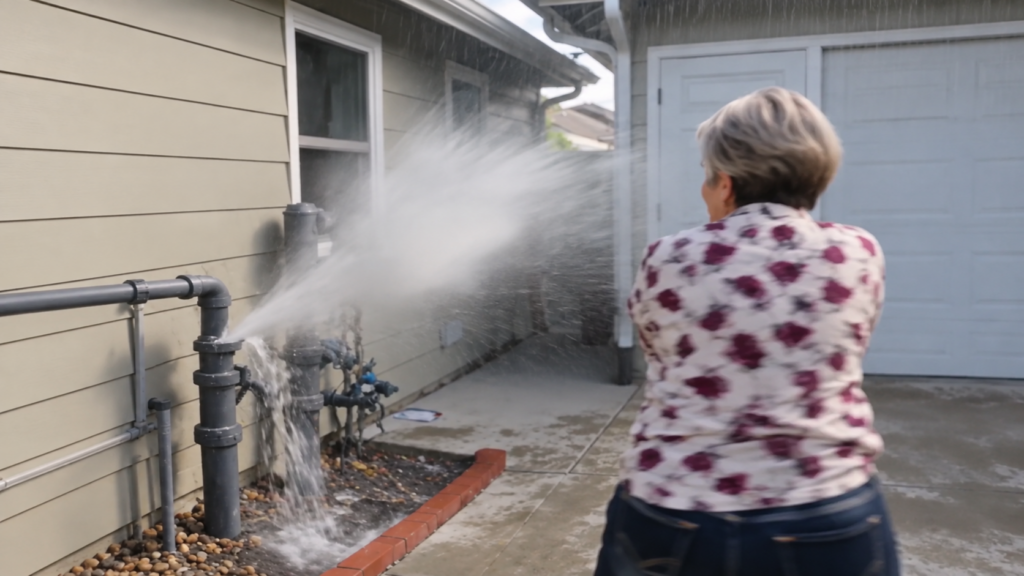
The first sign that someone had entered my orchard was the sound of water running where no water should have been.
At five forty on a cold Thursday morning, I stepped onto my back porch and heard a steady rush from the lower field.
I had lived in Bellhaven, Virginia, long enough to recognize the ordinary noises of our narrow valley.
A healthy irrigation line whispered beneath the grass, and a damaged one sounded like a creek breaking loose.
My boots were still unlaced when I ran past the tool shed and saw muddy water spreading around the roots of twelve young apple trees.
Someone had opened the distribution housing with a wrench and broken the brass regulator inside it.
The pressure line was split, and the lower orchard had become a pond.
The trees were the newest part of the farm my father had left me, and their roots could not survive for long in saturated soil.
I reached the main shutoff at the pump house and turned it until the rush began to fade.
Then I saw the red survey ribbon tied to the orchard fence.
The ribbon was fresh, and it carried the neat white lettering of a consulting company I had never hired.
I stood there with wet jeans and a useless regulator in my hand when my neighbor, Celeste Morrow, called from the opposite side of the hedge.
“That’s a terrible mess, Nolan,” she said.
Celeste wore a cream-colored coat and held a paper cup of coffee, though the morning was barely light.
She did not seem surprised to find me outside.
“Did you hear anything last night?” I asked.
“I’m afraid I sleep very soundly,” she answered.
She looked past my shoulder at the water pooling among the trees.
“You know, this is exactly why I keep telling the town that the old farms aren’t sustainable anymore.
”
“My irrigation system isn’t old,” I said.
“It was inspected last month.”
Celeste smiled without showing her teeth.
“Everything works until it doesn’t.”
She walked back toward her enormous new house before I could ask why she had been standing beside my fence at dawn.
The conversation lasted less than a minute, but it was the first time I felt certain someone wanted more than to annoy me.
Chapter 2: A Farm Nobody Wanted Until It Was Mine
My name is Nolan Price, and I was forty-one when Celeste Morrow began trying to erase my family’s farm from the county map.
I had inherited the property from my father eighteen months earlier, after a long illness had made him a stranger to his own hands.
He had been a patient man who could repair anything with a hinge, a chain, or an engine.
I was not nearly as good at the work, but I had promised him I would keep the orchard alive.
My sister, Rebecca, lived in Richmond with her family and supported that decision despite knowing how expensive it would become.
We had grown up on the slope above Willow Run, a narrow stream that cut through the valley and joined the river five miles away.
Our farmhouse stood behind a stone wall built by my grandfather.
The orchard covered six acres, and a meadow beyond it provided a walking path to a small public bridge.
My father had allowed neighbors to use the path for decades.
The only rule was that people shut the gate behind them.
That simple arrangement ended after Celeste arrived.
She purchased the old Landry house across the creek and replaced it with a glass-fronted mansion whose floodlights shone into my bedroom.
Within three weeks, she complained about tractors on the road, fallen leaves along the ditch, and the sound of my pump after sunset.
She also began attending every county planning meeting.
At first, I thought she was a wealthy newcomer who preferred a valley without the inconveniences that made it a valley.
I was wrong about the scale of her ambition.
Celeste owned an event company that staged expensive outdoor weddings, and she had plans for a private resort on the ridge.
The scenic route to the ridge passed directly across my meadow.
A private road would have been cheaper to build if it followed the footpath my family had maintained for seventy years.
I learned this when a surveyor knocked on my door carrying a map that showed a proposed driveway where my orchard rows stood.
The map had been prepared for Morrow Ridge Holdings.
I told him the property was not available.
He apologized and left without argument.
Celeste did not apologize when she called that evening.
“You could retire on what I’m offering,” she said.
“I have no intention of retiring,” I answered.
“Then think of your sister’s children.”
I ended the call when she began naming them.











