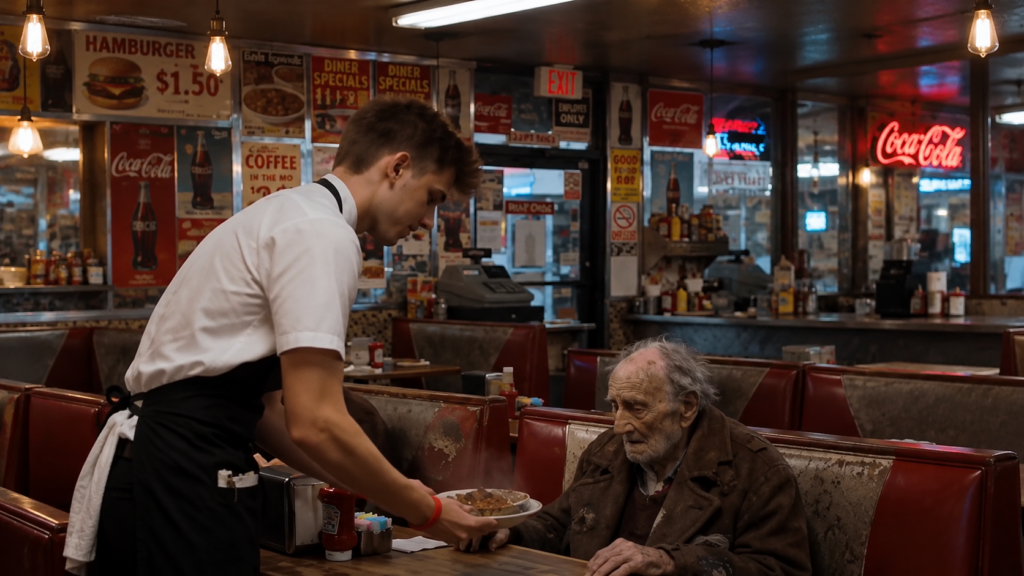
Ethan Cole knew the stew would be thrown away before he knew he was going to lose his job over it.
The restaurant closed for lunch at two, and Victor Hale required the kitchen to empty its steam table by two fifteen.
At nineteen, Ethan had learned to distinguish between the rules Victor enforced because they mattered and the rules he enforced because someone had challenged him.
A bowl of stew was sitting between those categories when the old man appeared in the back booth.
The stranger’s coat had a tear under one shoulder, and his fingers shook when he counted three coins beside the menu.
Ethan brought him water and asked whether he wanted the lunch special.
The man looked at its price and shook his head.
“I thought I could manage something small,” he said.
Ethan glanced toward the kitchen, where the final pot was cooling beside a stack of empty trays.
“We have stew,” he replied.
“I can’t pay for stew.”
“You can eat it before it gets cold.”
Ethan brought the bowl with bread and set it where the old man could reach without stretching his trembling hands.
The man stared at the spoon for so long that Ethan wondered whether he had embarrassed him.
Then he lifted it and tasted the broth.
“Someone took care making this,” the stranger said.
“Her name’s Rosa,” Ethan answered.
“You should tell her.”
Victor Hale appeared at Ethan’s elbow before he could move.
“Who authorized that order?”
Ethan looked at the bowl, the old man’s hands, and Victor’s polished shoes.
“It was going to be discarded,” Ethan said.
“That wasn’t my question.”
“Take it from my pay.”
Victor looked around the nearly empty room as though he were addressing an audience.
“My staff do not make charitable decisions with my inventory.”
Ethan knew that the pot had held enough for another six servings.
He also knew that Victor had docked Rosa’s hours when she asked why edible food went into the dumpster each evening.
“He’s eating it,” Ethan said.
“You’re fired.”
The old man placed his spoon on the saucer.
“Please don’t do that for me,” he told Victor.
“I didn’t do it for you,” Victor replied.
Ethan’s cheeks burned, but he untied his apron without begging.
He folded it twice because he did not want Victor to see his hands shaking.
Victor told him to leave through the kitchen, away from the few customers still finishing their coffee.
Ethan ignored him and waited while the stranger finished the bowl.
They walked together to the front sidewalk, where a bitter November wind pushed paper cups along the gutter.
“I’m sorry,” the old man said.
“You needed lunch,” Ethan answered.
“You needed a job.”
Ethan had thirty-seven dollars in his checking account and rent due the following Friday.
He had promised his younger sister that he could still help with the bus fare to her nursing classes.
He reached into his pocket and found six crumpled dollars.
“There’s a church two streets over that serves supper,” he said, putting the money into the man’s hand.
“This should get you there if the bus is late.
”
The stranger did not close his fingers around the bills immediately.
“What’s your last name?”
“Cole.”
“And your first?”
“Ethan.”
The man looked through the restaurant window at Victor ordering a dishwasher to wipe a clean table again.
Then he reached into a torn inner lining of his coat and removed a compact black phone.
It was newer than anything else he carried.
He dialed a number from memory and waited.
“I need you at the restaurant,” he said when the call connected.
He listened for a moment.
“Now, Miriam, and bring the blue folders.”
He ended the call before Ethan could ask who Miriam was.
“You don’t have to get involved,” Ethan said.
“I already was involved,” the man replied.
“What did you call them for?”
“Because there are six young people in that building who may be losing more than lunch money.”
Ethan turned back toward the restaurant.
The old man’s gaze followed a girl carrying a metal rack through the kitchen window.
Her name was Lacey, and she was seventeen.
For three weeks she had been introduced to customers as a trainee from the culinary school, although Ethan had never seen anyone teaching her.
“How do you know about Lacey?” Ethan asked.
The stranger slipped the phone back into his coat.
“I was supposed to meet her here this afternoon.”
CHAPTER TWO — THE BLUE FOLDERS
Miriam Calder arrived in a blue hatchback with one headlight taped at the edge and a cardboard box on the passenger seat.
She was about forty, wore a wool hat, and stepped onto the pavement carrying a stack of folders tied with string.
The old man introduced himself as Walter Finch.
Miriam shook Ethan’s hand and looked at the restaurant’s entrance without hiding her anger.
“Victor still has them inside?” she asked.
“Some of them,” Walter replied.
Ethan had no idea what they meant.
Miriam opened a folder against the hood of her car and showed him a photograph of six teenagers in white aprons.
Lacey stood in the back row beside a boy named Nico, who washed dishes at Victor’s restaurant every Saturday.
“They were enrolled in the Harbor Skills Kitchen program,” Miriam said.
“What’s that?”
“A paid apprenticeship for young people who haven’t had a straightforward path into work.”
Ethan saw the word paid and felt a knot form in his stomach.
Lacey had told him she was volunteering because the school required practical hours.
Nico had said something different.
He thought the restaurant was holding his wages until graduation.
“The program funds an hourly wage and an instructor at approved kitchens,” Miriam continued.
“Victor submitted certificates saying all six trainees completed a hundred and twenty hours under his supervision.”
“He doesn’t supervise anything,” Ethan said.
“That’s what we’ve been trying to establish.”
Walter leaned against the car while Miriam explained that she was the program’s field coordinator, not a police officer and not a restaurant owner.
The kitchen placements were run through a small regional training center that relied on restaurant partners because its teaching kitchen held only eight students.
Victor had been praised for accepting trainees when other restaurants declined.
The center had issued grants based on his signed attendance sheets.
The trainees themselves had received almost nothing.
“Why did you come dressed like that?” Ethan asked Walter.
Walter touched the tear in his sleeve.
“Because this is my coat.”
“You have a phone hidden in it.”
“My daughter worries when I travel without one.”
“Then what were you doing inside?”
Walter looked embarrassed for the first time.
“I wanted to see what happened to a guest who couldn’t meet the price of lunch.”
Ethan stiffened.
“You were testing us.”
“I was looking for Lacey,” Walter said.
“When Victor saw me waiting, he told her not to approach my table.”
“And you let me get fired?”
Walter did not defend himself immediately.
“I didn’t know what he would do until he did it.”
“You knew enough to bring folders.”
“I knew about the program,” Walter replied.
“I did not know you existed until you brought me food.”
The honesty sounded inadequate, and Ethan wanted him to understand that.
“Don’t turn me into a story about generosity,” Ethan said.
“I need my paycheck.”
Miriam closed the folder.
“We can help you pursue the wages Victor owes, but the first thing I need is to make sure nobody is still working here without pay.”
The kitchen door opened behind them.
Lacey appeared carrying a black trash bag nearly as tall as she was.
When she saw the folders, she dropped the bag and hurried toward the parking lot.
Victor emerged a second later.
“Lacey, where are you going?”
She froze with one hand on the car door.
Victor spotted Walter and walked straight toward him.
“I told you this morning that you weren’t welcome back,” he said.
“You told me I couldn’t speak to the apprentices,” Walter replied.
“They’re my employees.”
Miriam held out a business card.
“Then you can explain why your invoices call them grant-funded trainees.”
Victor looked at the card without touching it.
“You people keep harassing businesses that are trying to help.”
“We’re here to discuss their wages and training hours,” Miriam answered.
“Not on my property.”
Ethan stood between the curb and the doorway.
He knew he could leave, and nothing stopped him except the knowledge that Lacey would have to face Victor alone.
“Lacey,” he asked, “did he tell you not to talk to Walter?”
She glanced at Victor.
The manager’s expression did not change, but his right hand clenched around the door handle.
“He said my certificate would be canceled if I missed today’s shift,” Lacey whispered.
Miriam opened her mouth, and Victor slammed the door before she could respond.
The noise made Lacey flinch.
Walter bent and picked up the trash bag she had dropped.
The bag split along one seam, scattering clean pastry boxes into the parking lot.
Inside one box was a printed sticker naming a banquet company Ethan had never heard of.
Walter examined the sticker and frowned.
“That’s tomorrow’s event,” he said.
“What event?” Miriam asked.
“The graduation dinner.”