“Could’ve been kids,” one officer said.
“Could have,” June agreed. “I still want a report number.”
When the officers left, a few people began to gather their coats. Daniel expected the meeting to dissolve. Instead Imani placed her statement on the table and looked at everyone.
“I won’t tell anybody they have to come tomorrow,” she said. “But I’m still going.”
Nessa sat back down. She spread her kitchen diagram open and marked a dangerous crossing route in red pencil, making the evidence of her own work more precise. Rafael called his babysitter and arranged an earlier arrival. Ada, who had been quiet through the disturbance, asked where the coffee supplies were stored. She would bring a thermos in the morning, she said, but she refused to operate a machine designed by a person who apparently hated older hands.
June went to the shutter and examined the dent. Her garage insurance had a deductible she could barely afford. For a few seconds her expression hardened with anger. Then she fetched a sheet of plywood to cover the damaged panel and handed Daniel a screwdriver. They worked without speaking until the shutter was secure.
“You can still walk away,” Daniel said when they finished.
June stared at him. “From my own shop? That’s a strange suggestion.”
“I brought this here.”
“You brought a question here. Someone else threw the brick. Don’t mix up the verbs.”
She went back inside. Daniel followed, ashamed that he had again imagined himself at the center of everybody’s choices. The people gathered in the garage had arrived because their pay, hours, and safety mattered. His involvement was a circumstance, not the reason they deserved to be heard.
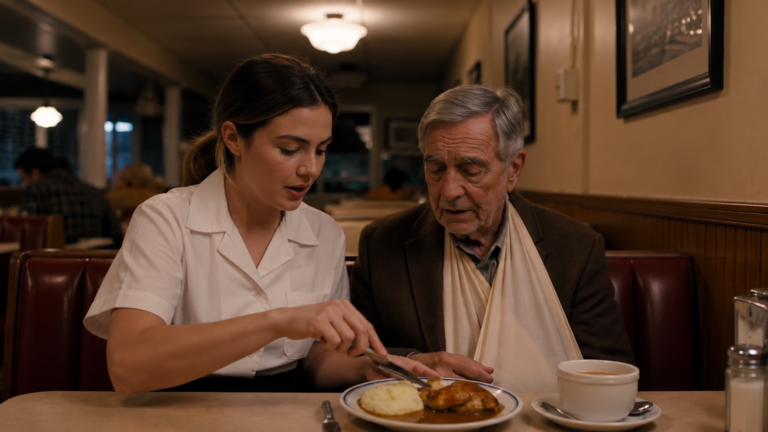
At eleven, the workers dispersed in pairs. Daniel and June walked the last few blocks with Imani, whose bus had stopped running, and waited until she entered her grandmother’s apartment building. On the walk home, June asked whether he regretted helping Marcel with breakfast. Daniel thought about the cut eggs, the small cup, and the embarrassed old man’s unsteady hand.
“No,” he said. “I regret thinking that helping him meant I understood him.”
June nodded. “That’s different.”
Chapter Eight B: Before the Doors Opened
The municipal auditorium opened at eight. Daniel arrived at seven thirty with June, who carried an envelope containing copies of the workers’ speaking schedule. The street was wet from a brief shower. Someone had placed decorative planters near the entrance, and city workers were unfolding barricades to keep the pedestrian path clear.
Anika was waiting on the steps. She told them that the concession company had filed a late statement accusing outside agitators of interfering with recruitment. The document named Daniel as an organizer with possible connections to Marcel Orsini. Anika had prepared a response but reminded him not to become distracted by accusations against himself.
“Your job is to speak about what you know,” she said. “If they want to argue about your character, they can do that without your help.”
Inside, Imani sat with her statement folded in thirds. She had changed into a neat green blouse and polished shoes that pinched her toes. Daniel asked whether she wanted to rehearse. She shook her head.
“Every time I rehearse, I sound like I’m trying to convince myself,” she said. “I already know what happened.”
A security employee directed them to seats near the back. Celia Brandt’s team had reserved the front rows, where branded folders waited on the chairs and a model of the future kitchen stood on a display table. Its tiny metal counters shone beneath the lights. Nessa stared at it and whispered, “They still haven’t changed the crossing.”
Daniel saw Kent Voss enter through the side door. The diner manager looked uncomfortable outside his usual territory. He nodded to Daniel without approaching. Several tables later, Lorna appeared with a cane she’d apparently borrowed for the morning. Ada insisted that the cane was unnecessary, and the two women began arguing about who had worse knees. Their bickering eased the tension more effectively than any prepared speech.
Then Marcel came through the auditorium doors. He was alone except for Vale, who stayed a few paces behind. People recognized him; conversations fell quiet, then resumed in whispers. He took a seat near an exit, not among the workers.
There were questions he still wanted answered about his father’s final years, about the promises Marcel had made and broken. But the hearing was beginning, and those questions were no longer urgent enough to displace the people whose work was at stake today.
Imani leaned toward him. “Do you think they’ll listen?”
“I don’t know,” Daniel said.
She drew a breath and looked at the front of the room. “Good. I was getting tired of people promising they would.”
The chair called the session to order. Daniel sat back, placed Nathan’s little knot pin inside his jacket pocket, and waited for Imani’s name to be called. When she stood, he didn’t follow. She walked to the microphone on her own feet, with a room full of people prepared to hear her.
Anika called Daniel aside before the meeting began and gave him one last practical warning. A journalist had requested interviews with Nathan’s children, and several people in the front row already knew the story they wanted to tell: a poor young waiter, an aging crime boss, a famous surname, and a dramatic reckoning. It would also leave the workers standing outside the frame.
“You can say no to interviews,” Anika said. “You don’t owe strangers the most painful part of your life.”
Daniel thanked her. He looked over at Imani, who was testing the height of the microphone with the assistance of a custodian. She was laughing at something the custodian said. Daniel realized how little he knew about her beyond the conflict: whether she liked music, whether she planned to leave the city, whether she wanted to cook for a living or simply needed the next paycheck. He knew her courage because he’d witnessed it under pressure, but he didn’t know her whole life. He hoped the people voting on her job would remember that distinction.
June joined him by the aisle. “You have a speech?”
“Two pages.”
“Then use the second page first.”
“You haven’t read it.”
“I’ve heard you explain the beginning three times.”
He folded the first page behind the second. On the front, in handwriting made uneven by a hurried train ride, he’d written one sentence that seemed clearer than all the others: A job should not require someone to buy the chance to be treated fairly.
When the clerk invited the first group of speakers forward, Daniel remained seated. Across the auditorium, Marcel straightened his coat and looked at the exit. For a second Daniel thought the old man might leave. Then Marcel placed his injured hand flat against his knee and stayed where he was.
Chapter Nine: The Hearing
The redevelopment hearing filled the municipal auditorium on Monday morning. Celia Brandt arrived with polished presentation boards and a team of consultants. Daniel came with June, Ada, Imani, Rafael, Tomas, and twenty other workers. Marcel entered separately, his injured hand tucked inside his coat.
The first hour was ordinary civic theater. Consultants described foot traffic, parking spaces, projected revenue, and the bright future of the waterfront. Celia presented the cooperative’s name as a historical tribute, emphasizing the community spirit of the old docks.
Then Imani approached the microphone.
“I was told to pay for training before I could receive a shift,” she said. “I borrowed the money. I still haven’t been paid for the hours I worked.”
A council member asked whether she had records. Imani produced the payment receipt and a schedule showing her attendance. Other workers stood as she spoke. Rafael described last-minute changes that made childcare impossible. Tomas described the uniform deductions. A representative from the labor center explained which complaints had already been filed and which questions required formal investigation.
Celia objected that these were personnel matters outside the hearing’s scope. The chair reminded her that the concession application included commitments about employment practices.
Daniel took the microphone after Ada.
“My father helped build the first Harbor Night Shift kitchen,” he said. “I came here thinking I needed to defend his name. But the people who worked there didn’t build it so their children could defend a name. They built it so a hungry person could eat and a worker could speak without being punished.”
He looked toward the presentation board showing the reconstructed communal table.
“You can copy a table. You can’t copy what happened around it by painting a logo on the wall.”
He stepped aside. Ada walked to the microphone carrying the repaired spoon.
“I cooked at that table,” she said. “And I remember who tried to close it.”
She turned toward Marcel.
The room went still.
Marcel rose slowly. Vale offered his arm, but he refused it. At the microphone he identified himself, acknowledged his role in ordering the cooperative’s closure, and described the coercion that had followed. He did not claim innocence for the fire. He did not ask the room to forgive him.