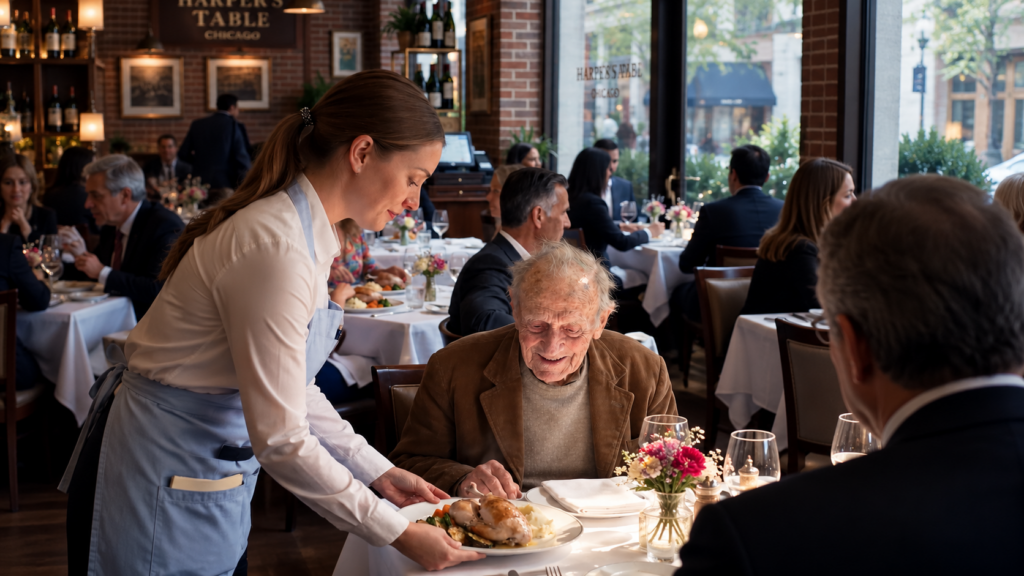
The chicken was still steaming when Calvin Rusk crossed the dining room.
Marissa knew the manager’s angry walk before he reached her table.
He moved fast when he wanted an audience and slowly when anyone needed help.
The elderly customer had taken only three bites.
His name was Walter, although Marissa had learned that only a minute earlier.
He sat near the window with a brown coat folded carefully over his knees.
His hands trembled slightly as he held his fork.
Calvin stopped beside the table and stared at the plate.
“Who authorized this?” he asked.
Marissa stood straighter.
“I did.
”
“Did he order it?”
“I gave it to him.”
“Did he pay for it?”
“I was going to cover the cost.”
Several guests turned in their seats.
Calvin noticed and raised his voice.
“You are not authorized to give food away in my restaurant.”
Walter put his fork down with painstaking care.
“I can leave,” he said.
“You don’t have to,” Marissa answered.
Calvin pointed toward the service station.
“You do.”
Marissa felt heat climb her neck.
“Calvin, we can talk in the kitchen.”
“There is nothing to discuss. You’re fired.”
An awkward stillness spread from table to table.
A server carrying two glasses paused near the bar.
The cook at the pass leaned forward, apparently unable to believe what he had heard.
Marissa looked once at the man whose lunch had started everything.
Walter’s face had gone pale.
“This is not his fault,” she said.
“I didn’t ask whose fault it was,” Calvin replied.
He extended his hand for her apron.
Marissa untied the pale-blue strings herself.
She folded the apron in three careful movements and placed it on the counter.
Her fingers were shaking by the time she finished.
The folding mattered because it gave her something to do besides cry.
Her shift had barely reached its second hour.
She had rent due on Tuesday, a grocery list at home, and a prescription waiting at the pharmacy.
Her mother, Elena, needed medicine after a complicated heart procedure.
The co-payment had increased again that morning.
Marissa had brought lunch from home so she could put the difference toward the prescription.
She could have told Calvin all of this.
He already knew she needed the hours.
“Someone else can cover your tables,” he said.
“They will need my checks transferred first.”
“Leave the checks.”
“Table nine has an allergy that isn’t on their printed order.”
“Marissa.”
She wrote the information on a notepad and set it beside the register anyway.
Then she walked out into a Chicago afternoon bright enough to make her eyes ache.
She reached the corner before checking her phone.
Her mother had sent a picture of their houseplant finally producing a flower.
Under it, Elena had written that good things sometimes took longer than expected.
Marissa sat on a low stone wall outside a bank and stared at the message.
She did not know how to tell her mother that she had lost the job.
Inside Harper’s Table, a man at table twelve pushed his chair back.
Ethan Calloway had watched the confrontation without interrupting it.
He regretted that hesitation already.
He wore an expensive charcoal suit and a watch that cost more than several months of Marissa’s rent.
He was not accustomed to being ignored by restaurant managers.
When Calvin approached, Ethan spoke before the man could ask about dessert.
“Who owns this restaurant?”
Calvin gave the question a professional smile.
“May I help you with something, sir?”
“I want to speak with the owner.”
“She’s not available.”
“Then tell me her name.”
“May I ask why?”
Ethan glanced at Walter, who had stopped eating entirely.
“Because I want to buy it.”
The words carried through the dining room.
A woman at the nearest table lifted her head so quickly that her earrings swung.
Calvin blinked.
“I’m sorry?”
“You heard me.”
“Are you serious?”
“I am serious about discussing a purchase.”
Calvin’s smile became strained.
“Our owner will be delighted to hear from you.”
“I didn’t say she would be.”
Ethan took out a card and placed it on the table.
“Ask her to call me today.”
He walked to Walter before Calvin could find another polite response.
“May I sit down?” he asked.
Walter nodded.
“The waitress was kind,” Walter said.
“I noticed.”
“They shouldn’t have done that to her.
”
“No, they shouldn’t.”
Ethan looked at the chicken and vegetables on Walter’s plate.
The meal had been prepared well, with crisp skin and fresh herbs.
He wondered how much of the work behind it was performed by people Calvin barely acknowledged.
“Would you like me to ask them to pack the rest?” Ethan said.
Walter shook his head.
“I would like to finish it here.”
“Then you should.”
Ethan settled into the chair opposite him.
He stayed until Walter finished every bite.
A few minutes later, Ethan found Marissa on the stone wall.
He introduced himself and explained that he had been inside.
“I’m sorry I didn’t speak sooner,” he said.
“That makes two of us,” she replied.
“I told your manager that I wanted to buy Harper’s Table.”
Marissa looked at him as if he had announced he planned to purchase Lake Michigan.
“You said that because you were angry.”
“I can afford to make an offer.”
“That’s not what I said.”
He hesitated.
Marissa put her phone in her pocket.
“If you buy it, who actually gets to run it?”
“I would hire competent people.”
“Calvin would describe himself as competent.”
“He wouldn’t survive my first week.”
“Someone else like him might survive the second.
”
Ethan glanced at the passing traffic.
“You don’t trust me.”
“I met you three minutes ago.”
“Fair point.”
“People with money are always promising to fix a place without asking the people who work there what is broken.”
Ethan considered that.
“Then tell me what’s broken.”
“I don’t work there anymore.”
“You did an hour ago.”
“And I spent twenty minutes of that hour teaching a new dishwasher where the clean plates go because Calvin refuses to give him a proper orientation.”
Ethan took a breath.
“Can we speak somewhere quieter?”
“You can speak.”
“I can pay you for consulting time.
”
“I can consider consulting after I find a way to pay for my mother’s medication.”
He reached for his wallet.
Marissa lifted a hand.
“Please don’t.”
“I wasn’t going to insult you.”
“People can mean well and still make you feel like a charity case.”
Ethan returned his hand to his side.
“Then what can I do that would actually help?”
Marissa stood.
“Find out how much money those people make and who gets to decide their schedules.”
She nodded toward the restaurant.
“Ask what happened to our tips during the last holiday weekend.”
“What happened?”
“That’s what you should ask.
”
“And then?”
“Then decide whether you still want to buy it.”
She left him beside the bank wall, looking more uncertain than any billionaire had looked that day.
CHAPTER TWO — NAMES ON A SHIFT BOARD
Marissa reached her apartment before three.
She found her mother sitting at the kitchen table with an envelope from the insurance company.
Elena wore a faded red cardigan even though the windows were open.
“You’re home early,” Elena said.
Marissa set her keys down.
“Calvin fired me.”
Elena closed the envelope without reading another line.
“Tell me what happened.”
Marissa did, slowly at first and then in a rush.
She described Walter’s empty stomach, the plate, and the way the whole dining room had watched her lose her job.
Elena listened without interrupting.
“Would you do it again?” she asked when Marissa finished.
Marissa considered the unpaid prescription.
“I’d do the food part again.”
“And the other part?”
“I’d make sure the manager couldn’t turn it into a spectacle.”
Elena nodded.
“That’s a practical answer.”
Marissa took the insurance envelope.
Its language was filled with percentages and phrases that disguised the simple fact that their share had increased.
She set it down before resentment could swallow her afternoon.
“I met a man who says he might buy the restaurant.”
“Did he offer you a job?”
“No.”
“Did you ask for one?”
“No.”
Elena looked surprised.
“Why not?”
“Because I don’t want my job to depend on whether he feels heroic next Tuesday.”
Meanwhile, Ethan had returned to his office in a converted warehouse overlooking the river.
His assistant, Priya Desai, was waiting with a folder for a meeting he had already missed.
“You were supposed to be at an acquisition review,” she said.
“I found a different acquisition.”
Priya watched him put his phone on the desk.
“Please tell me it isn’t another failing theater.”
“A restaurant.”
“That’s worse.”
“Probably.”
“What happened?”
Ethan told her the story without embellishment.
Priya listened through the part where he had announced his intention in front of thirty diners.
Then she took a long, disapproving breath.
“You publicly offered to buy a business before knowing whether it was for sale.”
“That’s an accurate description.”
“Did you consider asking its employees what they need?”
“One of them asked me that first.”
“Good.”
“She also asked about tip distribution.”
Priya’s expression changed.
“Then don’t make another promise until we understand the payroll records.”
Ethan sat down.
“Can we find the owner?”
“Of course.”
“Can we find out whether she’s running the place or whether Calvin is?”
“We can ask.”
“Do that first.”
Priya walked toward the door, then stopped.
“Ethan, if this is about impressing one young waitress, it will end badly.”
“It isn’t.”
“Make sure it stays that way.”











