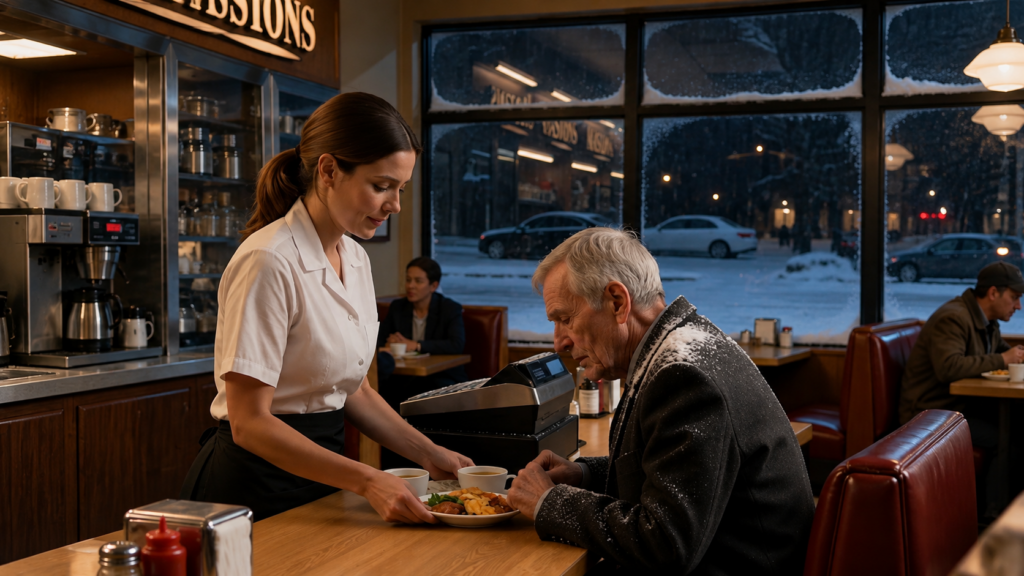
At ten forty on a snowy Chicago night, Nora Bennett counted twelve dollars beneath the counter of Mason’s Grill.
The bill was soft from being folded inside her wallet beside a picture of her eight-year-old son, Eli.
Four dollars would carry her home on the late bus, and the rest would buy milk, bread, and the inexpensive cereal he liked.
Eli was sleeping at her neighbor’s apartment two blocks from their own, where Mrs. Alvarez watched him when Nora worked nights.
Nora had promised to bring milk home before morning.
She had also promised herself that next month’s rent would be paid without another humiliating conversation with their landlord.
Outside the front windows, snow traveled sideways across the empty avenue.
The neon OPEN sign trembled whenever wind struck the glass.
Manager Curtis Shaw stood near the register, counting receipts with the grim concentration of a man who suspected every employee of stealing from him.
Nora carried two plates to the last customers and glanced at the clock.
She had twenty minutes before her shift officially ended.
The door opened so violently that its little bell struck the frame.
An older man stumbled inside, holding his coat closed with one hand.
His white hair clung to his forehead, and his trousers were wet above the knees.
He gripped the counter, tried to speak, and sank onto a stool.
Nora put down her tray.
The man’s lips were pale blue.
She brought a clean towel and placed it around his shoulders.
He looked at her with eyes that struggled to focus.
“Could I get coffee and something warm?” he asked.
“I left my wallet somewhere.”
Curtis looked up from the receipts.
“No payment, no food,” he said.
“You need to leave.”
The man tried to stand, but his hand slid across the counter.
Nora caught his elbow before he fell.
“He isn’t steady enough to go anywhere,
” she said.
Curtis approached with the register key in his fist.
“I am not running a charity, Nora.”
“Nobody said you were.”
She pulled the twelve-dollar bill from her wallet and laid it beside the register.
“I’ll pay for him.”
Curtis stared at the money, then at her face.
“You told me yesterday you needed another shift.”
“I still do.”
“Then you should understand what money is worth.”
Nora held out her palm for the change.
“I understand perfectly.”
Curtis rang up soup and coffee with deliberate slowness.
Nora carried both to the man and watched him wrap his trembling fingers around the mug.
He drank carefully, waiting for his hands to settle between sips.
She asked whether he wanted an ambulance.
He shook his head and said he had become confused after leaving an appointment.
His voice grew clearer as the warmth returned to him.
He introduced himself simply as Henry.
Nora did not press for a surname.
A person could be frightened without wanting to explain why.
When he finished, Henry asked to use the diner telephone.
Nora lifted the receiver from behind the counter and pushed it toward him.
He dialed slowly, using a number he seemed to know by heart.
“Claire,” he said when someone answered.
“I’m safe, but I need you to come.”
He listened, then gave the address.
“Come yourself, please.”
Henry hung up and thanked Nora.
He wanted to wait by the window, where he could see the street.
Ten minutes later, a compact maintenance van stopped outside.
A young man in an orange knit cap stepped inside and addressed Henry as sir.
He offered his own coat before guiding him to the vehicle.
Henry paused at the door.
“What is your name?” he asked Nora.
“Nora Bennett.”
He repeated it as if he needed to remember every syllable.
Then he disappeared into the storm.
Curtis waited until the van had gone.
“You embarrassed me in front of the customers,” he said.
Nora looked at the two empty booths.
“Nobody else was here.”
“You argued with management.”
“I bought a man soup.”
Curtis tore her weekend schedule off the noticeboard.
He crossed out Saturday and Sunday with a thick black marker.
“You can think about your attitude while those shifts go to somebody else.”
Nora stared at the sheet, calculating the money she had just lost.
She was still staring when headlights covered the windows in white light.
CHAPTER TWO — THE LEATHER CASE
Three black sedans pulled against the curb, followed by a silver Bentley that looked impossibly polished beneath the falling snow.
Curtis hurried toward the door before anyone knocked.
A woman in a navy coat entered with two security officers who kept their hands visible and their expressions unreadable.
She surveyed the counter and the empty soup bowl.
“Which one of you is Nora Bennett?” she asked.
Nora raised her hand.
The woman crossed the room without looking at Curtis.
“My name is Claire Whitmore, and I am executive director of Whitmore Industries.”
Curtis stopped smiling.
“Is there a problem with our restaurant?”
“I’m speaking to Ms.
Bennett.”
Claire looked at Nora’s apron and tired eyes.
“The man you helped is Henry Whitmore, my father.”
Nora glanced toward the street.
She recognized the name from buildings, billboards, and the business section of newspapers she read on the bus.
Henry Whitmore had funded hospitals and concert halls across the city.
His family also owned enough property that people joked he could cross Chicago without leaving his own buildings.
“Is he all right?” Nora asked.
“He’s receiving medical attention, and he insisted I come here.”
Claire set a small locked leather case on the counter.
The brass corners had scratches that made it look older than its expensive stitching.
“My father asked me to give this only to you.”
Curtis moved closer.
“If this concerns something that happened in my establishment, I should probably be present.”
Claire answered without turning.
“It concerns her choice, not your establishment.”
She placed a tiny key beside the case.
Nora made no move to touch it.
“Why would your father have something for me?”
“Because he heard you say that twelve dollars mattered to you.”
“That doesn’t explain a locked box.”
Claire’s expression changed almost imperceptibly.
“No, it doesn’t.”
She hesitated before adding that her father had insisted on bringing an object from a building that would close at sunrise.
Nora inserted the key and lifted the lid.
Inside lay a pair of white cotton gloves, a small brass winding handle, and a wooden music box with one corner chipped away.
There was also a stiff card bearing a photograph of a woman standing beneath theater lights.
The woman was laughing, her head tipped slightly back, with a microphone in her hand.
Across the bottom someone had written in ink, MARION WHITMORE, LAST REHEARSAL.
Nora looked from the photograph to Claire.
“I don’t understand.”
“Neither did I when he asked for it,” Claire replied.
Nora turned the music box carefully.
The winding hole was empty, and its lid had been repaired with mismatched screws.
A paper label on the underside read WREN THEATER, PROPERTIES, 1998.
Claire watched Nora’s hands.
“Do you know the Wren Theater?”
Nora nodded.
Her mother had cleaned costumes there before Nora was born.
When Nora was twelve, the theater held free afternoon performances for neighborhood children.
Her mother had taken her to hear a singer whose name Nora could no longer remember.
“It’s closing?” she asked.
“At sunrise, the company begins dismantling the old stage.”
“Why?”
Claire’s jaw tightened.
“Because a board committee approved a replacement production.
”
The answer sounded rehearsed.
Nora looked again at the photograph.
“What happened to Marion Whitmore?”
“She was my mother.”
Curtis made a sympathetic noise, but Claire ignored him.
“She died sixteen years ago.”
Nora closed the lid of the case gently.
“I’m sorry.”
“My father asked me to take you to the Wren tonight.”
“Why would I go?”
Claire held her gaze.
“Because tomorrow night, the theater is scheduled to present my mother’s voice to an audience of two thousand people.”
Nora frowned.
“Didn’t you say she died?”
“Yes.”
Claire looked at the music box as if it might answer for her.
“The voice they’ve prepared isn’t hers.”
CHAPTER THREE — THE VOICE THAT WASN’T THERE
Curtis stepped between Nora and the case.
“She has a shift to finish,” he said.
Nora faced him.
“You removed my weekend shifts ten minutes ago.”
“That doesn’t mean you can abandon tonight’s closing work.”
Claire asked him to give Nora a moment alone.
He began to object until one of the security officers moved toward the door and politely held it open.
Curtis retreated to the kitchen, muttering about lawyers.
Claire took off her gloves.
“There is a memorial concert scheduled tomorrow at the Wren.”
“It’s been advertised all over the city,” Nora said.
She remembered a poster on the train platform showing Marion Whitmore beneath the words ONE LAST SONG.
The poster had struck her as strange, though she had not understood why.
“The production team claims it can reconstruct Mother’s voice using recordings from her performances,” Claire said.
“They plan to project her image onstage.”
Nora rubbed the chipped corner of the music box.
“Does your father want that?”
“He approved an early demonstration.”
“And now?”
“Now he says they changed what he agreed to.”
Claire opened her phone to show Nora a video.
On its screen, a woman in a silver dress stood before a black curtain.
The face resembled the photograph in the case, although its smile never quite reached the eyes.
A clear singing voice filled the diner.
The singer delivered a line about coming home to someone she had never stopped loving.
Nora listened to the last note.
“Is that a real song she sang?”
“No,” Claire said.
“It was written last month.”
The video ended with the words WHITMORE ETERNAL EXPERIENCES.
Nora read them twice.
“That’s a product advertisement.”
Claire put the phone away.
“The company intends to sell performances based on licensed archives to other families and estates.”
“They want your mother to advertise it.”
“That is one way to describe it.”
Nora remembered a classmate who had lost his mother and kept an answering machine because her voice was still on it.
He had never let anyone record over the message.
She understood why an imitation might be both precious and unbearable.
“Why are you asking me?” she said.
“You don’t know me.”
Claire seemed relieved by the direct question.
“Father wanted somebody who hadn’t been invited to our meetings.”
“There must be a hundred people he trusts.”
“They all have something to gain.”
“And I don’t?”
Nora pointed toward the case.
“You came in a Bentley with a locked box and told a waitress her opinion matters.”
Claire looked down.
“You’re right to question it.”
Outside, the engine of the Bentley continued to idle.
Nora thought of Eli waiting for her to bring milk.
She could not accept a ride into a rich family’s argument without knowing how she would get home.
She told Claire about her son and the bus fare she no longer had.
Claire offered a ride and childcare payment, but Nora shook her head.
“I won’t take money before I know what I’m being asked to do.”
“Then I can drive you home first.”
“And the theater?”
“You can decide after you’ve seen it.”
Nora called Mrs. Alvarez from the diner telephone.
Her neighbor answered on the fourth ring.
Eli was sleeping, and she could keep him a little longer.
Nora promised to explain in the morning.
She folded her apron and placed it in her locker.
Curtis emerged carrying a trash bag.
“If you leave before the dishes are done, don’t come back.”
Nora looked around the diner she had cleaned for three years.
She thought of every time Curtis had threatened workers over a late bus or a sick child.
“The dishes are in the machine,” she said.
“And the people you threatened are the reason this place opens tomorrow.”
Curtis stared at her without answering.
Nora picked up the leather case and walked into the snow.











