A Police Chief Publicly Humiliated a Black Woman During a Traffic Stop — Three Weeks Later, Federal Court Revealed Who She Really Was
The rain had turned Route 9 into a narrow ribbon of reflected headlights when Young Jenkins saw blue lights behind her rental car.
She checked her speed and moved toward the shoulder beside a closed roadside produce stand.
The dashboard clock read 7:18 p.m.
She had been driving for almost five hours, and her shoulders ached from holding the wheel through a freezing November storm.
There had been no sudden turn, no missed signal, and no reason she could identify for a stop.
She switched off the engine, placed both hands where they could be seen, and waited.
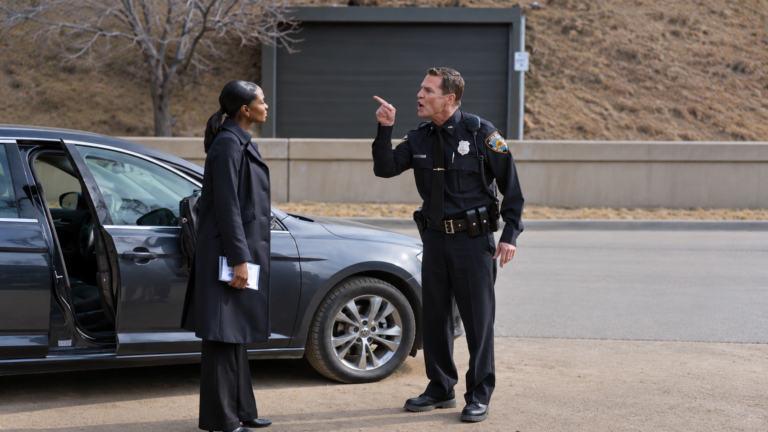
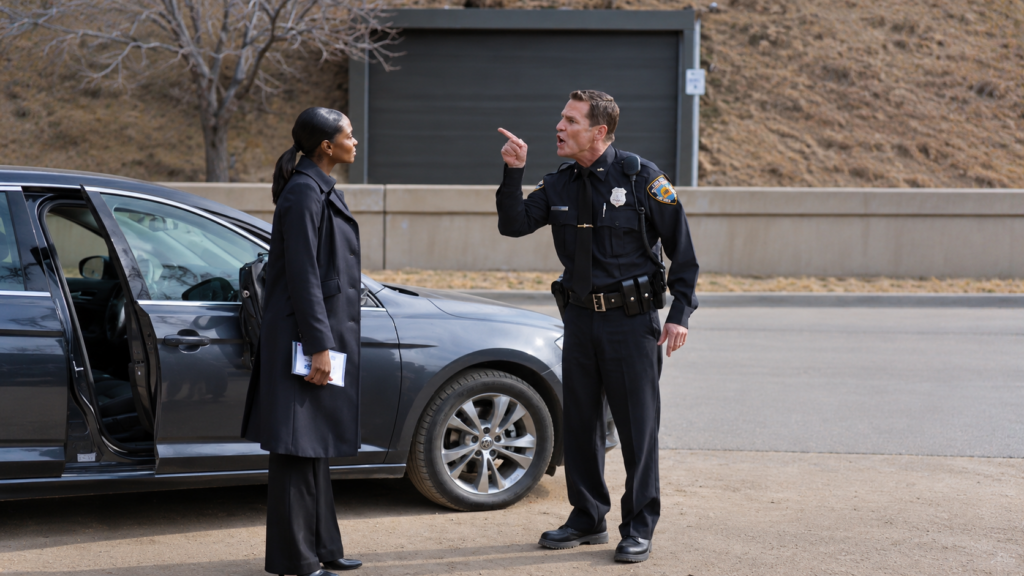
A tall officer approached her window without an umbrella.
His coat displayed four silver stars above the name Sterling.
The chief himself was making traffic stops on a miserable Thursday evening.
That struck Young as unusual, although she did not say so.
He shone his flashlight straight into her face.
“You are a long way from home, aren’t you, girl?” he asked.
Young kept her hands resting on the steering wheel.
“I am traveling for work, officer.”
“Do I look like an officer to you?”
She looked at the insignia and answered evenly.
“You are the police chief.”
“Then show some respect.”
Young gave him her license and the rental agreement she had placed in the visor that morning.
His light moved over her business blouse, her overnight bag, and the cardboard coffee cup in the console.
“What sort of work brings you to Crestwood?”
“Meetings in the area.”
“With whom?”
“I can provide the purpose of my travel if it becomes relevant to a lawful investigation.”
He stared at her, apparently offended by the precise answer.
A second patrol vehicle pulled behind his cruiser.
A young officer stepped out and hurried across the shoulder.
Sterling waved him closer.
“Hayes, watch how we handle someone who thinks she can talk her way through everything.”
The rookie’s face tightened.
Young watched him glance at the rain pouring off the patrol car’s roof.
“Ma’am, please step out,” Sterling said.
“Can you tell me the reason for the stop?”
“I don’t need to explain the obvious.”
“I would appreciate knowing the alleged violation.”
Sterling opened the door himself.
Young stepped into the cold without resisting.
He directed her to a patch of grass beside the road.
Passing tires threw water onto her trousers.
He searched the rental car while Hayes stood at the rear bumper.
Young watched Sterling remove her overnight case and set it on the wet ground.
He opened her clothes bag, shook out folded shirts, and dropped her shoes into the mud.
“There is no contraband in my luggage,” she told him.
“Did I ask for your prediction?”
He removed her travel folder from the passenger seat and examined its plain cover.
The folder held an itinerary, a personal notebook, and two restaurant receipts.
He looked disappointed when nothing more interesting appeared.
“Maybe the rental company should know how you treat its car,” he said.
Young did not respond.
There was a reason she had learned to save words for the right moment.
When she worked as a trial attorney early in her career, a supervisor had told her that silence could preserve facts more reliably than an argument in the street.
She had never imagined having to apply that advice while her socks filled with rainwater.
Hayes shifted toward the open suitcase.
“Chief, we have checked the registration,” he said.
“It comes back valid.”
Sterling ignored him.
He made Young wait while he returned to his cruiser twice.
A passing truck sounded its horn.
Sterling waved at the driver as though the roadside humiliation were an ordinary community event.
After forty-five minutes,
he pushed her documents toward her.
“You’re a nobody,” he said.
“Pick up your trash and get out of my sight.”
Young bent to retrieve her clothes.
Mud had soaked the lining of her bag.
One shoe had rolled beneath the car, and she had to kneel to reach it.
Hayes moved forward to help.
Sterling snapped his fingers.
“Leave it.”
The rookie stopped.
Young stood, her coat dripping.
“Have a good night, Chief Sterling,” she said.
“I’m sure we’ll see each other again.”
Sterling laughed.
He was still laughing when she drove away.
CHAPTER TWO: AN EMPTY REASON
Young reached a roadside hotel eleven miles farther north and locked herself in a room overlooking a dark parking lot.
The hotel clerk offered a towel when she saw the wet clothes in Young’s arms.
Young accepted it gratefully.
Her hands shook when she tried to unfasten the buttons on her blouse.
She was angry, but the shaking also came from cold and exhaustion.
A woman could understand the law perfectly and still be frightened when armed authority treated her as an object.
She called her sister, Denise, before calling anyone connected to work.
“I got stopped,” she said.
“Are you safe?”
“I’m inside a hotel.”
“Did they hurt you?”
“They made sure I knew they could.”
Denise listened as Young described the search,
the mud, and the rookie who had looked away.
“You should have told him who you are,” Denise said.
Young watched rain streak the glass.
“I was a driver on a public road.”
“That was all he needed to know.”
Her sister did not argue.
They both understood that a title could change the ending of a traffic stop without changing the wrongness of its beginning.
After the call, Young took photographs of her ruined clothing and wrote down the sequence of events while the details remained fresh.
She noted the first minute the blue lights appeared, the license plate numbers she had observed,
the officers’ words, and the positions of their vehicles.
She remembered that Sterling had never issued a citation.
She remembered that he had never identified a traffic violation.
She remembered Hayes saying the rental registration was valid.
At midnight, Young opened an encrypted work laptop and considered a name in her contact list.
David Roth had spent months preparing a federal civil-rights case involving the Crestwood Police Department.
Young had recently taken charge of a separate oversight division, and her scheduled regional visit had been known to only a handful of staff.
She had traveled in an ordinary rental sedan because she did not want local officials building a ceremonial reception around an oversight trip.
She had not intended to become an incident in the case.
That distinction mattered.
She called Roth.
He answered on the third ring.
“Director Jenkins?”
“David, something happened tonight that you need to document.”
When she told him about Sterling, he was silent for several seconds.
“Did he recognize you?”
“No.”
“Did you identify your position?”
“No.”
“Then we have a problem and an opportunity, and I want to be careful about both.”
“The opportunity is not mine to exploit,” Young said.
“I will submit a complaint like anyone else.”
“I agree.”
Roth explained that the existing case concerned alleged unlawful seizures and a pattern of retaliatory policing.
The civil hearing scheduled in three weeks was intended to consider preservation orders and interim relief, not decide every charge or hand someone a sentence.
Young knew that already, but she appreciated his insistence on procedural boundaries.
She asked him to assign another supervisor to decisions involving her complaint.
“You should not be overseeing an investigation in which you are a material witness,” Roth said.
“I won’t.”
He promised a separate intake process and advised her not to contact Hayes or Sterling herself.
“Get some sleep,” he added.
“That is not likely,” she replied.
After the call, Young opened an ordinary hotel stationery pad and wrote a sentence for herself.
The chief did not know my title, and the others did not have titles to protect them.
She placed the pad inside her suitcase and stared at the ceiling until dawn.
CHAPTER THREE: THE THREE VEHICLES
At seven the next morning, a tow truck rolled slowly through the hotel parking lot.
Young was carrying coffee to her car when she noticed its yellow lettering.
Crestwood Recovery and Storage was printed across the side.
The truck’s flatbed held a battered minivan with a child’s red mitten trapped beneath the rear wiper.
A woman ran across the lot from the breakfast entrance.
“That’s my vehicle,” she shouted.
The driver leaned out his window.
“You’ll have to call the office.”
“They told me I could pay after my husband’s shift.”
“I’m following a dispatch.”
The truck pulled away before the woman reached its door.
Young hesitated, then approached with her coffee held in both hands.
“Are you all right?”
The woman looked as if she expected another lecture.
“No,” she said.
“I have two kids and no way to get them to school.”
Her name was Marisol Vega.
She cleaned offices at night and worked a weekend shift at a grocery warehouse.
Her minivan had been stopped on Route 9 because one rear license plate light allegedly flickered.
An officer ordered a tow even though the light worked when her husband checked it afterward.
The recovery company demanded nearly six hundred dollars, including a release fee Marisol could not understand.
She had scraped together most of the money.
Then the company added another day of storage.
“Who told you the van was here?” Young asked.
“The tow office gave me this address yesterday.”
Marisol held up a card carrying the hotel’s name and the recovery company’s telephone number.
She had come to ask a manager whether the van had been delivered by mistake.
Young knew better than to promise instant help based on a stranger’s account.
Instead, she asked whether Marisol wanted contact information for the legal aid office in the next county.
“Someone already gave me a lawyer’s number,” Marisol said.
“The lawyer says the chief does this all the time.”
Young looked toward the empty space where the truck had been.
The connection to her stop could be coincidence, but her instincts warned her against dismissing it.
Later that day, David Roth called with a question.
“Did Sterling call a tow truck while he was searching your rental?”
“Not where I could hear him.”
“We have three drivers who say his officers threatened to impound otherwise operable cars.”
“I met a fourth this morning,” Young said.
“Then please send her to the independent intake line.”
Young gave him Marisol’s name only after obtaining Marisol’s permission.
She did not mention the woman’s children or work schedule in a way that would turn private hardship into courtroom decoration.
Roth described what his team had already uncovered.
Crestwood Recovery was a private firm with an exclusive towing arrangement for police-directed impounds.
The city had approved the arrangement years earlier after several roadside accidents.
Under normal rules, towing was supposed to address a specific legal or safety need.
Complaints suggested officers had stretched the reasons until almost any driver they disliked could lose a vehicle.
The suspicious part was not simply the towing company’s revenue.
A city program paid officers for additional traffic enforcement shifts using money classified as road safety reimbursements.
Some of those shifts appeared linked to impound totals rather than documented hazards.
“It is an unusual arrangement,” Roth said.
“Unusual is not proof of a crime,” Young answered.
“Exactly.”
Roth had assigned analyst Priya Nair to compare tow dispatches with patrol schedules and departmental records.
Priya wanted to know who authorized the invoices and why citizens received different explanations of the same fees.
Young kept her own role limited.
She supplied a factual statement about her stop, consented to access her rental paperwork, and returned to the oversight meetings she had originally come to attend.
When she passed Route 9 again that evening, she saw Hayes standing beside a car with its hazard lights flashing.
A mother sat behind the wheel with both hands visible.
A small boy watched from the passenger seat.
Sterling’s cruiser was parked farther down the shoulder.
Young did not pull over.
She called the incident into the independent intake line with the location and time.
An investigator could check the call without placing her in the middle of another confrontation.
She drove past the closed produce stand where she had stood shivering the night before.
She could still see her soaked suitcase lying on the ground.