Crestwood was a town of thirty thousand people, with an old textile district, a newer retail corridor, and roads that narrowed abruptly near the river valley.
Police Chief Richard Sterling had led the department for fifteen years.
He appeared in photographs beside every mayor who had served during that period.
He hosted charity breakfasts, attended football games, and spoke about respect at high school assemblies.
On Friday afternoon, he held a meeting in a basement conference room beneath police headquarters.
His deputy, Martha Quinn, sat across from him with a binder of weekly shift reports.
Bradley Hayes stood by the door.
“We have another complaint from a rental driver,” Quinn said.
Sterling did not look up.
“They always complain when they get stopped.”
“There is no citation number attached to this one.”
“Because I used discretion.”
Quinn placed a sheet on the table.
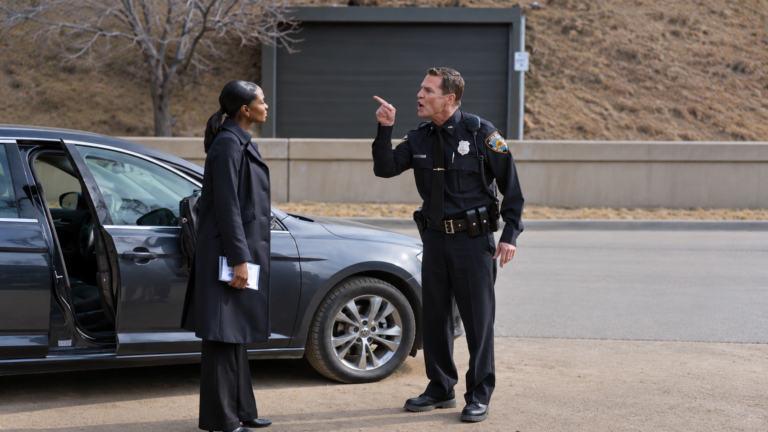
“Our records show that you searched the car for forty minutes.”
“Was there a point to the meeting?”
“Legal services wants the associated dash footage preserved.”
Sterling put down his pen.
“On whose authority?”
“The city attorney received a preservation request.”
His face hardened.
“We have our own rules for retention.”
“The request is specific.”
He turned to Hayes.
“Did you observe anything improper?”
The rookie glanced at Quinn.
“I observed the stop, sir.”
“That was not the question.”
“The driver complied with the instructions.”
Sterling leaned back.
“I see you’re becoming an expert in constitutional law after six weeks on patrol.”
Quinn intervened before Hayes could reply.
“The footage is being copied by the evidence custodian.”
“Then copy it,” Sterling snapped.
He stood so quickly his chair struck the wall.
“We are done here.”
Hayes remained in the hallway after the meeting.
Quinn joined him near the vending machines.
“You don’t have to answer questions in front of the chief without representation,
” she said.
“He was looking straight at me.”
“I noticed.”
Hayes rubbed his palms together.
“Did he have a reason to stop her?”
“I wasn’t there.”
“He told dispatch he was checking a vehicle that looked out of place.”
Quinn looked at him carefully.
“Write down exactly what you remember.”
“Do I put it in the report?”
“You put the truth in the report.”
Hayes lowered his voice.
“If I do that, I won’t be on patrol next week.”
Quinn had served under Sterling long enough to know the threat was credible.
She also knew what silence had already cost the town.
“A transfer is a possibility,” she admitted.
“But so is a federal subpoena.”
Hayes stared at the vending machine without choosing anything.
Across town, Marisol Vega and her husband, Luis, stood inside Crestwood Recovery’s office beneath a sign listing daily storage rates.
A clerk announced that their van could not be released because the police hold remained active.
“Yesterday you said the hold was gone,” Luis said.
“I can only tell you what the computer says.”
Marisol put both hands on the counter.
“My children’s seats are inside that vehicle.”
“Personal items can be retrieved by appointment.”
“We are here now.
”
“You need an appointment.”
A man emerged from the back office wearing a dark vest embroidered with the company logo.
He introduced himself as Wade Larkin, the operations manager.
“Let’s not make a scene,” he said.
Luis showed him the receipt for their payment.
“We are asking for our property.”
Larkin looked at the receipt, then at a notation on the screen.
“You owe a compliance inspection charge.”
“For what inspection?” Marisol asked.
“The one required before release.”
“Who inspected my van?”
Larkin did not answer.
Instead, he slid a payment form across the counter.
Marisol read the amount and felt the room tilt.
She had already paid the money she meant to use for rent.
Luis pulled the form away from her.
“We need the name of whoever authorized that charge.”
Larkin pointed toward the exit.
“Come back when you’re ready to follow the process.”
They left without the van.
Outside, Marisol sat on the concrete step and called the legal aid number Young had given her.
She expected a recording.
A real person answered.
That small fact nearly made her cry.
Priya Nair preferred patterns to speeches.
In her temporary office above the federal courthouse, she covered one wall with dates and the other with photographs of impound slips.
A junior analyst named Caleb Foster entered carrying a cardboard tray of coffee and a stack of municipal meeting minutes.
“I found the road safety program,” he said.
“The city called it the Safer Corridors Initiative.”
Priya opened the oldest packet.
The initiative had begun after a series of nighttime crashes near an unlit curve.
Its original budget funded reflective signs, a public information campaign, and voluntary overtime patrols.
Two years later, the program had acquired a new performance measure.
Vehicles removed from priority corridors were counted as successful hazard interventions.
The terminology seemed bureaucratic rather than sinister until Priya compared the counts with dispatch records.
Several removals occurred nowhere near a dangerous curve.
Some involved vehicles parked legally while drivers waited for roadside assistance.
Others were ordered following routine encounters that produced no citation.
“They counted a towed car the way another program might count a repaired guardrail,” she said.
Caleb examined the report.
“The mayor’s office celebrated a thirty percent improvement.”
“Improvement in what?”
“They said hazardous vehicles were being removed faster.”
“The report never defines hazardous.”
Priya circled a set of initials on an invoice.
Every month the city approved a batch of reimbursement claims submitted by Sterling’s department.
The amounts rose with the number of recorded interventions.
Overtime officers received flat payments, but an independent contractor billed a separate fee for processing the corresponding paperwork.
That contractor was not Crestwood Recovery.
Its name was Corridor Metrics LLC.
“Who owns it?” Caleb asked.
“We need a verified answer.”
They sent the question to the appropriate business registry rather than speculating from a matching surname.
Then Priya found a familiar address on the administrative invoices.
Corridor Metrics used the same second-floor office suite as a bookkeeping firm that handled Crestwood Recovery’s payroll.
“This might be legal shared office space,” she said.
“Or it might explain why the forms all look identical.
”
Caleb nodded.
The difference would matter in court.
They would need testimony about who approved what, not a dramatic arrow drawn between two companies.
Hayes lived above a hardware store at the southern edge of town.
The apartment smelled of radiator heat and the cedar soap his mother mailed every Christmas.
He had become an officer because he wanted to do useful work in a town where his father had repaired school buses for thirty years.
He had not expected his field training to include watching a woman pick shoes out of the mud.
On Sunday morning, he visited his parents for breakfast.
His father, Aaron, read the newspaper while his mother made pancakes.
“You look like you haven’t slept,” she said.
“Work has been busy.”
Aaron folded the newspaper.
“Busy with something you can tell us?”
Hayes pushed a piece of pancake around his plate.
“If your supervisor told you to do something wrong, what would you do?”
His father waited.
“It would depend on whether I knew it was wrong,” he said at last.
“I know.”
“Then you already know the first part.”
“The second part is paying the price.”
Aaron looked at his son for a long time.
“I lost a job once for refusing to certify a bus with bad brakes.
”
Hayes knew the story, but he had never asked what happened afterward.
“How long were you out of work?”
“Five months.”
“Were you scared?”
“Every day.”
His mother set down the skillet.
“We were scared too,” she said.
“Your father still had to make the decision.”
Hayes returned to his apartment and opened the notebook he had started keeping after the Route 9 stop.
He wrote down Sterling’s exact words, including the word girl.
He wrote down the way Sterling had told him not to help with the luggage.
Then he described the officer’s failure to identify a legal basis for the search.
He stopped at the paragraph about the dispatch call.
Before the stop, Sterling had told him that they were meeting a particular rental sedan because it might be associated with out-of-town agitation.
Hayes had assumed the chief meant a credible alert.
No alert appeared in the system.
He opened his department email and saw a message from the union representative offering confidential advice about the preservation demand.
He called the number and scheduled a meeting.
He did not call Young Jenkins.
He wanted to explain himself to her, but he understood that an apology delivered in private could become an attempt to influence a witness.
Instead, he wrote another line in the notebook.
I watched because I thought watching was safer than objecting.
He stared at that sentence longer than any of the others.
Marisol met attorney Nia Palmer at a small legal aid office above a pharmacy.
Nia had a soft voice and an uncompromising habit of asking one question at a time.
She explained what a federal civil hearing could and could not accomplish.
“The judge can order records preserved and may consider temporary protections,” Nia said.
“A final resolution will take longer.”
Marisol nodded.
“I don’t need a television moment,” she said.
“I need my van.”
“We will start there.”
Nia asked for documents, photographs, and every communication with Crestwood Recovery.
Luis produced the original tow receipt, the release fee, and the latest invoice.
Marisol had written dates on the backs of the forms because she did not trust herself to remember them after a double shift.
The attorney noticed that two charges were labeled with different names but carried identical amounts.
“Did anyone explain this to you?”
“They told us not to make trouble.”
“Did the police tell you why they held the vehicle?”
“An officer said our car was unsafe to drive.”
“What was unsafe?”
“He said a light was out.”
Luis leaned forward.
“I tested every light when they released us from the roadside.”
“Did you make a recording?”
“No.”
Nia made no expression of disappointment.
“Tell me who was present.”
A warehouse coworker had arrived to collect the couple and had seen the lights working.
Nia asked for the coworker’s name.
Marisol then explained that her children’s school had called twice because they missed the bus on a day she could not leave work.
She was ashamed of that detail, although she had done nothing wrong.
“The consequences are relevant,” Nia told her.
“You are allowed to describe them.”
On the way out, Marisol encountered another man waiting to speak with an attorney.
He wore a delivery uniform and carried a folder swollen with paperwork.
He introduced himself as Patrick Rios.
His truck had been towed from a parking lot while he was buying a replacement tire.
“They called it an abandoned vehicle,” Patrick said.
“I was inside the store for fourteen minutes.”
Marisol laughed once without humor.
“They called mine unsafe.”
They compared receipts.
Both carried a small stamped code in the upper right corner.
Nia glanced at the codes and wrote them down.
The marks might mean nothing more than internal accounting categories.
They might also reveal which office had created the charges.
Unlike Sterling, Nia did not pretend to know before asking.