CHAPTER 4: THE SMITHY AFTER SUNSET
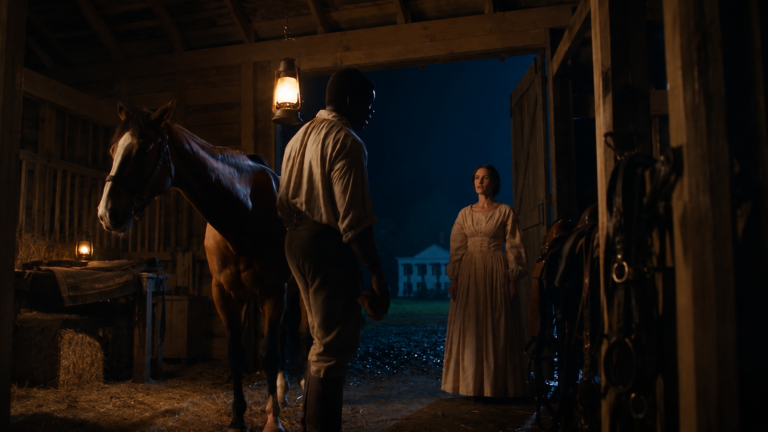
Daniel returned to the blacksmith shop by the lower pasture before sunset.
He had worked at Willow Creek for only seven months, but he knew the difference between honest ironwork and a lock designed to hide a second purpose.
The key from Eleanor’s bedroom had been made to operate a concealed bolt rather than an ordinary door latch.
He examined the matching key he had repaired for Vane and found a shallow notch along the shaft.
The notch corresponded to a spring mechanism that could release a lock without turning the handle.
Someone with the proper key could open Eleanor’s room without making the familiar sound of a lock turning.
Daniel considered telling the local sheriff immediately.
He had met Sheriff Nathan Price once after a theft at the feed store.
The sheriff had been polite until Richard entered the room, and then his attention shifted toward the landowner.
Daniel decided that evidence would be more useful than an unsupported accusation.
He placed Lydia’s letters beneath a piece of slate and heated a spare length of iron.
The steady work helped him think through the details Eleanor had given him.
Two messages had reached two different people without either knowing who sent them.
The hidden compartment had been opened recently,
yet Lydia’s older letter remained inside.
The person who marked the door might have wanted Daniel to find it.
That person might also have wanted Vane to discover Daniel beside Eleanor’s bed.
At dusk his apprentice, fifteen-year-old Jonah Reed, arrived carrying a sack of coal.
Jonah said a rider had stopped at the shop an hour earlier.
The rider had asked whether Daniel intended to stay employed at Willow Creek.
Daniel asked for a description.
Jonah described a gray beard, a dark coat, and a horse with an unusually white left ear.
Daniel recognized the horse as belonging to the county surveyor,
Benjamin Rusk.
Rusk had been dismissed from Willow Creek after a disagreement over the northern boundary.
He had since been seen at the courthouse arguing about missing land records.
Daniel asked whether Rusk had left anything.
Jonah produced a small folded map marked with the outline of Willow Creek Ranch.
A red cross stood beside an abandoned mill near the southern creek.
Across the bottom was a sentence written in a careful hand.
The sentence instructed Daniel to ask who paid for the bridge that no longer existed.
Daniel placed the map beside Lydia’s letter and compared the ink.
He could not identify the writer,
but the paper smelled of the same cedar oil used in the Whitmore library.
He told Jonah to close the forge early and go home by the main road.
Jonah resisted because he wanted to help.
Daniel said helping sometimes meant remaining out of danger until the truth was known.
After Jonah left, Daniel saddled his horse and rode toward the abandoned mill.
A mist had settled over the creek, and frogs called from the reeds.
He found the remains of an old bridge almost hidden by willow branches.
One stone support bore an engraved date from eleven years earlier.
Another carried initials that matched Lydia’s family name before her marriage.
Daniel knelt to examine the mortar.
He found an empty space beneath a loose stone and pulled out a small tin containing three pages from a ledger.
The pages recorded payments to men hired to divert water around a road that existed only on old maps.
One payment had been authorized by Richard Whitmore.
Another had been witnessed by Thomas Vane.
The third carried a signature Daniel recognized from his own childhood.
It belonged to his father, Jacob Hayes.
Daniel had believed his father died without ever working for the Whitmores.
For a long moment he remained on the wet bank listening to the current.
Then a horse snorted somewhere behind him.
A man emerged from the trees with a lantern and a rifle hanging at his side.
Daniel turned and saw Benjamin Rusk standing beside the ruined bridge.
Rusk said he had waited years for someone to follow the map.
He added that Daniel’s father had not signed the ledger willingly.