CHAPTER 23: THE HEARING
The first hearing took place in a crowded county room rather than a grand courtroom.
Farmers stood along the walls with hats in their hands.
Richard arrived wearing a dark coat and an expression of injured dignity.
Marsh sat beside him with a stack of papers tied in green ribbon.
Abigail Mercer represented several families challenging the old boundary and the accounts used to seize their property.
She also presented Eleanor’s petition concerning the intercepted correspondence and the threatened search of her rooms.
The presiding judge made clear that the hearing would not decide every allegation that day.
Its immediate purpose was to preserve evidence and determine whether an independent inspection was warranted.
Mercer began with Rusk’s original survey measurements.
Rusk described the old creek bed, the moved boundary pins, and the altered county copy.
Richard’s attorney suggested that changes in the watercourse explained the discrepancy.
Rusk answered that seasonal flooding did not explain forged signatures or boundary stones placed in dry soil.
He presented dated field notes that identified the original measurements.
Hannah Cole then described the accounting entries she had copied while employed by Richard.
She distinguished what she had witnessed directly from what she later suspected.
Mercer showed the judge examples of loans recorded as unpaid after receipts confirmed settlement.
A farmer named Isaac Morton stood and identified the receipt he had received from Vane seven years earlier.
He explained that his family lost access to the southern spring after being told the loan remained outstanding.
Richard’s attorney objected that the receipt was not part of the present petition.
The judge accepted it provisionally as evidence supporting the need to preserve records.
Eleanor testified after lunch.
She described the blue ribbon, the strange key, the concealed wall, and the bundle of letters found in the archive.
She explained that Richard had asked her to sign a statement admitting a condition she did not believe she suffered.
She also described his threat to close the estate gates.
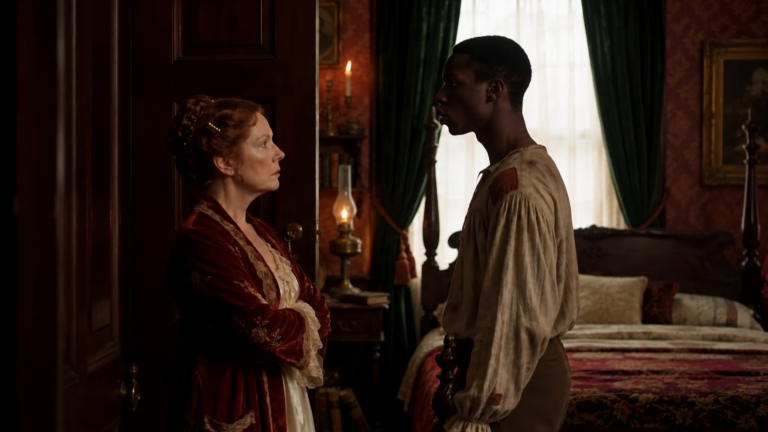
Richard’s attorney asked about Daniel’s visit to her bedroom.
Eleanor answered with the exact reason for the repair and identified Ada as the housekeeper present nearby.
The attorney suggested that her personal attachment to the blacksmith colored her judgment.
Eleanor said her feelings about Daniel were irrelevant to whether a special key existed and whether her correspondence had been hidden.
She handed the judge the intercepted letters with their original envelopes.
She explained that Catherine could confirm writing one of them.
The judge instructed the attorney to confine further questions to facts connected with the applications before him.
Daniel testified about the unusual lock and his father’s forged signature.
He did not describe private conversations with Eleanor beyond those necessary to explain the repairs.
Martin Vale presented his old construction drawings showing the archive and the ventilation passage.
He said the hidden opening could be used to observe the western hall.
He could not confirm who had used it in recent years.
The judge questioned Vane about the special keys.
Vane admitted that spare keys existed but said he kept them only for emergencies.
The judge asked why one had been found beneath Eleanor’s mattress.
Vane said he did not know.
The judge then asked whether he had ordered the stable floor altered after receiving notice of the property dispute.
Vane said he ordered general maintenance.
Mercer produced Caleb Wynn’s statement and the stable hand’s description of late-night work.
The judge announced that an independent inspection would be authorized and that no further alteration of the feed room could occur without approval.
Richard leaned toward Marsh and whispered something that made the adviser lower his eyes.
Mercer asked that the old archive be preserved as well.
The judge granted that request after reviewing the concealed letters and construction plans.
Eleanor listened to the order with a cautious sense of relief.
The hearing had not proven what happened to Lydia.
It had only stopped Richard from destroying important spaces while the questions were investigated.
That was enough to change the balance of power.
For the first time, the Whitmore estate was required to answer questions from people who could not be dismissed by a steward’s notebook.