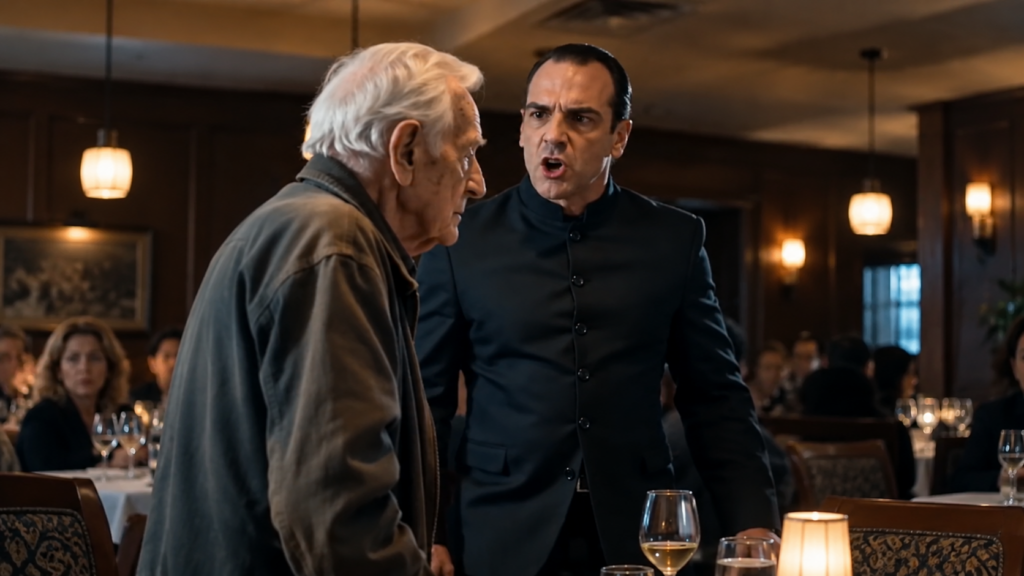
Ethan Cole first noticed the old man because he kept moving his fork without taking a bite.
The bistro window reflected a slow parade of headlights moving along Mercer Street.
Outside, November rain collected in the seams of the sidewalk.
Inside, the dining room smelled of browned butter, pepper, and the expensive candles Victor Hale insisted upon lighting even when the electric bill was overdue.
The man had ordered chicken, potatoes, and a glass of water.
His jacket was clean but frayed near the cuffs.
He had been sitting alone for nearly an hour.
When Ethan brought the check, the man opened a worn leather wallet and counted a few bills under the table.
His fingers stopped at the final note.
He looked toward the kitchen, then toward the door.
Ethan recognized the expression before the stranger said a word.
He had worn it himself at a pharmacy counter two winters earlier.
“I’m a little short,” the old man admitted.
“How much?” Ethan asked.
“Seven dollars and forty cents.”
Ethan glanced toward the service station.
Victor stood beside the register, checking a reservation list with the sharp concentration he usually reserved for finding fault.
Ethan slipped his own cash into the check folder.
“You’re covered,” he said.
The stranger studied him.
“I didn’t ask you to do that.
”
“I know.”
“You’ll need that money.”
“Probably,” Ethan said.
“But you’re not walking out of here feeling ashamed over seven dollars.”
He closed the folder before the man could protest again.
Victor caught Ethan at the register.
“What did you just do?” he demanded.
“I paid the balance.”
“With whose permission?”
“My own.”
Victor took the receipt and held it up where the tables near the bar could see.
“We are not a charity, Ethan.”
“I didn’t ask the restaurant to pay.”
“You interfered with a customer’s bill.”
“The customer paid, and I covered the difference.”
Victor’s jaw tightened.
He was a handsome man in his forties who had learned to make ordinary reprimands sound like verdicts.
“Take off your apron,” he said.
Ethan stared at him.
“You can’t be serious.”
“You’re done.”
The kitchen door swung open behind them.
Line cook Marta Ruiz stopped with a pan in her hand.
Busser Levi Price froze beside a tray of glasses.
A woman near the window lowered her menu.
Ethan could hear the rain ticking against the glass.
He untied the apron carefully because his hands had begun to shake.
“You are firing me because I used my own money?” he asked.
Victor smiled at the room, as if this were a demonstration everyone had requested.
“I’m firing you for thinking rules don’t apply to you.
”
Ethan folded the apron once.
He folded it again.
He set it beside the register.
The old man closed his wallet with a dry snap.
When he stood, his back straightened in a way Ethan had not expected.
“Sir, this doesn’t concern you,” Victor said.
The stranger did not look at him.
He took a phone from inside his jacket and dialed a number without searching his contacts.
Someone answered almost immediately.
“This is Gideon Mercer,” he said.
“Close this restaurant tomorrow morning.”
The color drained from Victor’s face.
The old man listened.
“Yes,” he said.
“The existing order permits a temporary suspension pending review.
”
He ended the call and placed the phone on the table.
“Now,” he said to Victor, “I believe you have some explaining to do.”
CHAPTER TWO: THE MAN WHO COULD CALL
Nobody moved for several seconds.
The woman near the window slowly put down her water glass.
Victor took one step toward the old man and then stopped.
“Mr. Mercer,” he said, “this is an internal staffing matter.”
“You made it a public spectacle,” the stranger answered.
“That was your decision.”
Ethan looked between them.
He knew the name Mercer from the street outside, but half the buildings downtown carried names from families long dead.
Gideon Mercer appeared to be in his seventies.
His blue eyes were alert, his hands unsteady, and his shoes worn at the heels.
“You’re making a mistake,” Victor said quietly.
“I made a mistake when I believed your last compliance report,” Gideon replied.
Victor glanced toward the dining room.
“We should discuss this privately.”
“You have been asking everyone else to speak privately for months.”
Marta stepped out of the kitchen.
“What compliance report?” she asked.
Victor pointed at her.
“Get back to work.”
Gideon raised his hand.
“She may stay wherever she chooses.”
Ethan felt the unpleasant sensation of becoming an object in an argument whose history he did not know.
“Who are you?” he asked.
Gideon looked at him at last.
“I’m the independent receiver appointed to supervise this business while its ownership dispute is resolved.”
Ethan knew what a receiver was only in the vaguest sense.
Gideon explained that the bistro’s finances and operations were being supervised under a court order after its former partners accused one another of diverting customer deposits.
“Victor still manages daily service,” Gideon said.
“He doesn’t have the authority to hide operational decisions from me.”
“One firing doesn’t close a restaurant,” Victor snapped.
“No,” Gideon said.
“One firing doesn’t.”
He turned toward the tables along the northern wall.
They were set for tomorrow’s private dinner, with black place cards already tucked into brass holders.
“But tomorrow’s memorial event does,” he continued.
Victor reached for the cards.
Gideon stopped him with a glance.
“I have asked twice for the attendee list and the consent records.”
“The event is private.”
“The deposit money is held under a court-supervised account.”
“You have no idea what you’re stopping.”
“That’s precisely the problem.”
A woman at the front table stood.
“My family booked two seats for tomorrow,” she said.
“Is our dinner canceled?”
Gideon answered gently.
“No decision about your money has been made.
”
“I have requested that the premises remain closed to service while we establish what people were promised.”
The woman looked at Victor.
“You told me the event was approved.”
Victor opened his mouth.
No words came out.
Gideon turned to Ethan.
“You have no obligation to stay.”
Ethan could still leave with his jacket, catch the last bus, and find another restaurant before the weekend.
But Marta was watching him, and Levi was watching the mysterious black place cards.
The old man’s dinner check sat on the counter between them.
“I want to know what happened,” Ethan said.
Gideon nodded.
“Then ask the question that matters.”
Ethan faced Victor.
“Whose names are on those cards?”
Victor’s expression changed from anger to something closer to fear.
CHAPTER THREE: THE EMPTY CHAIRS
The following morning, the bistro’s doors were locked.
A white notice stated that service was temporarily suspended under the receiver’s authority.
The notice promised customers an update about their reservations and deposits.
It did not accuse anybody of a crime.
Ethan arrived at eight because Marta had called before dawn.
“Victor’s inside with two men carrying boxes,” she had said.
“He says they’re removing holiday decorations.”
Ethan crossed Mercer Street beneath a gray sky.
Through the glass he saw tables stripped of linen and flowers piled on the floor.
Two men loaded black cartons onto a hand truck.
Gideon stood at the entrance with a younger woman wearing a raincoat and carrying a clipboard.
“Ethan,” Gideon said.
“This is Talia Brooks, the business administrator assigned to the receivership.”
Talia had a brisk voice and tired eyes.
She explained that the suspension applied to food service, not ordinary inventory under supervision.
“Those boxes stay until we record their contents,” she told Victor.
One of the movers put down the hand truck.
Victor held up his palms.
“They’re decorations.”
Talia opened the nearest carton.
Inside were hundreds of folded cream envelopes tied with narrow ribbons.
Every envelope bore a handwritten name.
Ethan saw one marked LUCILLE PRICE.
He looked at Levi, who had just entered through the rear door.
Levi’s face tightened.
“That’s my grandmother,” he said.
Victor snatched the envelope away.
“The cards belong to customers.”
“My grandmother died twelve years ago,” Levi answered.
“Why is her name here?”
Gideon asked everybody to stop touching the boxes.
Talia photographed their arrangement and noted the names visible from above.
Ethan watched Levi move toward a chair.
The young busser sat down hard.
“My mother came to a dinner here last summer,” he said.
“Victor told her it was a remembrance evening.”
“He said the restaurant would collect stories from families and give them a printed book.”
“Did she receive it?” Talia asked.
Levi shook his head.
“She got an invitation for tomorrow instead.”
“It said she could finally hear what the neighborhood remembered about Grandma.”
Ethan studied the envelopes.
The handwriting was elegant and consistent, with the same curling capital letters on every name.
A memorial dinner was not suspicious on its own.
Families gathered around restaurant tables to remember people all the time.
But the cartons contained enough invitations for a banquet hall, not a forty-seat bistro.
“Where are the books?” Ethan asked.
Victor said nothing.
Marta pointed toward an office behind the kitchen.
“I saw printing samples two weeks ago.”
“Victor told us they were menus.”
Talia followed her.
Inside, a machine stood beneath a dust cover beside stacks of pale paper.
The sample on top contained a paragraph attributed to a woman named Helena Marsh.
It praised the planned conversion of the old Eastbank Recreation Center into private offices.
Ethan read the paragraph twice.
It did not sound like a memory of a loved one.
It sounded like a political statement wearing a memorial’s clothing.
Gideon read it without speaking.
Then he called Talia into the hall.
Their conversation was brief.
When Talia returned, she asked Victor a question that made his shoulders sag.
“Who authorized you to attach these families’ names to a redevelopment campaign?”











