The woman arrived at 7:14 on a Saturday morning, carrying a black garbage bag that knocked against her knees with every step. From the living room, Mara Ellison would later remember the silence of the street more clearly than the sound of the trash hitting the pool. There had been no shouting, no car door slamming, no warning. Just the chime of a security alert, followed by the sight of someone doing something so outrageous that Mara’s first impulse was to doubt her own eyes.
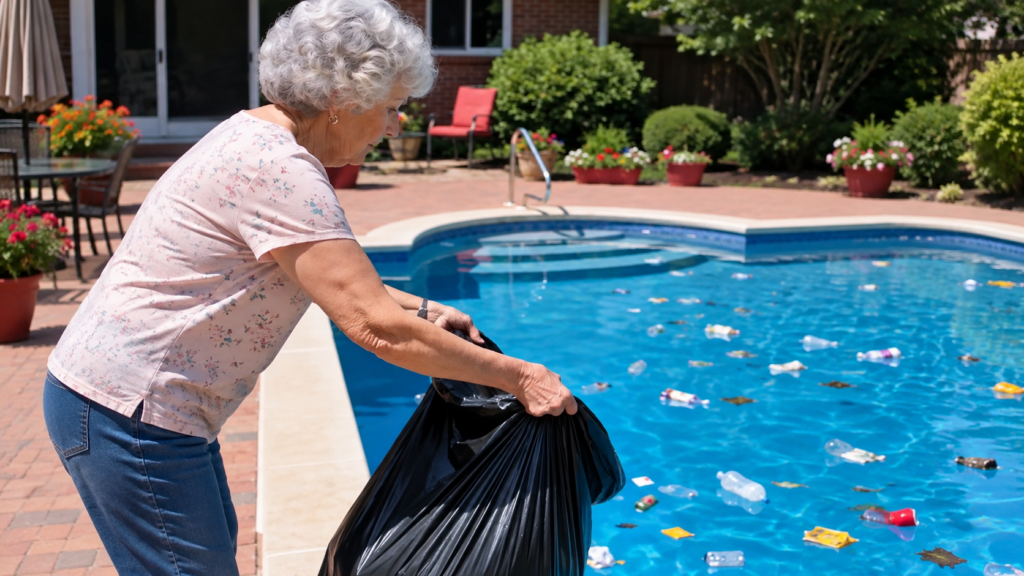
The woman was Edith Voss, seventy-one, who lived in the pale yellow bungalow behind the Ellison property. Edith wore her usual olive raincoat despite the warm weather. Her silver hair was arranged in the careful roll Mara had seen every Wednesday at the grocery store. With both hands, she lifted the bag and shook a stream of cartons, empty cans, greasy wrappers, and paper cups across the surface of Mara’s swimming pool.
An orange carton drifted beneath the diving board. A collapsed coffee cup sank slowly near the steps. Edith stood still until the last wrapper floated free. Then she looked directly toward the corner of the house where the security camera was mounted. She held that look for almost three seconds, long enough for Mara to recognize that this had not been an accident.
Mara did not go outside. She replayed the clip at half speed, not because she needed to identify Edith, but because something about the entrance bothered her. Edith had come through the side gate without touching it. That gate had a spring latch that clicked shut every time. Mara checked it twice every evening because the dogs sometimes raced through the yard before she could catch them.
In the footage, the gate hung open by four inches before Edith appeared. A small wedge of yellow foam held it there. Mara hadn’t put that wedge in place. Edith hadn’t brought it in. Somebody else had opened the gate first.
From the hallway came a soft metallic scrape.
Mara muted the video. The noise sounded again, this time from the laundry room that connected to the garage. Seven dogs were asleep in the converted sunroom beyond it, or at least they should have been. Mara had volunteered to foster former racing greyhounds for three years, but she had never agreed to keep seven at once until a transport company shut down unexpectedly on Thursday. The local rescue group, Second Mile, had needed somewhere secure while its coordinator negotiated temporary boarding space.
She crossed the room without switching on the lights. Through the interior glass she saw six lean bodies rise from their blankets. The seventh bed was empty. The dog missing from it was Cedar, a brindled male who had never barked in the three days he’d lived with her. He had a crooked foreleg, a small white patch beneath his chin, and a gift for opening gates with his narrow nose.
Mara heard the garage door chain rattle. She slid the deadbolt on the hallway door, took two steps backward, and dialed the emergency number. She spoke quietly: there was someone inside her garage, and the person outside dumping garbage appeared to be distracting her.
The dispatcher asked whether she was alone.
“My nephew is upstairs,” Mara answered. “He’s eleven. The dogs are in the sunroom. I can see an intruder through the laundry room window.”
She couldn’t actually see a face yet. Only a moving shadow, the edge of a boot, and a hand reaching through the narrow opening between the garage shelves. She could see enough to know that the person was not looking for a wallet, a television, or anything else a burglar might ordinarily want. He was reaching toward the row of folded dog crates.
Mara sent a message to her nephew: Stay in your room. Lock the door. Don’t come downstairs until I call you.
The three dots appeared immediately. Then: Is it about Cedar?
Mara’s stomach dropped. She tapped: Why would it be about Cedar?
Before her nephew could answer, a metal crate crashed in the garage. All six dogs sprang to their feet. The man cursed, suddenly loud enough for Mara to hear him through the glass. Edith was still visible on the phone feed, walking slowly away from the pool, as if she had been instructed to make the performance last.
Mara switched on the laundry-room light. The man froze. She raised her phone so he could see that she was calling for help, then shouted through the locked door: “Leave. Right now.”
He was tall and wore a charcoal work vest with no company name. A canvas leash hung from his wrist. His expression changed when he saw her, and Mara realized he had expected her to be outside confronting Edith. Instead, he backed toward the side exit. At the last moment he grabbed the nearest dog crate, but it caught on a stack of detergent boxes and tipped sideways. He abandoned it and fled.
A van engine started in the alley. By the time Mara reached the sunroom, Cedar was standing beneath the kitchen table, trembling so hard that his tags clicked against the chair leg. He had not been taken. He had escaped his bed and hidden when the intruder tried to lift him.
Only then did Mara allow herself to feel afraid. Someone had entered her property for a dog, and a woman she knew had made sure the camera would record her doing the wrong thing in precisely the right place.
2. Seven Names on Blue Collars
The first officer arrived eight minutes after Mara’s call. Her name was Officer Keene, and she listened without interrupting while Mara described the gate wedge, the van, the crates, and the deliberate trash dumping. A second officer checked the alley. Edith had returned home and shut her curtains. The van was gone, leaving a pair of narrow tire tracks in the loose gravel beside the fence.
“I can show you the video,” Mara said.
“We’ll take it,” Keene replied. “But tell me about the animals first. Did you receive threats?”
Mara shook her head. “The group has been getting unpleasant messages online. People say greyhound rescue groups take dogs from the people who raised them. That’s not what happened here. These dogs were transferred after a kennel surrendered them.”
Cedar nudged her hand, forcing her to look down. She stroked his ears automatically. Across the room, a pale fawn female named June was trying to climb onto a chair too small for her. A black male called Ledger stood beside the water bowl, waiting politely for the others to finish. Pumpkin, a red brindle with a shaved patch on her side, rested near the air vent. Tully had a white muzzle, Patch wore a blue collar with a damaged clasp, and Iris would not come close to anyone wearing heavy boots.
Seven names. Seven ordinary, frightened animals. Each had arrived with a vaccination record and enough food for three days. None had come with an explanation for why a stranger would want them back.
Officer Keene examined the yellow foam wedge recovered from the gate. It had been cut from the corner of a thicker mat. Nothing about it identified a person. What mattered was that its placement showed preparation. Mara noticed Keene looking at the camera angle on her phone.
“She knew exactly where to stand,” Mara said.
“Possibly,” the officer replied. “Or somebody told her. We’ll speak with her. For now, no one visits these dogs without us knowing about it.”
Mara called Second Mile’s director, Nisha Patel. Nisha was at a veterinary clinic forty miles away, arranging examinations for two other dogs from the same surrender. She stopped speaking when Mara explained the garage intrusion.
“The crates?” Nisha asked. “He went for the crates, not the animals?”
“He tried for both. Why?”
“Because whoever sent him knew the dogs would resist strangers. Crates make them easier to move. Mara, keep the collars on. I’m coming.”
Mara asked what Nisha wasn’t saying.
“I don’t know yet. Don’t let the names get changed.”
By noon, Mara’s nephew Owen had come downstairs and confessed the meaning of his earlier message. He had heard a van outside before the garbage appeared, and through his bedroom window he had seen a man examining a phone. The screen displayed a photograph of Cedar.
“I thought maybe somebody was adopting him,” Owen said. “I wasn’t supposed to be looking out, but he kept pointing at our house.”
“You did the right thing telling me,” Mara said. “Next time, tell me immediately.”
“There won’t be a next time, right?”
Mara wished she could promise. Instead she told him to help her carry fresh towels to the sunroom.
The pool looked terrible. Mara watched the trash drift around in slow circles from behind the glass doors, too occupied with the dogs to attempt cleaning. A white cup had lodged in the skimmer. The orange carton had become waterlogged and tilted upright like a little boat. Her neighbors, summoned by the police vehicles, peeked over their fences. Some whispered that Mara must have provoked Edith. Others asked whether Edith had lost her mind.