Alden finally nodded. His face suggested that nothing in his life had prepared him for a day when so many people expected an answer from him at once.
The following afternoon, the louvers moved for the first time with everyone standing clear. The counterweight descended slowly, stopped against its new brake, and lifted again when Aaron released the handle. Daniel asked Ruth to test it. She did, then called Jonas to try. Each person operated the brake while the others watched the mechanism rather than the person giving instructions. The first successful test was quiet. No applause followed. The workers simply returned to their tasks, having seen that the machine could be stopped by the people required to use it.
Daniel walked back toward his workshop, carrying the worn brass pin that had survived the midnight accusation. He had recovered it from Mercy, who had kept it despite his warning. He would replace it with a better one and use it in a drawer that needed mending. The pin was an ordinary object again; he preferred it that way.
Before the final test, Nell asked the youngest apprentice to identify the stopping lever with his eyes closed. Aaron laughed at the request, then discovered he had reached for the wrong handle. Nobody mocked him. Nell moved the handles farther apart and wrapped the brake grip in coarse cloth so it could be recognized by touch.
They repeated the lesson until he found it without hesitation. Ruth watched the exercise from the doorway and asked that the women who carried the drying baskets be taught as well. Daniel saw Alden prepare to dismiss the suggestion. Instead of arguing on anyone’s behalf, Daniel placed his tools down and waited. One by one the basket carriers walked to the frame, tried the release, and explained what they would do if the carriage jammed while a load was inside. Their questions exposed two narrow places in the walkway that Daniel had never noticed from his workbench. He moved the supports before the final load test.
The smallest correction came from a woman named Esther who had been carrying tobacco through that doorway for eighteen years. She knew exactly where a shoulder would strike the frame in darkness. Daniel marked her suggested clearance on the post, and Nell widened it before lunch.
10. THE BENCH
Three days later, Daniel returned to the woodshop at daylight. His chain was gone, but he still belonged to an estate whose rules could shift with its owner’s temper. The threatened sale had been canceled. The changed conditions would need more than promises to last. Daniel knew that one stopped catastrophe was not the end of a system built to produce new ones.
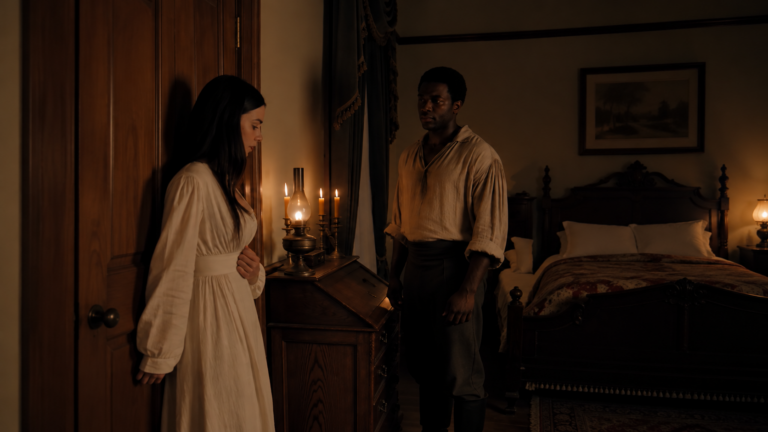
He found his cabinet where he had left it, the left drawer resting on the bench. The pale sawdust beneath it had been swept away. One of his brass hinge pins was still missing. He selected another pin from the tray and fitted the drawer carefully, testing its movement until it slid without sticking.
Ruth entered carrying bread wrapped in a cloth. “They want you at the drying house.”
“I know.”
“You are going?”
“After breakfast.”
She looked at the cabinet. “The lady’s furniture?”
“A cabinet for the laundry room. Mercy asked for it last month.”
Ruth set down the bread. “You could leave it unfinished.”
“I could.” Daniel pushed the drawer closed. “But Mercy needs a place where the children can keep clean shirts away from the dust.”
Ruth smiled for the first time in days. Together they carried the cabinet across the yard. Mercy met them at the laundry door and cleared space beside the window. Daniel set it level with a folded wedge of scrap walnut. A child opened the drawer, shut it, and opened it again, delighted by the ease of its movement.
That afternoon the rebuilt frame was laid out on the ground rather than raised above anybody’s head. Daniel insisted that every operator handle the release before a single weight was lifted. They tested a lever with no load, then with a small load, then with more. When a pin showed a hairline crack, an older field worker named Jonas held it up and refused to proceed. Alden watched in silence while the part was replaced.
The work went slowly. For once, slowness was allowed to count as care rather than disobedience.
At sunset, Daniel walked past the empty gallery and stopped beside the loading pit. Wind moved through the drying-house windows. He looked at the ground where Pike had stood with a pistol, then at the place where Aaron had helped a stranger to his feet. The world had not transformed overnight. Daniel had no reason to believe tomorrow would be easy. But he had seen people refuse to let one man’s fear decide everyone’s fate, and he had seen that refusal make a difference.
Ruth called his name from the path. Supper was ready. Daniel put down the measuring rule, closed the workshop door, and went to join her before the food grew cold.
The End.