The auctioneer laughed when only one bidder raised her hand for Elijah Carter.
“Thirty-five dollars for him?”
The crowd joined in, delighted to discover somebody apparently foolish enough to purchase a man who walked with a pronounced limp.
Elijah stood beneath the Georgia sun with his shoulders still and his hands open.
His shirt had torn along one shoulder during the morning inspection.
A bruise marked the side of his neck where a guard had pulled him away from another buyer.
Catherine Whitmore raised her hand again.
“I said thirty-five dollars.”
The auctioneer gave her a theatrical bow.
“Then the gentleman is yours,
Miss Whitmore.”
The word gentleman drew another round of laughter.
Elijah looked at Catherine as the auctioneer closed his ledger.
For an instant, she saw recognition in his expression, followed by something more difficult to understand.
He looked relieved, but he did not look grateful.
Catherine was twenty-four, newly returned to the plantation her father had left her, and thoroughly unprepared to manage the ugliness of owning it.
Her father had died three weeks earlier after a fever that had emptied the great house of sympathy long before it emptied his lungs of breath.
His younger brother, Ambrose Whitmore, had already begun speaking of debts and necessity.
He had insisted that the household’s enslaved workers should be sold in groups as soon as a judge confirmed the estate accounts.
Catherine had refused to authorize a sale, but Ambrose controlled the papers and the creditors knew his name.
At the auction, she had seen Elijah turned around like a damaged horse and refused by men who wanted cheap strength.
Then he had met her eyes.
She had purchased him before considering how easily a moment of indignation could become another form of power over a stranger.
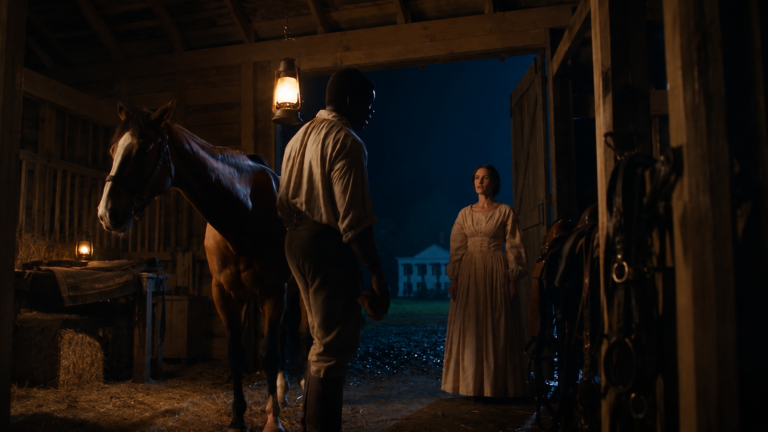
On the ride home, Elijah sat opposite her in a wagon beside three sacks of flour.
He watched the road more closely than the house approaching at its end.
Catherine finally asked whether his leg needed a physician.
“It needs a night without somebody deciding how fast I ought to walk,” he answered.
She flushed and looked away.
A mile later, he asked whether her mother’s writing desk remained in the house.
Catherine turned toward him so sharply that the wagon jolted beneath them.
“My mother died when I was twelve.”
“I remember.”
“How could you know about her desk?”
“Mrs. Whitmore asked me to find you.”
Catherine stared at him.
“My mother has been dead twelve years.”
“I know how long she has been gone.”
His voice carried no invitation to pity him.
“Your father told you she died after a sudden illness, and he told the households that she had gone away to relatives before she died.”
“He told me she was buried here.”
“He told you many things.”
Catherine opened her mouth, but the wagon arrived at the iron gate before she could frame a useful question.
Ambrose stood on the steps with a walking stick and an expression of injured ownership.
He looked at Elijah and grimaced.
“You paid money for that fellow?”
Catherine climbed down.
“I did.”
“He will cost more to feed than he can produce.”
Elijah did not lower his head.
Catherine was suddenly aware of every worker listening from the porch, yard, and kitchen doorway.
“He can have food and somewhere to rest tonight,” she said.
Ambrose smiled without warmth.
“You always did mistake a household for a charity.”
He walked inside before she could answer.
Elijah waited until the front door closed.
“Do not tell him what I asked about the desk.”
“Why?”
“Because he is listening to everything else.”
Catherine followed his glance toward an upstairs window.
A curtain moved,
and the house appeared to close its eyes.
CHAPTER TWO — THE EMPTY SPACE
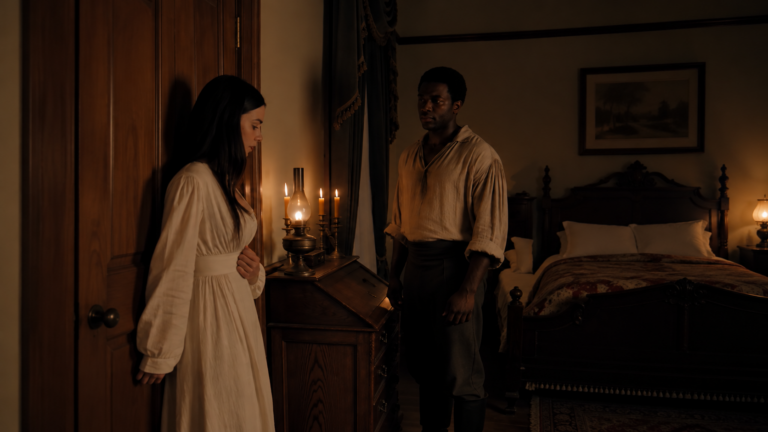
That evening, Catherine found Elijah beside the kitchen garden speaking quietly with a woman named Odessa.
Odessa was a potter who had worked at Whitmore for nineteen years, though the estate called her a kitchen hand whenever outside buyers asked about production.
Her fingers carried old burns beneath the nails.
She stopped speaking when Catherine approached.
“Elijah says there is something in my mother’s room,” Catherine said.
Odessa’s eyes moved toward the house.
“Elijah says many things only when he must,” she answered.
Catherine asked what that meant.
“It means a person ought to listen before deciding she has understood.”
Elijah stepped between them without touching either woman.
“I need to see the east wing tonight.”
Catherine knew the unused rooms had been locked for years.
Ambrose claimed the plaster was unstable and had ordered the passage sealed when she returned from Savannah.
“I can open it,” she said.
“You can bring a lamp and leave the rest to me.”
“Why should I trust you?”
“You do not have to.”
He looked past her at the kitchen, where three children were carrying firewood.
“But the people who asked me to come cannot afford another year of waiting.”
The words stayed with her through supper.
Ambrose talked about debts, weather, and the price of cotton, carefully avoiding the question of Elijah.
At nine o’clock, Catherine pretended to retire.
She took the brass key to the east passage from the household ring and met Elijah outside the old staircase.
He walked slowly, testing each board before putting his weight on it.
The east wing smelled of dust and the sharp mineral scent of old limewash.
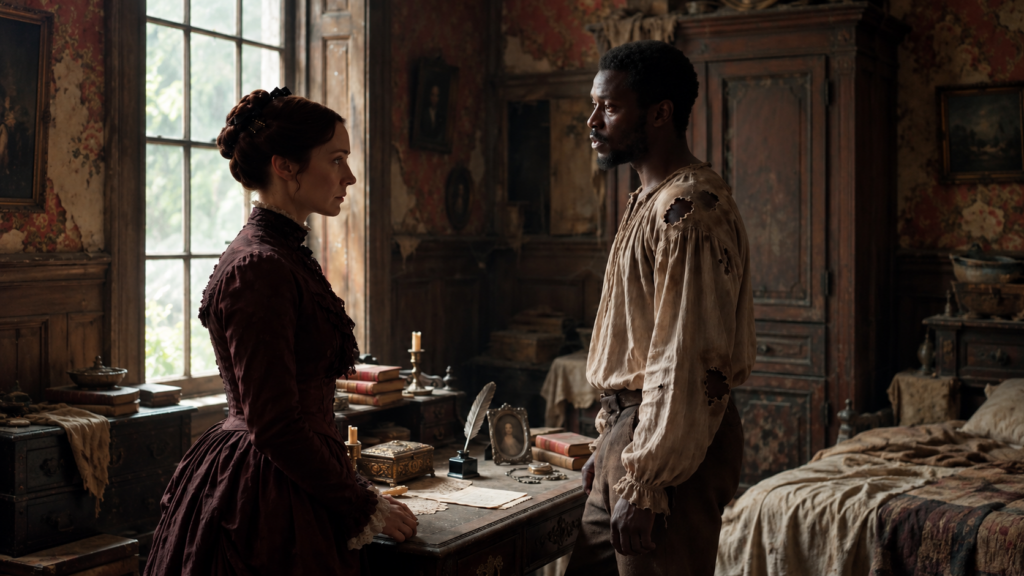
Her mother’s room remained almost as she remembered it.
A broken mirror leaned beside the hearth.
The writing desk stood against the far wall,
missing one drawer handle.
Catherine touched its edge and remembered her mother carving small spirals into lumps of clay for her to imitate.
Elijah watched the movement.
“She taught you that in this room.”
“Yes.”
“She asked you to remember which way the spiral turned.”
Catherine frowned.
“I was a child.”
“She knew you were a child.”
He knelt beside the fireplace and pressed the edge of a floorboard.
Nothing happened.
Then he reached behind the writing desk and removed a wooden peg from a narrow seam.
A hidden compartment opened beneath the paneling.
It was empty.
Catherine stared into the dust-lined recess.
“You brought me here for nothing.”
Elijah shook his head.
“I brought you here so you would see that another person has already searched it.”
There was a pale rectangle on the back wall where something had rested for many years.
Fresh scratches surrounded the wooden opening.
Catherine rubbed one with her thumb.
“These cuts are recent.”
“Somebody opened it after your father died.”
“What was inside?”
“A set of small fired pieces.”
“Jewelry?”
“Not jewelry.”
He hesitated as footsteps sounded beyond the locked bedroom door.
“Elijah, whose footsteps are those?”
He extinguished the lamp with his palm and moved away from the door.
Ambrose’s voice came through the wood.
“Catherine, I know you are in there.”
She reached for the key, but Elijah caught her sleeve lightly.
“Wait until he moves away from the latch.”
“What is he going to do?”
“He has been waiting for me to come back.”
Ambrose tried the handle.
“Open this door immediately.”
Catherine straightened.
“I’m dressed for bed, Uncle.”
“You are not in your bedroom.”
She looked at Elijah in the darkness.
The truth was now obvious.
Ambrose had watched them climb the staircase.
Elijah pointed toward an interior doorway behind the bed.
Catherine remembered that it led to the nursery and then to a narrow servants’ stair.
She turned the key as quietly as possible, keeping a hand on the door until Elijah reached the other passage.
When Ambrose entered, Catherine was standing beside the desk alone.
“You forbade me this room,” she said.
“I forbade everyone this room.”
“It was my mother’s.”
Ambrose glanced at the panel beneath the desk.
The glance lasted less than a second.
Then he surveyed the room with deliberate indifference.
“You have inherited a house full of things you do not understand.”
“That is why I came to look.”
He stepped closer.
“Your father trusted me to manage the estate, and I expect you to remember why.”
“Father is dead.”
Ambrose’s expression sharpened.
“And debts are not.”
He escorted her downstairs, keeping one hand on her elbow as though she were still twelve.
Through a crack in the stairwell, Catherine saw Elijah watching from the passage below.
He made no gesture.
But she understood that the danger had not ended when Ambrose found the room empty.
CHAPTER THREE — THE KILN ROAD
Elijah had been born at Whitmore and sold away at seventeen.
He had not told Catherine that during the journey from the auction because memory was no protection on a public road.
In the years since, he had worked on tobacco land, at a brickworks, and beside a potter who taught him to test the sound of fired vessels.
His damaged leg had come from a cart accident during a forced move between owners.
The injury made labor harder, but it also taught him which men considered a human being disposable once profit became inconvenient.
Two years earlier, a traveling carrier had brought news that Silas Whitmore was ill.
In the same conversation, the carrier mentioned that the plantation’s pottery yard was closing.
Elijah had spent his childhood near that yard and knew the names of everyone who worked there.
He arranged to be sold closer through choices so narrow that he seldom called them choices at all.
He endured two sales that moved him farther away before a third put him within a day’s journey.
At the latest auction, he had seen Catherine beneath her mourning bonnet.
He had not known whether she would recognize the name his mother had once whispered about her.
Now, standing in Odessa’s kitchen before dawn, he began explaining what had happened twelve years earlier.
Odessa set a cracked earthenware bowl on the table.
The inside was covered by a yellow glaze that looked harmless until sunlight reached its uneven surface.
She slid a knife tip across the rim and collected a few bright grains.
“This was one of the good pieces,” she said.
Catherine stared at the grains.
“It was beautiful.”
“Beautiful things can be bad at their jobs.”
Odessa set the knife down.
“The old pottery shed made bowls for the estate and for the neighboring farms.”
Catherine remembered rows of painted vessels in the summer kitchen.
Her mother had insisted that children drink from plain stoneware instead.
“Mother said the yellow cups made tea taste bitter,” Catherine remembered.
“She gave you a reason a child would remember.”
Odessa nodded toward Elijah.
“Tell her what the kiln foreman changed.”
Elijah lifted a shallow dish from a shelf.
“The old recipe fired too slowly for your father’s orders.”
“He wanted more pieces,” Odessa said.
“He wanted them cheaper.”
“Elijah’s father, Ben Carter, worked the clay pits and told the foreman the new glaze was wrong.”
“The foreman told Ben to keep digging,” Odessa continued.
“The potters began seeing sickness among families using the vessels every day.”
Catherine looked at the bowl again.
“What kind of sickness?”
“Stomach pains, shaking hands, children who could not keep food down, men too dizzy to stand.”
She remembered an autumn when the infirmary filled and her mother stopped receiving visitors.
“My mother died that autumn.”
Odessa’s face changed.
“Your mother grew sick before she knew why.”
Catherine gripped the edge of the table.
“Are you saying the bowls killed her?”
“I am saying they hurt people, and the house kept using them long after it was warned.”
Elijah drew a breath.
“Your mother learned enough to confront Silas and his brother.”
“What did she do?”
“She tried to stop the kiln, and then she tried to make the harm visible.”
Odessa took the bowl back.
“She asked every family to keep one broken shard from a sick person’s vessel, because a broken piece might still tell what the whole bowl had carried.”
Catherine felt the room tilt beneath her.
“My father told me Mother was frightened of infection.”
“Your father was frightened of a different thing,” Elijah said.
“He was frightened of a buyer discovering he had sold dangerous wares.”
Catherine looked from Elijah to Odessa.
“Why would my mother hide fired pieces in her desk?”
“Because we were not permitted to keep evidence in our cabins,” Odessa answered.
“The foreman searched them whenever he pleased.”
Elijah put a scarred hand on the table.
“The pieces in that compartment were not just broken bowls.”
“They were the pattern stamps that identified the batches.”
“Your uncle cannot sell what remains at the kiln if somebody can match the stamps to the spoiled glaze.”
Catherine opened her mouth to argue, then remembered Ambrose looking directly at the hidden panel.
“There’s still pottery out there?”
Odessa’s laugh was a dry sound.
“Your uncle has hired wagons to carry it away on Friday.”
“To whom?”
“That is what we need to find out before more people are made sick.”
A child began coughing in the next room.
Odessa went to him without waiting for permission.
Catherine remained at the table with Elijah.
“Is that why you waited two years?”
“I waited because Odessa and the others could not leave and nobody in this house would hear them.”
“You think I’ll hear them?”
“I think you can open doors that are closed to us.”
“Then you expect me to save everyone.”
Elijah’s expression hardened.
“No, Miss Whitmore.”
“I expect you to stop blocking the people who have been trying to save themselves.”