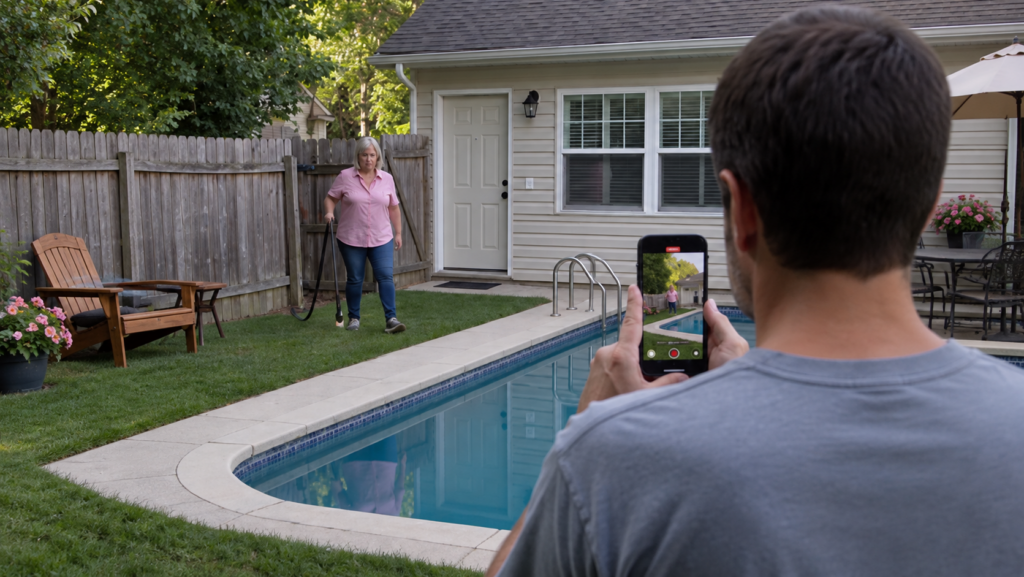
The black cord dragged across the grass like a line drawn between two different stories.
Mara Voss stood in the open kitchen doorway with a grocery bag still hooked over her wrist.
Her neighbor, sixty-three-year-old June Talbot, was kneeling beside Mara’s swimming pool.
June held one end of the cord inches above the water.
At the far end of the yard, June’s nephew Owen Pike recorded everything with his phone.
Mara put the groceries down without looking away from June.
“Move away from the pool,” Mara said.
June lifted her head.
“You should have answered your door yesterday.”
“That doesn’t give you permission to come into my yard.
”
Owen stepped sideways to keep all three people in the frame.
“I saw everything,” he announced.
Mara noticed that he had not asked June to stop.
She also noticed that the cord ended in a thick rubber sleeve rather than an ordinary electrical plug.
“Is that connected to power?” Mara asked.
June’s mouth tightened.
“You think I’m stupid enough to bring a live wire into water?”
“I don’t know what you’re doing.”
“That’s exactly the problem,” June replied.
Owen moved closer.
“Can you repeat what you said about the wire?”
Mara looked directly at his phone.
“I said that I don’t know what you’re doing.
”
June stood up too quickly and lost her balance.
Her left shoe slid against the wet coping.
Mara reached for her instinctively.
June caught Mara’s sleeve, then deliberately let her knees buckle.
She landed on the lawn, well clear of the pool.
Owen rushed forward with his phone still raised.
“You pushed her,” he shouted.
Mara stared at him.
“I caught her.”
June remained on the grass with one hand against her shoulder.
“My arm,” she whispered.
Mara backed away and called emergency services.
She told the dispatcher that an older woman had entered her yard with an unidentified cord and fallen beside the pool.
She did not accuse June of pretending.
She did not touch the cord.
She did not move June.
Owen kept filming until the ambulance arrived.
Then he stopped the recording and slipped his phone into his pocket.
CHAPTER TWO: THE FIRST VERSION
By sunset, the video had reached half the neighborhood.
Its opening frame showed Mara reaching toward June.
Its next frame showed June collapsing.
The first thirty seconds, including the cord and Mara’s questions, were missing.
The caption called Mara a violent homeowner who had assaulted an elderly woman trying to warn her about a dangerous swimming pool.
Mara watched it once on her sister’s phone.
Her sister, Lena, sat beside her at the kitchen table.
“You need a lawyer,” Lena said.
“I need to understand why June was there.”
“Both things can be true.”
Mara turned her own phone face down.
She worked as a freelance caption editor, and she knew how much a cut could change the meaning of a sentence.
But knowing that did not make the comments less frightening.
People who had never met her were calling her dangerous.
A local parenting group had already warned families to avoid her house.
June’s nephew had posted a second clip of an ambulance leaving the street.
In that clip, Owen claimed June had been trying to prevent a tragedy.
He did not explain what tragedy she expected.
Mara called the nonemergency police number and asked how to document the trespass and the disputed video.
An officer took her statement and told her not to confront June.
When Mara hung up, Lena pointed toward the back window.
A small white card had been pushed beneath the patio gate.
It carried three words in blue ink.
ASK ABOUT ELLIOT.
Mara had never heard the name.
CHAPTER THREE: THE WRONG ACCIDENT
The following morning, Mara visited the neighborhood association office.
The office occupied a narrow storefront between a laundromat and a bakery.
A volunteer named Dev Patel was sorting recycling notices behind the counter.
He recognized Mara before she introduced herself.
“I saw the video,” he said.
“Then you saw the edited version.”
Dev set down his papers.
“I also saw June here on Thursday.”
Mara waited.
“She wanted us to cancel a children’s swimming event at your house.”
“There isn’t a swimming event at my house.”
“That’s what I told her.”
Dev opened a calendar and pointed to a different address.
The neighborhood’s annual safety demonstration was scheduled at the public recreation center,
three streets away.
Mara frowned.
“Why would June think it was happening at my pool?”
Dev looked uncomfortable.
“She didn’t think that.”
He explained that June had argued for twenty minutes about an accident that had occurred the previous summer.
A maintenance worker named Elliot Brand had fallen from a portable stage during the recreation center’s reopening ceremony.
The fall had injured his back and ended his contract.
The city had described it as a personal misstep.
June had insisted that the stage was defective.
“What does that have to do with my pool?” Mara asked.
Dev shook his head.
“I don’t know.”
Outside, Mara found another white card beneath her windshield wiper.
This one contained an address for a storage company and a time.
FOUR O’CLOCK.
She photographed the card and called Lena.
“Someone wants me to follow a trail,” Mara said.
“Then don’t go alone,” Lena replied.
CHAPTER FOUR: THE STORAGE COMPANY
Lena arrived twenty minutes before four.
They drove together to a storage facility near the interstate.
The receptionist refused to discuss other customers, but she handed Mara an envelope that had been left in her name.
Inside was a photograph of a folding aluminum platform with one leg bent inward.
A second photograph showed a yellow equipment tag attached to the same platform.
The tag read RECREATION CENTER DEMONSTRATION UNIT.
There was no letter.
There was only a handwritten number on the back of the second photograph.
Mara called it from the parking lot.
A man answered on the fourth ring.
“Elliot Brand,” he said.
Mara identified herself.
He went silent.
“I didn’t leave those photographs,” Elliot finally said.
“Someone did.”
“Then somebody has decided to make my life difficult again.”
Mara described the cord, June’s fall, and Owen’s recording.
Elliot interrupted when she mentioned the rubber sleeve.
“Was it black with a green seam?”
“Yes.
”
“That isn’t a household electrical cable.”
“What is it?”
“It’s a portable pressure-sensor lead.”
Mara glanced at Lena.
“What would someone use that for?”
“Measuring movement on temporary flooring,” Elliot said.
“Or pretending to.”
He gave them the address of a diner and asked them to arrive before the evening rush.
CHAPTER FIVE: THE MAN WHO FELL
Elliot Brand walked with a cane and kept his right hand braced against the edge of the diner booth.
He was forty-two, with close-cropped hair and the tired expression of someone who had repeated the same account too many times.
“The stage wasn’t supposed to be there,
” he told Mara.
“It was a temporary platform for a product demonstration.”
Mara asked what product.
“A wearable fall detector,” Elliot said.
“A company called TrueStep had rented the recreation center for a demonstration.”
He described a crowded opening ceremony and a presenter who wanted a dramatic example of the device’s emergency response.
Elliot had been hired to assemble the platform.
He had refused to sign off on one unstable corner.
An event supervisor ordered the platform opened anyway.
“I went back to put a warning cone beside the loose leg,” Elliot said.
“Somebody called me onto the platform before I reached it.
”
He fell when the support folded.
The company released a statement saying its equipment had detected the accident correctly.
The city said the accident had nothing to do with the demonstration.
Elliot’s temporary contract ended a week later.
“June was the only person who believed me,” he said.
Mara leaned forward.
“Then why would she stage another fall?”
Elliot looked at the window.
“Because she thinks nobody pays attention until somebody gets hurt.”
He admitted that June had once offered to organize a public protest.
He had refused because his rehabilitation appointments were already exhausting.
“I wanted to get better,” he said.
“I didn’t want to become somebody’s cause.”
Mara showed him the photographs.
He recognized the damaged platform but not the handwriting.
When she described Owen’s behavior, Elliot gave a bitter laugh.
“Owen worked for TrueStep last summer.”
“As what?”
“A freelance videographer.”
CHAPTER SIX: TWO CAMERAS
Mara returned home to find a city safety officer waiting on her porch.
His name was Caleb Ortiz, and he carried a clipboard rather than a citation.
“We’ve received complaints about an unsafe electrical installation beside your pool,” he explained.
Mara invited him to inspect the yard.
Caleb found no exposed wiring or damaged outlets.
He photographed the empty section of lawn where June had fallen.
“Did you keep the object she brought?” he asked.
“The responding officer took it.”
Caleb wrote down the report number.
“The complaint says you invited June here to test a fall detector.”
Mara stared at him.
“I have never owned a fall detector.”
Caleb showed her a printed screenshot from an event announcement.
It displayed her backyard beneath the words COMMUNITY SAFETY PREVIEW.
The address was hers.
The contact number belonged to Owen.
The announcement had circulated in a private neighborhood group for less than an hour before being deleted.
Mara realized that the confrontation had been arranged around a story written before she entered the yard.
Caleb looked toward the pool.
“Do you have your own camera footage?”
Mara shook her head.
Her exterior camera had been disconnected for repainting.
Then she remembered the contractor who had worked on the fence that morning.
He had been using a small body camera to record the gate alignment for his insurance documentation.
Mara called him immediately.
The contractor, Luis Moreno, answered from his truck.
“I haven’t erased anything,” he said.
“But I need to know why the police are asking about my work.”











