CHAPTER TWO: THE ORCHARD WITHOUT FRUIT
Elias emerged into the laundry passage while the household gathered around the front staircase.
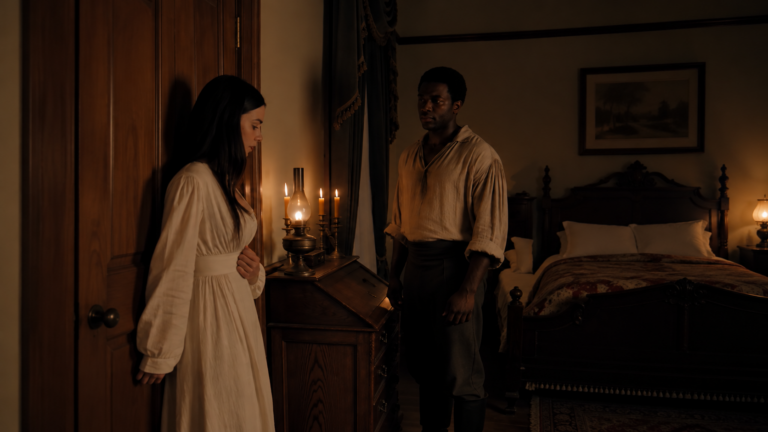
A maid named Ruth was carrying a basin of warm water toward Adelaide’s room.
She stopped when she saw him.
“They have locked the back doors,” Ruth said.
“Who ordered that?”
“Mr. Ralston.”
Elias asked her whether the master had returned from the stables.
Ruth shook her head and pointed toward the east orchard.
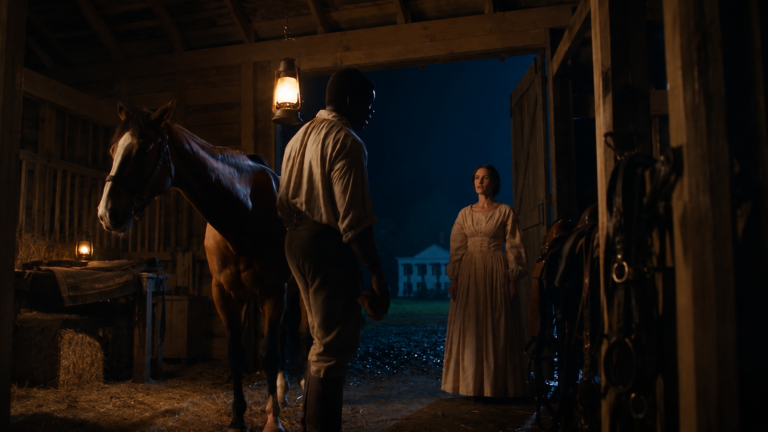
The night was wet, and the first autumn wind pressed against the shutters.
Elias crossed the kitchen without speaking to the cook.
He slipped through a pantry window that had been repaired badly after the spring storms.
The orchard stood beyond a low wall, its trees thin and neglected.
No fruit had grown there since the estate moved its laborers to the cotton fields.
At the edge of the orchard stood the abandoned kiln.
Elias had worked there as a child, turning clay into bricks for the new west wing.
He remembered the day the furnace was shut down.
A wagon had arrived with blankets, and the overseer had ordered everyone to leave.
His mother had searched for a little girl named Hannah until the light disappeared.
Hannah was not Elias’s sister, but she had slept beside his family for two years.
The overseer had said the girl was sent to another estate.
No one had seen the wagon leave by the main road.
Elias opened the blue cloth beneath the kiln’s crumbling arch.
The wooden counters carried three marks that he had once seen on the kiln workers’ tools.
A circle meant a full brick.
A slash meant a broken brick.
A square meant a hollow brick.
The counters were not a message by themselves.
They were pieces of a counting game Hannah had invented to make long days bearable.
Elias turned the child’s shoe over in his hands.
The stitching was unmistakable.
His mother had sewn that crooked blue thread through the heel.
A voice spoke behind him.
“She did not die here.”
Elias turned and found Ruth standing beneath the orchard wall.
She held a lantern wrapped in her apron.
“You followed me,” he said.
“I saw the shoe when Mrs. Voss brought it upstairs,” Ruth replied.
“When?”
“Yesterday morning.”
Ruth stepped into the kiln and set down the lantern.
“Adelaide has been sending for you because she thinks you know where the children were taken,” she said.
“Which children?”
“The ones Ralston removed from the work lists before the last harvest.
”
Elias felt the cold settle into his hands.
“Why would she think I knew?”
“Because you were the only one who kept asking after Hannah.”
He looked back toward the house.
“Then why does she threaten me?”
Ruth did not answer immediately.
“She believes threats are the only language anyone here understands,” she finally said.
“That does not make them harmless.”
“I know.”
A bell rang once from somewhere beyond the orchard.
Ruth covered the lantern with her apron.
“We should go,” she whispered.
Elias listened until the sound faded.
“No,” he said.
“We should find out who is ringing it.
”