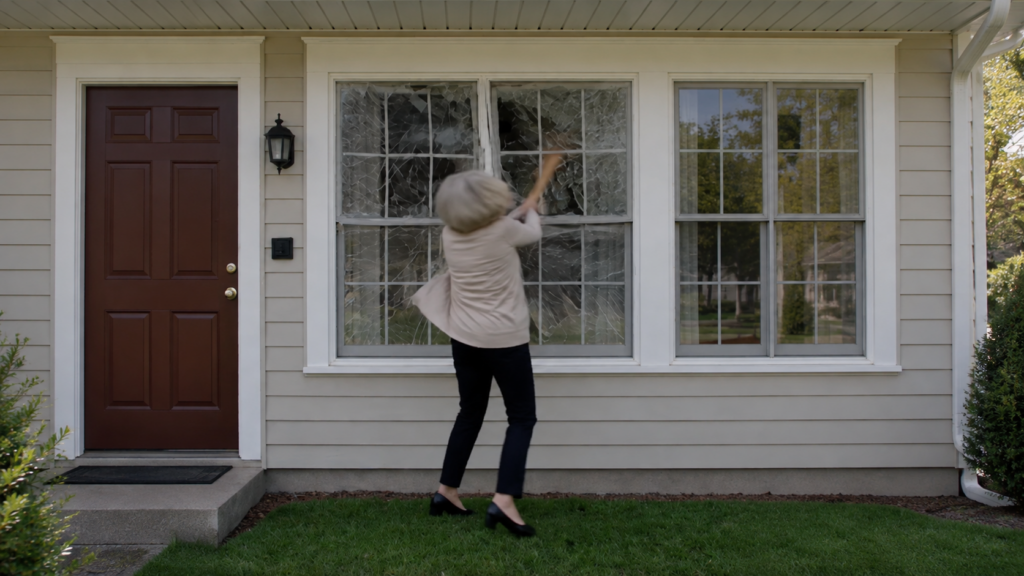
The first thing I saw when I returned from the hardware store was a sentence painted across my front door.
GO BACK WHERE YOU CAME FROM.
The paint was red, wet, and running down the blue wood in thin streams.
Someone had also emptied two bags of soil over the porch and snapped the young pear tree beside my steps.
My name is Rowan Vale, and I had lived on Bellwether Lane for nine days.
I stood beside my truck holding a packet of brass screws while the late afternoon wind lifted the broken leaves.
Across the street, a woman in a white gardening visor watched from her driveway.
She was holding a mug, although she never lifted it to her lips.
I knew her name because she had introduced herself on moving day.
Patricia Hollen had called herself the person who kept the neighborhood respectable.
She had also asked where I worked, whether I owned the house, and why I had chosen a street where everybody knew everybody.
I had answered the first question vaguely and the second truthfully.
The third question had made her smile without showing her teeth.
Now she watched me discover what somebody had done to my home.
I set the screws on the truck’s hood and took a slow photograph of the door.
Patricia crossed the street before I could photograph the broken tree.
“What a shame,” she said.
Her eyes traveled over the paint with theatrical disappointment.
“Some people get upset when the character of a neighborhood changes.”
“Did you see who did it?” I asked.
“I mind my own business.”
She said it while standing on my porch.
“Then you won’t mind stepping away from the paint,” I said.
Her smile tightened.
“You might find people friendlier if you made an effort.”
“I made an effort to move into my own house.”
“You know what I mean.”
I looked at the broken pear tree.
“No,” I said.
“I don’t think I do.”
She went home without another word.
At the corner, a boy riding a bicycle slowed to stare at the door.
He could not have been older than eleven.
He read the message, glanced at Patricia’s house, and pedaled away so fast that his rear tire skidded on the gravel.
That was the moment I understood that the paint was not the beginning of the trouble.
It was the first trouble somebody had allowed me to see.
CHAPTER TWO — AN UNUSUAL STATUS
I did not tell Patricia what I did for a living.
That omission would become the most expensive mistake she made.
Three years earlier, I had been appointed an independent court monitor for the regional youth housing transition program.
The job was temporary, publicly funded, and deliberately separate from the agencies it examined.
My team assessed whether young adults leaving residential care were receiving safe placements, usable transportation, and access to their own records.
We were not police officers, and we did not arrest people.
We could, however, demand explanations from participating contractors, inspect their facilities under the terms of their agreements, and submit findings directly to the court supervising the program.
My appointment carried strict conflict rules.
I could not accept favors from providers, announce findings before review, or use the position to settle private disputes.
I had purchased the house on Bellwether Lane because it was close to my mother’s rehabilitation center and far enough from my office that I could sleep without hearing the freight trains.
The appointment was public information, but my home address was not part of my professional biography.
Patricia had seen an ordinary woman unloading boxes and decided that ordinary meant defenseless.
She had not known that I spent my days asking powerful people to explain why vulnerable residents were being pushed around.
Even so, I had no intention of turning my front door into an official investigation.
I called the local police to report the damage, requested a case number, and arranged for a contractor to replace the broken door panel.
The responding officer, Luis Serrano, was young and careful with his notebook.
He photographed the paint and asked whether I had received any threats.
“Nothing direct,” I said.
“A neighbor has made comments about newcomers.”
“Which neighbor?”
I pointed across the street.
Patricia had closed her curtains.
Serrano wrote down her name without promising anything.
He also noticed a faint scrape across the lower edge of the doorframe.
“Looks like somebody tried to pry this before they painted it,” he said.
I crouched beside him.
The scrape was fresh and pale against the old varnish.
“Would a vandal do both?” I asked.
“Sometimes people do more than one stupid thing.”
He took another photograph.
“Keep an eye on the locks,” he said.
“And call us if anyone comes back.”
I replaced the deadbolt that evening.
At nine, my mother called from the rehabilitation center and asked whether I had finally unpacked the kettle.
I told her the kettle was fine.
I did not tell her about the door.
She had survived a stroke and was learning to walk again, and I refused to make my first week in town another reason for her to worry.
When I hung up, a folded note slid under the new door.
It was written on bright yellow paper.
YOU DON’T BELONG HERE.
I opened the door immediately.
The street was empty.
Across the road, Patricia’s upstairs light went out.
CHAPTER THREE — THE HOUSE AT NUMBER SIX
The following morning, a woman named Mina Calder arrived with a tray of cinnamon rolls.
She lived at number six and worked nights as an emergency department receptionist.
She was exhausted, direct, and visibly angry when she saw the damaged porch.
“Patricia did this,” she said.
“Did you see her?” I asked.
“No.”
“Then we need to be careful about what we say.”
Mina set down the tray.
“You sound like a lawyer.”
“I’m not.”
“You sound worse.”
She pointed to the yellow note I had placed in a clear sleeve.
“My sister got one of those when she rented here.”
“What happened?”
“She moved.”
Mina took a breath and sat on the bottom step.
“Patricia has a way of making people feel that every problem is their fault.
”
She told me about a family whose moving van had been blocked by a neighborhood welcome committee, a tenant whose recycling bins were repeatedly overturned, and a school custodian who had been accused of stealing garden tools because he parked his truck on the street.
None of those incidents had ended with a clear answer.
Each had ended with somebody deciding that staying was more trouble than leaving.
“Why doesn’t anybody confront her?” I asked.
Mina stared at the street.
“Because she doesn’t do everything herself.”
She told me Patricia ran a volunteer organization called the Bellwether Neighborhood Stewardship Circle.
The group had no legal authority over homes, but it organized seasonal events, coordinated yard work for older residents, and controlled access to a privately donated community workshop.
Patricia used that influence to decide who was invited, who was recommended for odd jobs, and who was quietly left out.
“People need the workshop,” Mina said.
“Especially the young people.”
“What young people?”
Mina looked at me more closely.
“There are four houses nearby where young adults live while they finish training.”
“Transition housing?”
“Something like that.”
I kept my expression neutral.
The placement program was familiar, but I had never seen Bellwether Lane listed among its approved locations.
“Who runs those houses?” I asked.
“A company called Northbridge Pathways.”
The name struck like a dropped glass.
Northbridge Pathways was a contractor under review by my office.
Its director had recently insisted that every placement was voluntary, that residents could leave freely, and that neighborhood volunteers had no say in who qualified for housing.
I had believed the last statement because it seemed too absurd to be false.
Mina watched my face change.
“You know them,” she said.
“I know the name.”
“Then you should know something else.”
She leaned toward me.
“Patricia decides which of their residents get to use the workshop.”
CHAPTER THREE A — THE FIRST RESIDENT
Before Kira arrived at my porch, I met a young man who introduced himself as Devon.
He was carrying a grocery bag and searching for a house number that had been painted over on a mailbox post.
“Is this number twelve?” he asked.
“It’s number ten,” I replied.
“Twelve is two doors down.”
He looked relieved.
“I moved here yesterday.”
“Welcome.”
He glanced at the red writing on my door.
“Did somebody do that because you moved here?”
“I don’t know why they did it.”
He nodded as though that was an answer he had expected.
I asked whether he needed help finding the house.
He said he could manage and continued along the sidewalk.
Ten minutes later, he returned without the grocery bag.
“Can I ask you something?” he said.
“Of course.”
“Do people here get to choose who visits them?”
I considered the question.
“That depends on their housing arrangement, but people should be told what rules apply and why.”
“They said my brother couldn’t come over.”
“Who said that?”
“The house manager.”
“Did they explain the rule?”
“They said it was a neighborhood preference.”
I gave him the number for the independent residents’ advocate and suggested he ask for the written visitor policy.
He looked at the paper without taking it.
“Will they know I called?”
“You can ask how they protect confidentiality before sharing details.”
He took the number and folded it into his pocket.
“My brother drove me here,” he said.
“He wants to know I’m okay.”
“That sounds reasonable.”
Devon looked at the door again.
“Maybe everybody here is scared of somebody.”
He walked away before I could answer.
That night, I wondered whether he had managed to speak with his brother.
I did not know his last name, and I did not try to find it through my work.
Three days later, he passed my house with another young man who looked enough like him to be family.
They were laughing about a basketball game.
Devon raised one hand when he saw me.
I waved back and kept watering the garden.











