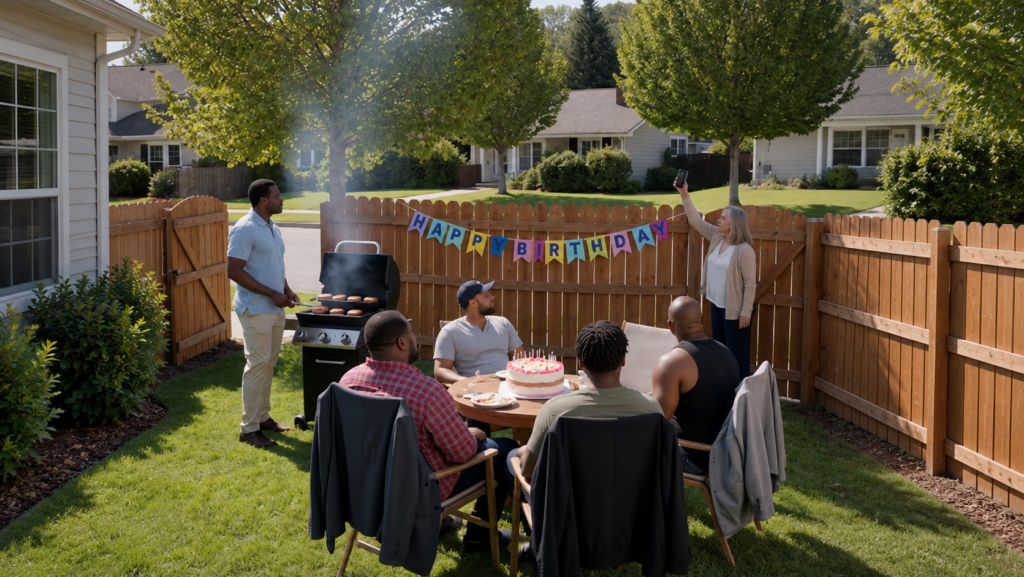
The officer turned toward Margaret Collins and asked her to step away from the gate.
Margaret’s mouth opened, but no words came out.
Marcus Bennett had expected the patrol cars to arrive, yet he had not expected to recognize the younger officer.
Officer Daniel Price had worked under him during a difficult winter when a warehouse fire displaced three families.
Marcus had been the incident commander that night, and Daniel had been a rookie trying to keep frightened residents away from a collapsing wall.
They had not seen each other in nearly six years.
“Captain Bennett,” Daniel repeated, this time with an embarrassed glance toward the untouched birthday cake.
“It’s my day off, Daniel,” Marcus said.
The second officer, Sergeant Elena Ruiz, stopped beside the patio table and looked at the four leather badge holders.
One belonged to a county fire investigator, another to a hospital emergency physician, a third to a municipal building inspector, and the fourth to a state search-and-rescue coordinator.
They were not a secret unit, and none of them had come to Marcus’s house on official business.
They had come because Marcus was turning forty-three, and they had survived enough difficult nights together to value an ordinary afternoon.
“Are you all right?” Elena asked.
“We were fine until somebody reported a crime that wasn’t happening,
” Marcus answered.
Margaret pushed through the gate despite Daniel’s outstretched arm.
“Those badges don’t prove they live here,” she said.
“Nobody claimed all five men live here,” Elena replied.
“Mr. Bennett has identified himself as the homeowner, and I need you to stop interrupting.”
Margaret looked at Marcus as though he had personally arranged her humiliation.
“You could have told me who you were.”
“I told you I lived here,” Marcus said.
His friend Andre Coleman lifted the lid from the grill and moved the burgers away from the hottest coals.
Andre was the physician, and he had spent the morning joking about Marcus’s refusal to buy a larger grill.
Now his expression had gone flat.
“The cake is melting,” Andre said quietly.
Nobody laughed.
Elena asked Margaret exactly what she had witnessed before calling emergency services.
Margaret said she had seen unfamiliar men entering the yard.
Marcus explained that his friends had arrived through the front door and carried folding chairs around the side of the house.
Margaret changed her description and said she had heard shouting.
“We were singing badly,” said Curtis Vale, the fire investigator.
“I can demonstrate if you want evidence.”
Daniel nearly smiled, but Elena remained serious.
She asked whether Margaret had seen anyone climbing a fence,
forcing a lock, threatening a person, or damaging property.
Margaret looked toward her own kitchen window.
“I knew something was wrong,” she insisted.
“That isn’t an answer,” Elena said.
A neighbor across the street had begun filming from his porch.
Marcus noticed the phone and felt the afternoon slipping beyond his control.
He had invited his friends to celebrate a birthday, not to become characters in somebody else’s argument.
“Please finish your questions,” he told Elena.
“My guests deserve to eat while the food is warm.”
Elena nodded and asked Margaret to accompany her toward the sidewalk.
Margaret refused until Daniel told her the conversation would continue outside the private yard.
As she passed the grill, she pointed at the badge holders.
“You people always know how to make someone look foolish.”
Marcus did not answer.
He watched her leave and then closed the gate himself.
The small click of the latch sounded louder than it should have.
Chapter Two: What the Call Actually Said
Daniel stayed behind long enough to explain that the dispatcher had described an active trespass complaint involving five men who might be armed.
Marcus set down the plate he was holding.
“Armed?” he asked.
Daniel looked uncomfortable.
“That’s what came over the radio.”
“None of us has a weapon,
” Andre said.
“Did the caller say she saw one?”
“I don’t know what she said directly,” Daniel admitted.
“I only know what dispatch sent us.”
Curtis leaned against the table and studied the street through the fence slats.
“Then somebody needs to establish the difference before the story gets any bigger.”
Marcus nodded, but he did not reach for his phone.
He had spent twenty years telling frightened people to avoid acting on incomplete information.
He would not abandon that discipline simply because the accusation was personal.
Elena returned ten minutes later and explained that Margaret had agreed to remain on her own property.
The officers had found no evidence of trespassing or a threat.
They were closing the call without taking action against Marcus or his guests.
“What happens to the report?” Marcus asked.
“The dispatch record remains,” Elena answered.
“I can make sure your account is included.”
“Please include the birthday cake,” Curtis said.
“It’s a material witness.”
This time Daniel laughed.
The officers left, and the men stood around the patio table while a faint breeze lifted the paper napkins.
The birthday cake read FORTY-THREE AND STILL BOSSY in blue icing.
Marcus’s daughter, Nia, had chosen the message before leaving for a weekend debate tournament.
Marcus had planned to send her a photograph of the first slice.
Instead, his phone already held three messages asking why police had been outside his house.
One came from his sister.
One came from a colleague.
The third came from a number he did not recognize.
The unknown message contained a short video showing Margaret pointing at the yard while a voice shouted that five dangerous men had been caught.
The clip ended before the officers learned who owned the house.
“Somebody is already editing the afternoon,” Marcus said.
His friend Lionel Brooks, the building inspector, held out his hand for the phone.
“Don’t send that around,” Lionel warned.
“People will argue about the ending before they know the beginning.”
Marcus put the phone facedown.
“Then we tell the beginning ourselves.”
Andre cut the cake with a plastic knife that bent beneath the frosting.
They ate standing up because the chairs suddenly felt too close together.
Nobody wanted to admit how quickly a harmless afternoon had become dangerous.
Chapter Three: The Woman at the Fence
Margaret Collins had lived next door for eleven years.
She was sixty-four, a retired office supervisor who kept her hedges trimmed with almost mathematical precision.
Marcus had moved into his house eighteen months earlier after separating from his wife.
He had introduced himself on moving day and offered to help Margaret carry a heavy planter.
She had declined without smiling.
Their conversations since then had concerned fallen leaves, a delivery van, and the height of a shared fence.
Nothing in those conversations explained why she had called police on a birthday cookout.
At seven that evening, Margaret rang Marcus’s doorbell.
Marcus opened the door but left the screen locked.
Margaret stood beneath the porch light holding a covered casserole dish.
“I thought we should put this behind us,” she said.
Marcus looked at the dish and then at her face.
“What would putting it behind us involve?”
“You accept that I made a mistake, and I accept that you were offended.”
“You told a dispatcher we might be armed,” Marcus said.
“I never said that.”
“Then you should be willing to clarify what you said.”
Margaret’s expression tightened.
“Are you threatening to sue me?”
“I’m asking you to tell the truth.”
She lifted the dish as though it could settle the matter.
“I made lasagna.”
Marcus kept his hand on the doorframe.
“My daughter has been asking whether I was arrested.”
Margaret lowered the dish.
“Children hear things.”
“She heard that police came because somebody claimed I didn’t belong in my own yard.
”
“I couldn’t have known who those men were.”
“You didn’t need to know their jobs to know they weren’t trespassing.”
For a moment, Margaret seemed prepared to argue again.
Then she glanced toward the street, where two teenagers were walking their bicycles past the driveway.
“People are talking,” she said.
“Yes,” Marcus replied.
“They are.”
Margaret took the casserole home without another word.
Marcus watched her porch light switch off.
He had not expected an apology, but he had hoped she might understand the difference between making a mistake and demanding that someone else absorb its consequences.
Chapter Four: The Wrong House
On Monday morning, Marcus returned to the county emergency operations office and found his supervisor waiting outside the conference room.
Deputy Director Evelyn Park held a printed screenshot from the neighborhood video.
“I want you to know we have received calls,” she said.
“Calls about what?”
“Some people want to know why a county employee was displaying badges during a neighborhood dispute.”
Marcus stared at the photograph.
The badge holders lay on the patio table exactly where his friends had placed them.
“Nobody used a badge to threaten her,” he said.
“The officers asked questions, and we answered.”
“I believe you,” Evelyn replied.
“That doesn’t mean I can ignore the complaints.”
She asked Marcus to write an account before lunch.
He agreed, although the request made his stomach tighten.
He had coordinated responses to tornadoes, chemical spills, and missing-person searches.
Now he was being asked to explain why his friends had attended his birthday party.
At noon, Nia called from school.
“Dad, somebody posted our address,” she said.
Marcus stood up so quickly that his chair struck the filing cabinet.
“Where did you see it?”
“A group chat.”
“Don’t forward it to anyone else.”
“They’re saying you staged the whole thing.”
Marcus closed his office door.
“Listen carefully,” he said.
“You didn’t cause this, and you don’t have to answer strangers about it.”
“I know that,” Nia replied.
“But they put a picture of our house next to a picture of another house.”
“What other house?”
“The empty one on Willow Bend.”
Marcus opened the neighborhood map on his computer.
Willow Bend was two streets away, and an abandoned rental property there had recently drawn complaints about broken windows and nighttime visitors.
The houses shared the same pale brick and dark green shutters.
Their numbers were different, but the similarity was striking in a cropped photograph.
Marcus asked Nia to describe exactly what she had seen.
She said the post claimed Margaret had called police because men were breaking into the vacant house.
Marcus looked again at the screenshot on Evelyn’s desk.
The caption beneath it referred to a burglary at 118 Willow Bend.
His own house was 118 Alder Court.
The two addresses had been fused into one story.
That did not excuse Margaret’s accusation, but it explained why strangers were beginning to repeat details that had never appeared at his property.
Marcus called Evelyn back into the room.
“We have a second problem,” he told her.
“Someone is attaching a real burglary report to a false claim about my backyard.”











