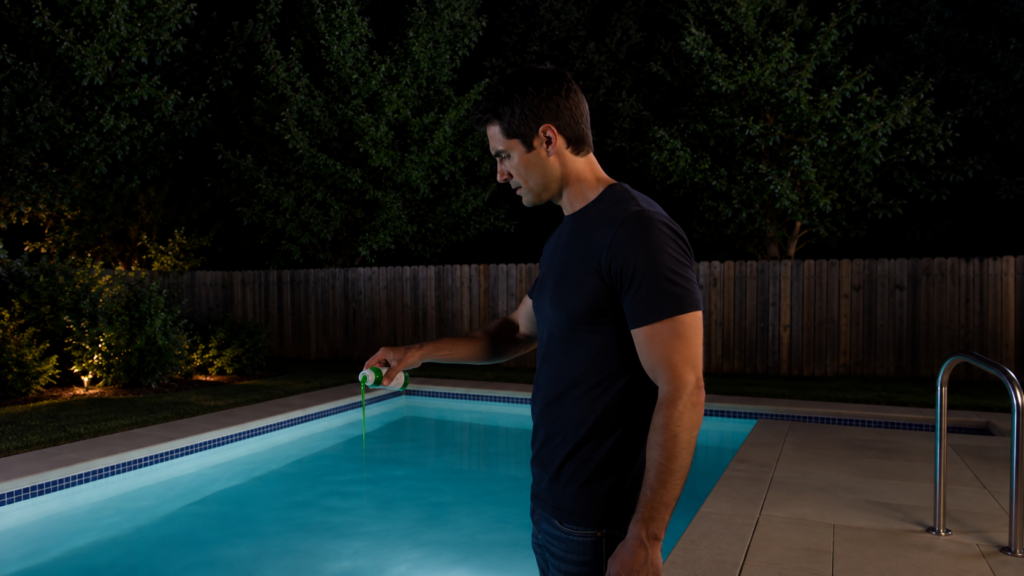
The first time I found a stranger floating in my swimming pool, she raised her sunglasses and asked why I was home so early.
She spoke as though I had interrupted a reservation rather than discovered a trespasser behind my own house.
Her name was Vanessa Kline, and she lived two doors down in the neat blue house with the white porch columns.
She had brought a pink inflatable chair, a chilled bottle of sparkling water, and a striped towel embroidered with initials that did not belong to anybody in my family.
My daughter, Lucy, stood beside me clutching the handle of her school backpack.
She had been hoping to practice swimming before her first competition in three weeks.
Instead, she watched our neighbor casually dip her feet into the water we had paid to heat.
I asked Vanessa to leave, and she smiled with the patient expression of somebody correcting an unreasonable child.
She said she had always been welcome in that backyard when the previous owner lived there.
I told her that the previous owner had moved to Arizona nine months earlier.
She replied that good neighborhood relationships should survive changes in ownership.
Then she reached for her drink as if the matter had been settled.
I had bought the house after a long divorce, and I had stretched my savings to give Lucy a place that felt stable.
The pool was not a status symbol to me.
It was the one place where my daughter stopped listening for arguments that no longer happened.
I said, as clearly as I could, that Vanessa did not have permission to enter our yard again.
She climbed out, collected her belongings, and walked toward the side gate.
At the threshold, she glanced back and said that some people moved into a neighborhood without understanding its traditions.
I closed the gate behind her and changed the latch code before dinner.
I believed that would end the problem.
I was wrong about the size of the problem, and I was wrong about how many people already knew about it.
Chapter 2: The First Summer
I had nearly forgotten how excited Lucy was when we first toured the house.
The realtor had opened the back door, and Lucy had walked straight past the kitchen without noticing its cramped counters or the peeling paint beside the pantry.
She stopped in front of the swimming pool and asked whether we could have breakfast outdoors every day.
I told her winter mornings would be too cold,
and she said we could eat beside the window instead.
Her confidence made the purchase feel possible at a moment when I was frightened of every decision.
My divorce had left me with the exhausting habit of anticipating objections before I expressed a preference.
I asked the realtor about maintenance costs, fencing, and the condition of the pump.
Lucy asked whether she could invite her friends without feeling as though she was asking permission to exist.
The realtor had no answer to that question, and neither did I.
I only knew that a permanent address mattered to my daughter after two years of temporary arrangements.
For her, the pool meant something about permanence that I could not describe on a mortgage application.
We closed on the house in January.
Rain hammered the roof during the moving weekend, and the empty pool looked like a gray piece of the sky.
Lucy wrote WELCOME HOME on a scrap of cardboard and taped it to the refrigerator.
In spring, we watched the water turn blue again after the service technician restored the filter.
I made her wait until the temperature was safe before entering.
She complained for a week, then plunged into the water on the first warm Saturday.
I still remembered the sound of her laughter bouncing off the fence.
That memory became the reason I refused to let Vanessa describe my home as a community amenity.
An amenity was something you checked on a brochure.
Our backyard was where my daughter had begun trusting that tomorrow would happen in the same place as today.
The distinction was difficult to explain to someone who saw every beautiful object as a thing she could borrow.
It was not difficult for Lucy to understand.
She knew exactly what had been taken from her whenever an unexpected guest appeared at the gate.











