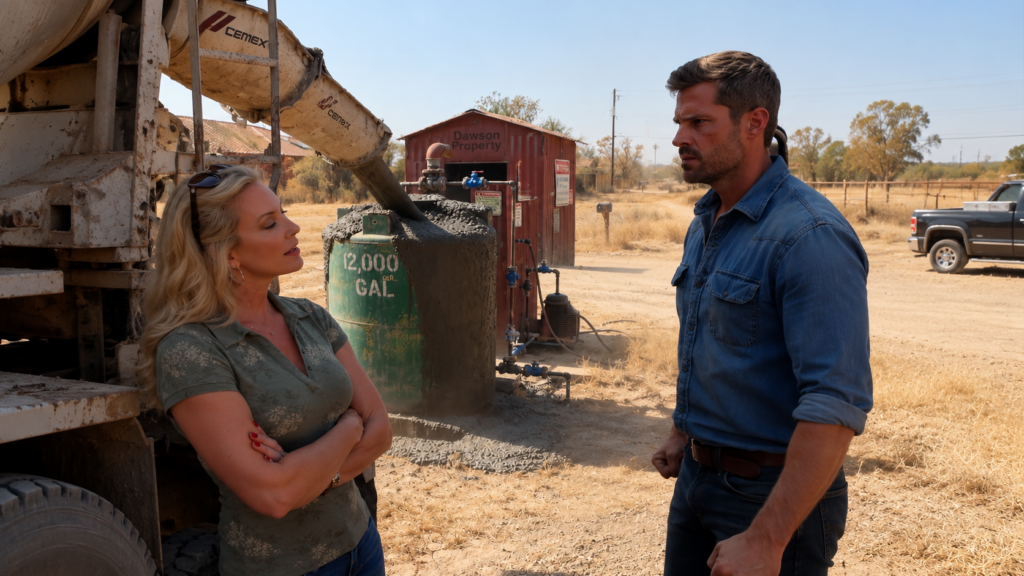
Cole Dawson was sixty miles west of Lone Star Bluffs when his phone began vibrating against the dashboard.
He ignored the first call because he was passing a tractor on a narrow two lane road.
He answered the second when his cousin Tessa appeared on the screen.
Tessa did not bother saying hello.
“Debbie has a concrete truck in your yard.”
Cole almost laughed because the sentence made no sense.
“What kind of truck?”
“A mixer, Cole.”
He heard shouting behind her.
“They’re pouring into Grandpa Hank’s tank.”
Cole pulled onto the shoulder so hard the truck bounced into gravel.
“Stop them.”
“I’ve tried.”
“Get the driver on the phone.”
“Debbie told him she owns the house next door and the neighborhood voted to remove the eyesore.”
“There was no vote.”
“I know that.”
Something metallic boomed through Tessa’s phone.
Then a man shouted that the hopper was empty.
Cole stared at the morning sky above his windshield.
For an instant he could see his grandfather climbing the ladder of the old green tank with a wrench in his teeth.
Hank had built the system in 1971, when the nearest municipal line stopped four miles short of the Dawson place.
The tank held twelve thousand gallons when full, although the neighborhood usually kept it well below capacity.
It fed the common irrigation network, the clubhouse’s sprinkler reserve, the swimming pool’s replenishment line, and a limited backup supply that served 142 homes.
In 2003, Cole’s father had sold surrounding acreage to a developer under an agreement that preserved access to the original well and storage system.
The people buying the finished houses rarely heard about the agreement.
Their monthly association statements called it the western utility reserve.
Cole knew the names of every valve.
Debbie Prescott knew only that she could see an ugly green cylinder beyond the fence of her immaculate patio.
“Get everyone away from the tank,” Cole told Tessa.
“Why?”
“Because concrete weighs more than water, and somebody just put several tons where they don’t belong.”
He turned around and drove home faster than he had driven in years.
By the time the rooftops of Lone Star Bluffs appeared beyond the cedar trees, four cubic yards of quick-set concrete had disappeared into the tank.
The concrete driver was washing his chute into a plastic tub.
Two workers stood beside their truck looking deeply uncomfortable.
Debbie Prescott leaned against a silver sport utility vehicle, her sunglasses reflecting the sun.
She wore a spotless white blouse and held a paper cup of iced coffee.
Cole stopped so abruptly that gravel sprayed across his own driveway.
He ran toward the tank without closing his door.
A gray ridge of concrete had risen around the access opening.
The pump housing beneath it was buried almost to the electrical junction box.
Water seeped through a lower seam where pressure pushed against an old gasket.
The sight made Cole physically sick.
“Who authorized this?” he demanded.
Debbie lifted her chin.
“I did.”
“You ordered people to destroy a working water system.”
“I ordered an abandoned tank filled so it wouldn’t collapse on my children someday.”
“You don’t have children.
”
“That isn’t the point.”
Cole turned toward the driver.
“Did you check who owned the property?”
The driver rubbed his forehead.
“She presented a removal request from the neighborhood association.”
“A request isn’t ownership.”
“It had an association letterhead.”
Debbie gave a little shrug.
“Everybody agreed the thing needed to go.”
Cole pointed toward a row of houses downhill.
The sprinklers were coughing in short bursts.
At the curb, an automatic irrigation valve opened and released a thin brown ribbon before falling silent.
“That tank feeds your house, Debbie.”
She looked amused.
“My water comes from the city.”
“Most days.
”
He crouched beside the ruined pump house.
“When the city pressure drops during drought restrictions, this system keeps the western reserve alive.”
Tessa arrived carrying a binder full of worn plastic sleeves.
“The agreement is here,” she said.
Debbie did not look at it.
“You can show me twenty binders.”
Cole stood.
“One hundred forty-two homes are tied to this system.”
The first homeowner appeared at the fence with a dead hose in his hand.
“Cole, are you shutting us off for maintenance?”
Another neighbor shouted that the clubhouse fire panel was reporting low reserve pressure.
A third asked why the pool pumps had stopped.
Debbie’s smile finally failed.
“They have city water,” she whispered.
Cole watched the service meter flicker and die.
“You just destroyed the one thing that protected them when city water isn’t enough.”
CHAPTER TWO — THE FIRST TEN MINUTES
Cole did not call a lawyer first.
He called the district water operator, a blunt woman named Marisol Vega who had serviced the western reserve since before Debbie moved in.
He gave her the pump serial number and the words concrete in the tank.
There was a pause.
“Tell me nobody started the motor after that,” Marisol said.
“The controller shut itself down.
”
“Good. Leave the breaker locked.”
Cole asked how quickly she could come.
“Twenty minutes if traffic behaves.”
“Bring everyone you trust.”
Next he called the fire district, not because a fire had begun but because the clubhouse’s dedicated suppression storage had just lost its replenishment source.
The dispatcher asked whether hydrants were working.
Cole said some were municipal and some shared the reserve.
He refused to guess about pressure.
Then he called the neighborhood association president, a retired school principal named Ruth Alvarez.
Ruth listened without interrupting.
“Do we have drinking water?” she asked.
“Some houses are still on city pressure.
”
“Which ones aren’t?”
“We need to test.”
“Then I’ll get people organized.”
Ruth hung up before Cole could thank her.
Meanwhile Debbie had begun calling someone named Brian.
Cole could hear her saying the situation was being exaggerated.
She paced beside the truck and insisted that a concrete company would never have obeyed her without proper paperwork.
The driver, whose name was Luis, asked Cole if he could leave.
“Give me your company’s contact information first.”
“The owner will call you.”
“I need your name and the batch ticket.”
Luis handed over both.
His hands were trembling.
“She said the tank was empty.
”
Cole could not bring himself to reassure him.
“You should have looked.”
Luis gazed toward the tank.
“I know.”
A little girl emerged from the house across the lane holding a plastic watering can.
She told Cole her father said the taps were making coughing noises.
Cole knelt and asked her to tell him where the adults were.
Her father appeared moments later with a worried expression.
The child’s name was Poppy.
Her father, Evan Pike, was an emergency room nurse who normally worked nights.
He had just come off a twelve hour shift.
“Is the water safe?” he asked.
“Do not use anything from the backup system until Marisol clears it.”
“How do I know which supply I’m using?”
Cole hesitated.
That was the question he should have expected years earlier.
He could name every mechanical connection but had never made a plain language map for his neighbors.
“The district can identify it by address,” he said.
Evan looked past him toward Debbie.
“Did she actually fill that tank?”
Debbie turned around.
“It was a safety hazard.”
Evan pointed at his kitchen window.
“My daughter has asthma, and I have a refrigerator full of medication that needs proper storage.
”
“Your house still has electricity,” Debbie replied.
Evan stared at her.
“That doesn’t answer my question.”
Ruth’s car arrived followed by two neighbors carrying clipboards.
She stepped onto the gravel and surveyed the truck, the tank, and the people gathering in small groups.
“Nobody gets to improvise with this now,” she said.
She assigned one neighbor to collect addresses with low pressure and another to check households with infants or medically vulnerable residents.
She told everyone else to keep clear of the damaged structure.
Debbie marched over.
“Ruth, tell them this was approved.”
Ruth looked at her steadily.
“By whom?”
“The neighborhood improvement committee.”
“We have no such committee.”
“Brian said—”
“Brian does not chair this association.”
Debbie fell silent.
Ruth held out her hand.
“Show me whatever he gave you.”
Debbie opened her phone but did not surrender it.
Cole watched the movement, then looked back toward the tank.
A slow crack was growing across the concrete ring at its base.
“Everybody behind the fence,” he called.
This time nobody argued.
CHAPTER THREE — A TANK IS NOT A WELL
Marisol arrived with an electrician and two utility technicians in a white service van.
She did not ask who was to blame.
She walked the perimeter once, photographed the exposed equipment, and listened to the tank’s faint metallic creaking.
Then she asked for the original maintenance drawings.
Cole fetched the cardboard tube from his workshop.
They spread the drawings across the hood of his pickup.
The tank had a steel shell supported by a circular concrete pad.
The well fed it through a riser at the north side.
A distribution pump drew from the lower chamber and sent water into a pressure regulated line along the subdivision’s western road.
The tank did not independently supply every kitchen faucet.
Under normal conditions, municipal water handled residential demand.
The reserve connected only to the designated backup loop and certain shared facilities through approved backflow protection.
Marisol made that distinction to Ruth immediately.
“People need accurate information,” she said.
“Some homes have lost irrigation and backup service, while others are experiencing real pressure problems because the switching equipment is locked out.”
Ruth nodded.
“We’ll say exactly that.”
A technician checked the pressure gauges.
Another tested the electrical isolation.
They found that the incoming well still had power but the pump assembly could not be safely operated.
The quick-set concrete had crushed the manifold and trapped the valves in unknown positions.
Any attempt to restart it might push debris into lines that could not be inspected from the outside.
“Can we dig it out?” Cole asked.
Marisol shook her head.
“Not while we have a tank full of water above an unstable mass.”
“How bad is it?”
“Bad enough that nobody stands under the south seam.”
Cole swallowed.
That seam had been welded by his grandfather.
“Is the tank going to burst?”
“I don’t know yet.”
“What do we do now?”
“We isolate the reserve, establish alternate water access, and find a structural engineer who knows older storage tanks.”
Ruth was already dialing the county emergency coordinator.
Debbie watched from the other side of the fence, her arms crossed tightly.
Brian eventually arrived in a black pickup with a company logo on the doors.
He was tall, sunburned, and dressed like someone who wanted to be mistaken for a contractor.
He introduced himself as Brian Sutter of Bluffs Renewal Group.
Ruth recognized the name at once.
“You’re the man who circulated the beautification petition.”
Brian smiled.
“We only wanted to improve property values.”
Cole stepped forward.
“Did you tell Debbie to fill my tank with concrete?”
“Absolutely not.”
Debbie’s head snapped toward him.
“You said you would handle the paperwork.”
“I said we would explore legal removal options.”
“You gave me a letter.”
“A draft letter.”
“You said the water line was obsolete.”
Brian glanced at the gathered neighbors.
“Let’s not have this conversation in public.”
Cole felt his temper rise.
“You arrived at a public disaster.”
Marisol cut between them.
“Move away from the work zone.”
Brian backed up, his smile gone.
Debbie looked as if she might start crying, but instead she announced that she was going home to find the agreement.
Ruth stopped her.
“Do not delete your messages with Brian.”
Debbie stared.
“Are you threatening me?”
“I’m asking you not to make this worse.”
At noon the county issued a precautionary notice for the affected reserve network while crews confirmed which lines could be safely restored.
The elementary school three miles away offered its gym as a temporary water distribution point.
Fire officials arranged a portable supply for the clubhouse’s event hall and restricted its capacity.
People who had never given the green tank a second thought suddenly wanted its entire history.
Cole stood beside the fence answering questions until his voice grew hoarse.
One man accused his family of hiding a dangerous private system behind ordinary utility bills.
A woman asked why her closing paperwork had mentioned a water covenant she did not remember reading.
Cole answered what he knew and admitted what he did not.
That was harder than arguing with Debbie.
By evening, two rows of bottled water stood outside the clubhouse.
The old green tank remained silent against the sunset.











