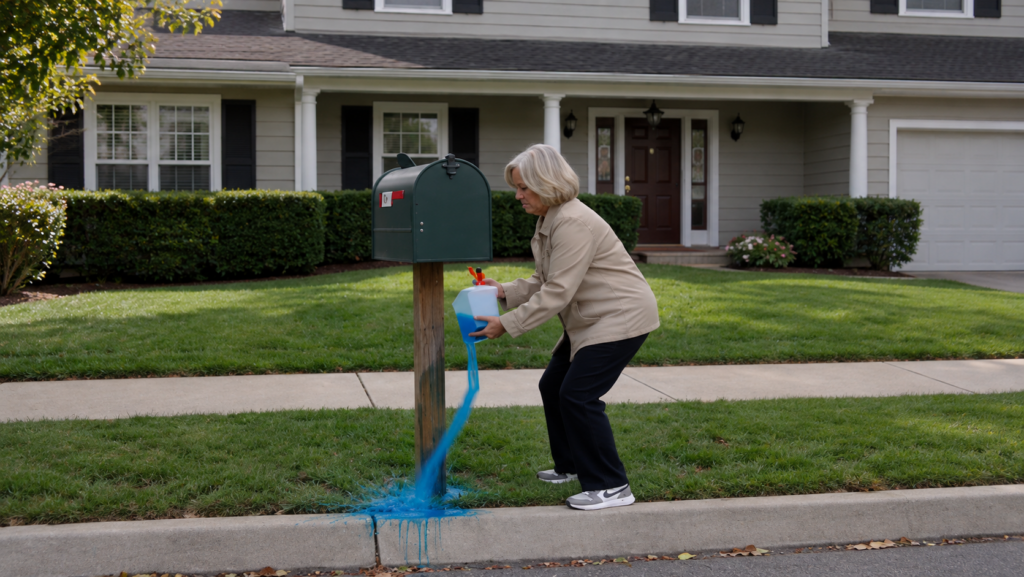
The first thing I noticed was that the woman carrying the container was wearing gardening gloves on a day when nobody was gardening.
The second thing I noticed was the man standing across the street with his phone raised before she reached my mailbox.
I had been standing behind my living room curtain, waiting for a delivery that had already been delayed twice.
My name is Claire Donnelly, and I had lived on Alder Court for eleven months.
That morning, I expected a letter from the state professional licensing board.
I did not expect my mailbox to catch fire.
The woman was Miriam Locke,
who lived two houses east of mine.
The man filming her was Owen Rusk, my next-door neighbor and the person who had spent the previous month telling everyone that I was dangerous.
Miriam tipped the container toward the curb.
A pale liquid spread over the pavement, and she stepped away.
Fire suddenly raced along the wet trail and rose beside the wooden mailbox post.
I shouted through the window and reached for my phone.
Owen continued filming.
Miriam looked directly at his camera, and something about her expression stopped me from opening the front door.
She looked frightened, but not surprised.
The fire grew quickly enough that I called emergency services instead of running outside.
I told the dispatcher where the flames were and that someone was standing dangerously close to them.
Miriam set down the container and finally backed away.
Owen crossed the street, still recording, and called out that he had witnessed an attempted attack on the neighborhood.
He did not look at the fire until I shouted his name.
The dispatcher told me to remain inside while firefighters approached.
I watched Owen move his phone from Miriam to my front window.
He smiled when he saw me watching.
The smile disappeared when the first fire engine turned into Alder Court.
CHAPTER TWO: A LETTER THAT HAD NOT ARRIVED
The firefighters extinguished the flames before they reached my porch.
The mailbox had blackened along one side, and the post leaned toward the road.
A captain named Denise Hall asked whether anyone had been injured.
I said nobody had been hurt, but the person who started the fire was still standing beside her container.
Miriam sat on the curb with her hands folded between her knees.
Owen approached the captain before she could speak to Miriam.
He said he had recorded the entire crime and could provide the evidence immediately.
Captain Hall asked him to stand back until the scene was safe.
He objected loudly enough for two neighbors to come outside.
I recognized the performance because I had seen him deliver the same speech at our neighborhood meeting.
Owen liked an audience more than he liked answers.
An officer took statements from each of us separately.
When it was my turn, I explained that I had been waiting for a letter that could determine whether I would return to my profession.
The officer asked whether the envelope contained money or confidential information.
I said it contained a decision about my professional standing,
but I had no reason to believe anyone else knew its contents.
That was not entirely true.
Owen knew enough to tell the neighbors that I had lost my license.
He did not know that I had appealed the decision or that the board was reconsidering the case.
I had never told him either detail.
When the officer asked about our disagreement, I told her that Owen had accused me of concealing an incident at my former workplace.
She asked what incident he meant.
I said a young patient had been injured during a transfer at the rehabilitation center where I worked.
I had reported a staffing failure, and the center had responded by accusing me of falsifying the transfer notes.
The accusation had suspended my occupational therapy license pending review.
Owen had learned about the suspension from a public notice and had treated it as proof that I was unfit to live beside his family.
He did not have children.
He simply preferred the phrase because it made his complaints sound less personal.
The officer listened without interrupting.
Then she asked whether I had seen Miriam ignite the liquid.
I said I had seen the fire erupt, but I had not seen the exact moment of ignition.
I refused to claim something I could not prove.
Across the street, Owen was telling another officer that his footage showed everything.
I wondered why a man who had been ready to record a fire had done nothing to prevent it.
CHAPTER THREE: THE WRONG WOMAN
Miriam was taken to the hospital for observation after she complained of dizziness.
Before the ambulance doors closed, she called my name.
I stepped toward her, and the paramedic allowed us a moment.
Miriam’s voice was barely audible over the engine.
She said she had not wanted the fire to reach my house.
I asked why she had brought the container at all.
She looked past me toward Owen and pressed her lips together.
Then she said that he had promised the liquid would only leave a visible stain.
I asked what he had wanted her to stain.
She said my mailbox, because he believed it held something that belonged to him.
The paramedic closed the door before I could ask another question.
I watched the ambulance leave and turned toward Owen.
He was already speaking to a television reporter who had arrived without being called by anyone I knew.
He told the reporter that he had intervened in a dangerous incident involving a troubled resident.
I realized he was talking about me.
He said my professional history had created a climate of fear on the street.
He never mentioned that Miriam had carried the container.
I asked the reporter whether Owen had explained why he started recording before the fire began.
Owen answered for her.
He said he had noticed suspicious activity and acted responsibly.
I asked why he had not warned Miriam or called emergency services.
He said I was trying to distract everyone from the real issue.
The reporter lowered her microphone and asked what the real issue was.
Owen looked at the damaged mailbox and said the neighborhood deserved to know what I was hiding.
I went back inside without giving him the confrontation he wanted.
At my kitchen table, I opened the tracking page for the expected letter.
The page showed that the item was still at the regional sorting facility.
My mailbox had burned before the letter reached our street.
That made Miriam’s statement about an envelope inside it impossible.
Someone had either lied to her or expected a different delivery.
CHAPTER FOUR: A SECOND ADDRESS
I called my attorney, Vanessa Cho, and described the fire.
She told me to preserve my photographs and stop discussing the licensing appeal with neighbors.
I said I had already told the police about the letter.
Vanessa said that was appropriate, but Owen’s interest in the decision needed an explanation.
I told her that Miriam had claimed Owen believed the mailbox contained something belonging to him.
Vanessa was silent for several seconds.
Then she asked whether I had received any correspondence from the former rehabilitation center at my home address.
I said I had received nothing since moving.
She asked me to check the address printed on the last notice from the licensing board.
I found the scanned notice in my email.
My street address was correct, but the apartment number field contained the words REAR UNIT.
There was no rear unit at my house.
Vanessa asked me to forward the notice to her.
She explained that someone had submitted an address amendment during the appeal.
The amendment was unusual because it added a delivery instruction I had never requested.
I asked whether Owen could have made the change.
She said we needed the submission history before drawing conclusions.
That afternoon, I walked to the post office instead of waiting for another delivery.
A supervisor named Grace Bellamy confirmed that my address was being flagged for manual review because of conflicting delivery instructions.
She could not tell me who had submitted them without a formal request.
She could tell me that a second delivery attempt had been scheduled for Monday.
I asked whether the letter could be held for pickup.
Grace checked the available options and arranged a hold after verifying my identification.
I left with a receipt showing that no important letter would be placed in my damaged mailbox.
When I returned home, Owen was standing at the curb beside the charred post.
He asked whether the fire had frightened me enough to move.
I told him the firefighters had done their job.
He said the neighborhood would not forget what happened.
I said I doubted it would.
For the first time since I met him, he seemed unsure whether I was afraid.
CHAPTER FIVE: THE FIRST CUT
The video appeared online before sunset.
Owen had posted a forty-second clip under a headline accusing me of provoking an elderly neighbor into a violent breakdown.
The footage began with Miriam pouring liquid and ended with her stepping back from the flames.
It did not include Owen’s conversation with her beforehand.
It did not include the fire captain telling him to move away.
It did include my face in the window, enlarged until it looked as though I was watching a spectacle rather than calling for help.
By dinner, strangers had begun sending messages to my workplace’s public contact address.
They demanded to know why a suspended therapist had been allowed near patients.
I had not worked with patients since the suspension.
My current job involved editing accessibility instructions for a small equipment manufacturer.
The messages were still enough to alarm my supervisor.
She called and asked whether I was safe.
I told her about the fire and the edited video.
She asked whether I wanted the company to issue a statement.
I said I wanted the company to stay out of it until we understood who had started the story.
After the call, I replayed Owen’s clip without sound.
The camera shifted left just before Miriam approached the mailbox.
For a fraction of a second, a silver vehicle appeared at the edge of the frame.
The vehicle was parked beside Owen’s house.
I recognized it as a delivery van used by the private courier company that serviced the rehabilitation center.
The recognition made me sit down.
The center had employed outside couriers to transport patient equipment and confidential administrative packets between branches.
Owen had once told me he worked in property maintenance.
He had never mentioned a connection to that courier company.
I enlarged the frame, but the company logo was partly hidden behind a tree.
I sent the original clip link to Vanessa and told her what I had noticed.
She replied that we needed the unedited footage, not a guess from a blurry frame.
I agreed.
Still, I could not forget the van.











