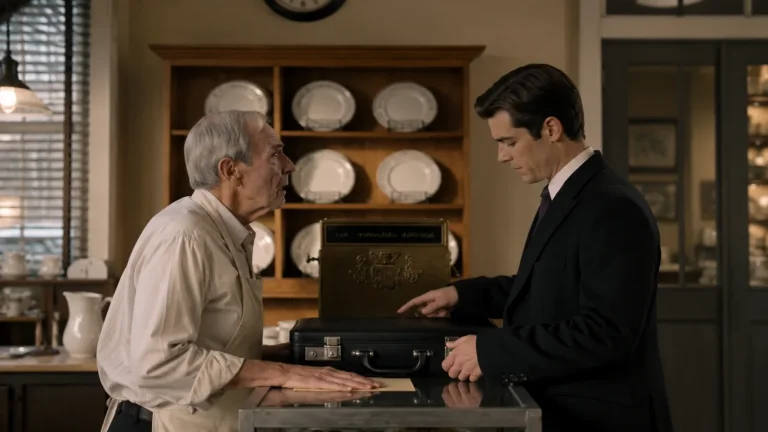
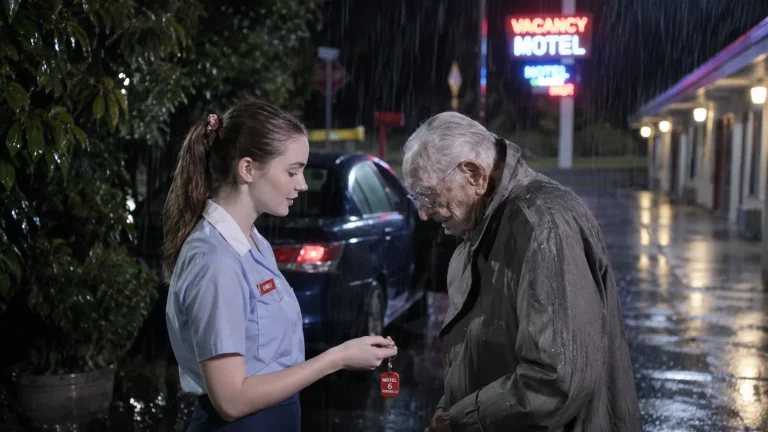
Some names belonged to workers injured during the hotel’s construction.
Others belonged to families whose relatives had died in the basement fire.
The payments were not company checks.
They came from Thomas’s personal account.
“He was helping them himself,” Ethan said.
Celia examined the list.
“Or recording payments he was responsible for distributing.”
Beatrice found a matching folder of canceled checks.
Several carried Thomas’s signature, while others had been issued from an account controlled by the Harrington Preservation Trust.
The amounts differed.
One family had been promised twenty thousand dollars but received only four thousand.
Another had signed a receipt acknowledging a payment its surviving daughter said she had never seen.
Ethan looked at the names.
“Who were these people?”
Beatrice opened an old staff directory.
“Maintenance workers, electricians, kitchen employees, and two night cleaners.”
Ethan recognized a surname from Samuel’s account of the fire.
Leonard Price appeared on the list with a note beside his name.
The note read, ‘Witness to the door.’
Celia asked Beatrice to preserve the checks with the other records.
Adrian studied the list and then took out his phone.
“The trust still has an account for historic employee relief,” he said.
“I approved a payment from it last year.”
Ethan looked at him.
“To whom?”
“A consultant who claimed to be locating descendants of former staff.”
Celia asked for the consultant’s name.
Adrian checked the archived invoice.
“Bellamy Heritage Research.”
Howard Bellamy had opposed the preservation review at the board meeting.
Adrian sat down hard on the edge of a chair.
“I signed that invoice.”
“You signed an invoice based on a representation,” Celia said.
“Now we find out whether the work was performed.”
Adrian shook his head.
“I thought I was helping people.”
Ethan remembered the old man’s shaking hands as he accepted coffee in the lobby.
“So did I,” he said.
“The difference is that you still have the power to check what happened next.”
That evening, Celia arranged a video call with a retired financial examiner named Patricia Webb.
Patricia had worked on trust audits for charitable organizations and agreed to review the public filings before deciding whether she could assist formally.
She warned them that historic accounting could be incomplete without being fraudulent.
“A missing receipt is not proof of theft,” she said.
“But a pattern of fabricated recipients would be different.”
She asked for the trust’s grant registers, bank statements, and the consultant’s deliverables.