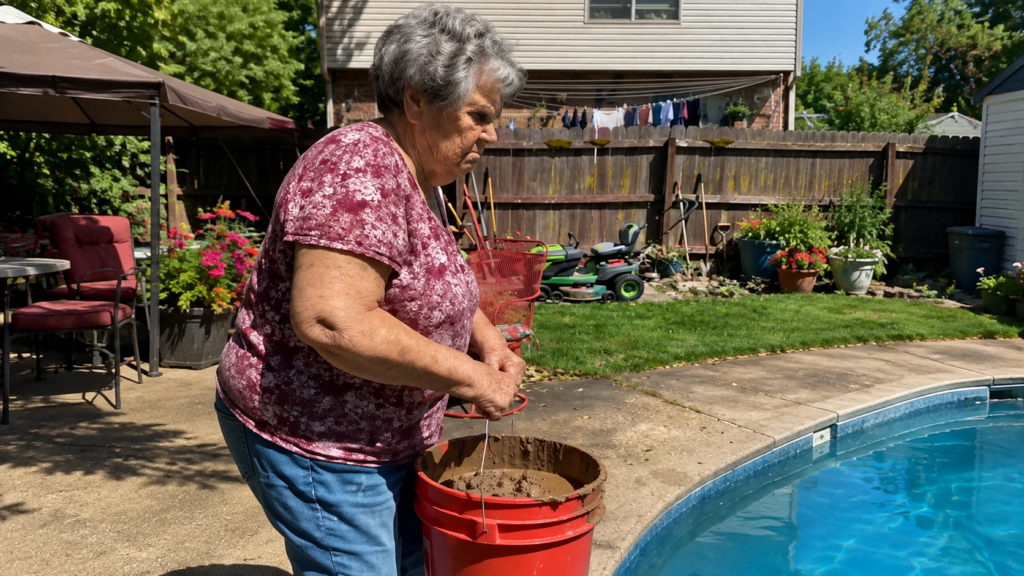
Carol Briggs came through Ethan Cole’s side gate carrying a yellow bucket in both hands.
The bucket was heavy enough to make her shoulders sag, but she never slowed down.
She crossed the patio, planted her feet beside the deep end, and tipped the contents into the water.
A thick brown cloud rolled beneath the surface.
It spread around the ladder and drifted toward the pale blue tiles like smoke trapped underwater.
Carol shook the bucket twice to dislodge the last clumps.
Then she lowered it and waited.
The sliding door rattled open behind her.
Ethan Cole emerged barefoot, still holding the sandwich he had been making for lunch.
He looked at the spreading mess, then at Carol, then at the bucket.
“What the hell are you doing?”
Carol let the empty bucket fall on the concrete.
“You should have listened when I warned you.”
“You warned me about parking.”
“I warned you about the people coming to this house.”
“You ruined my pool because you don’t like my visitors?”
“You don’t understand what they’re doing.”
Ethan stopped three steps away from her.
The old woman had angry eyes, but her hands were shaking.
She looked up toward the upstairs bedroom window.
She looked there again even while Ethan spoke.
It was the room where his guest, Oliver Venn, had been staying since Monday.
Ethan lowered his voice.
“You weren’t trying to ruin the pool, Carol.”
Carol stared at him.
“You were trying to make me drain it.”
The color left her face.
Three days earlier, Ethan had removed a leaf from the deep-end drain cover and noticed an orange plastic object wedged beneath the grate.
It looked like the corner of a tiny propeller guard.
He had taken a photograph, then decided to leave it until the pool service arrived.
Now Carol was looking straight at that part of the water.
“Who told you it was down there?” he asked.
“Nobody.”
“Then why did you look at the deep end before you emptied your bucket?”
Carol bent to pick up the bucket.
“Drain it and find out.”
Ethan caught the handle before she could lift it.
“Tell me what I’m supposed to find.”
A window slid open above them.
Oliver leaned out, a cheerful man in his late thirties with close-cropped hair and the permanently pleasant expression of a salesman.
“Everything okay down there?”
Carol turned her back to the house.
Ethan saw the change immediately.
The woman who had just marched into his yard swinging a full bucket now seemed frightened of being recognized.
“Someone dumped something in the water,” Ethan called.
Oliver’s eyes traveled from the muddy surface to the deep end.
“That’s unfortunate,” he said.
He closed the window without asking who had done it.
Carol whispered, “Don’t let him near the equipment in your garage.”
Ethan opened his mouth, but a horn sounded from the street.
A white van had stopped outside the gate.
On its side was the logo of the junior engineering competition Ethan had agreed to host that Saturday: BLUE CURRENT CHALLENGE.
Carol stepped away from him.
“I did something terrible,” she said.
“Then help me understand it.
”
“I will.”
She looked up at the closed window one last time.
“But not while he’s listening.”
CHAPTER TWO — THE GUEST UPSTAIRS
Four days earlier, Ethan would never have imagined Carol near his pool with anything worse than a complaint about noise.
She had lived next door for nineteen years and had opinions about everything from fence height to holiday decorations.
She also maintained the neatest front garden on the block and collected discarded bicycles for the local repair club.
Ethan knew both versions of her, though he preferred conversations that ended before she began counting his guests.
He was thirty-six,
a science teacher between school contracts, and his late father had left him the house and its enormous, expensive swimming pool.
For most of the year, he used the garage as a workshop for neighborhood students who liked building small machines.
Their latest fascination was underwater robotics.
An organization called Blue Current had offered to provide kits and mentors for a regional competition.
Ethan had volunteered his pool for the trials because the public aquatic center had closed for repairs.
The idea had seemed harmless, even generous.
Teenagers would build small remote-controlled machines, guide them through underwater hoops, and retrieve colored markers from the pool floor.
Saturday’s event would feature eight teams, a local news photographer, and a modest scholarship for the winners.
The organizer, Oliver Venn, had arrived early with two crates of equipment and a promise that insurance covered everything.
Oliver was friendly, decisive, and aggressively grateful.
He had offered to stay in a motel, but Ethan had put him in the guest room to simplify the preparations.
By the second night, the cheerful organizer had taken over the garage and begun locking his equipment crates.
He called them proprietary training units.
Ethan disliked the locks but accepted the explanation because schools often worried about children copying designs before competitions.
On Tuesday morning, a freshman named Priya had brought in a yellow-and-black underwater robot she built with her friend Mateo.
Oliver handled it for a long time and complimented the workmanship.
Then he set it beside one of his orange prototype vehicles.
“These are fun,” Oliver said, “but ours can do something more interesting than retrieve rings.”
“What?” Priya asked.
“Work autonomously.”
Priya frowned.
“Underwater, without someone driving?”
Oliver smiled.
“You’ll see Saturday.”
Later that afternoon, Ethan spotted Carol outside the fence listening to the kids test a motor.
“They’re loud,” she said.
“They’re fourteen,” Ethan replied.
“One of those boys in your garage is fourteen?”
“Some are sixteen.
”
“Are they being paid?”
“They’re competing for a scholarship.”
“Who owns what they invent?”
The question seemed so unlike her usual complaints that Ethan laughed.
Carol did not.
“Read the fine print,” she said.
He promised he would, then forgot because Mateo’s controller had started smoking and required attention.
On Wednesday morning, Ethan noticed the orange piece under the drain cover.
He was cleaning leaves when he saw it lodged between two bars.
He photographed it because it had a distinctive three-pronged shape.
He intended to show the picture to Oliver.
But Oliver was on a video call upstairs, speaking sharply enough that Ethan heard him through the hallway.
“We need the last one accounted for,” Oliver said.
“I don’t care what the parents think they signed.”
Ethan stepped away before hearing anything else.
He told himself he had probably misunderstood a discussion about equipment inventory.
By Friday noon, that explanation no longer satisfied him.
Especially after Carol dumped an entire bucket of brown garden sludge into the pool.
CHAPTER THREE — WHAT WAS IN THE WATER
The white van driver turned out to be a young delivery worker carrying replacement battery packs.
Ethan signed for them without mentioning the pool.
Carol stood beside the fence, her bucket now hidden behind a planter.
When the van left, Ethan led her into the garage.
He closed the door before Oliver could come downstairs.
“Start at the beginning,” Ethan said.
Carol seated herself on a wooden stool.
Her old hands rested flat on her knees.
“My granddaughter is on one of those teams.”
Ethan remembered a reserved sixteen-year-old named Nell who had visited twice with Priya.
“I didn’t know she was your granddaughter.”
“My daughter lives across town.”
“Why didn’t you say anything?”
“Nell asked me not to.”
Carol looked embarrassed.
“She thinks I ruin everything by interfering.”
Ethan waited.
“Three weeks ago, Nell came to my house with a small orange robot part,
” Carol said.
“She wanted me to help repair a broken guard because I used to make molds for a plastics factory.”
“You used to do that?”
“For thirty-one years.”
“You never told me.”
“You never asked.”
Ethan deserved that.
Carol continued.
“The guard had a serial mark etched into it, not stamped.”
“Why does that matter?”
“Because someone had scraped off the original maker’s mark and etched a new one over it.”
She pointed at Ethan’s photograph on his phone.
“That shape is the same part.”
“How could you see it in the pool?”
“Nell showed me a picture yesterday.”
“Why didn’t she tell me?”
“She’s scared.”
Carol swallowed.
“Oliver told the students their scholarship entries would be disqualified if they talked about his special equipment before Saturday.”
“That’s normal for a contest.”
“He also made them sign an agreement giving Blue Current permission to exhibit and modify their designs.”
Ethan shrugged.
“Exhibition permission sounds ordinary.”
“It would be, except Nell says the prototype he calls his own is built from the students’ machines.”
Ethan pulled up his pool photograph again.
The orange fragment was visible, but it was small and blurry.
“Why would he put it in my pool?”
“He didn’t mean to.”
Carol stared at the concrete floor.
“Nell was testing the robot Thursday night when Oliver arrived and ordered her out.”
“She wasn’t supposed to be here Thursday night.”
“She knows.”
“How did she get in?”
“The side gate was open.”
“And you knew?”
Carol nodded.
“I brought her over.”
Ethan rubbed his forehead.
Carol continued quickly.
“Nell said the machine moved on its own.”
“Autonomous control isn’t impossible.”
“She said it ignored the safety line and drove straight toward the drain.”
“And the guard broke off?”
“Yes.”
“Then why ruin the pool?”
Carol’s voice fell.
“Because Oliver saw her testing it.”
She lifted her eyes.
“He told her if the broken piece stayed in the water, there would be consequences for her and her school.”
“What consequences?”
“He said she had taken confidential technology.”
Ethan considered the situation.
“He could simply remove it.”
“He didn’t want you watching.”
“Then why not come when I’m asleep?”
“Because you installed a gate alarm this week.”
Ethan nodded reluctantly.
The alarm had been his response to the children entering unsupervised.
Carol wrung her hands.
“I thought if the pool had to be emptied for cleaning, the service crew would find the broken part before Oliver could make Nell look like a thief.”
“You could have told me.”
“I tried Thursday.”
“You complained about the parked cars.”
“I was trying to get you outside without him.”
“That was a terrible way to communicate.”
“I know.”
Ethan glanced toward the garage window.
Oliver was crossing the patio in dress shoes, carrying his laptop.
“Tell me what you dumped,” Ethan said.
“Compost and spent coffee grounds.”
“Nothing chemical?”
“Nothing chemical.”
“That’s still going to take hours to clean.”
“I’ll pay for it.”
Oliver knocked on the garage door.
“Ethan? We need to talk about tomorrow.”
Carol went pale.
Ethan drew a breath and opened the door.
“So do I,” he said.











