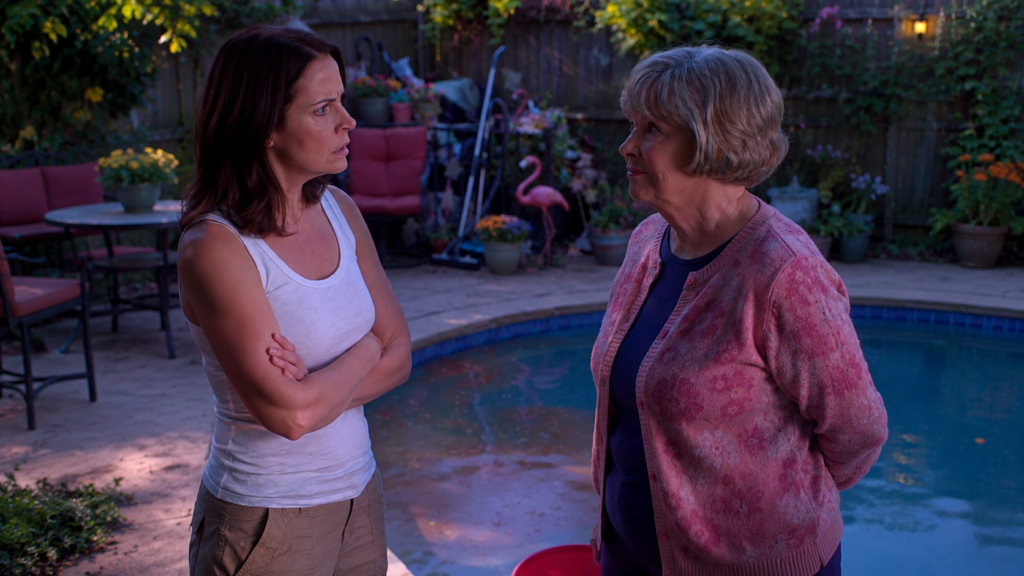
Daniel Reed stepped into his backyard and froze.
Carol Mercer stood on the coping of his swimming pool with an empty bucket dangling from one hand.
A brown cloud spread over the blue water and curled around a yellow inflatable duck.
The duck had been there since his niece’s birthday on Saturday.
Daniel recognized Carol’s pale cardigan and the satisfied expression she wore whenever she believed she had won an argument before it began.
“What did you put in my pool?” he demanded.
“Something that should persuade you to listen,” she said.
“Was that sewage?”
“You should have drained it when I told you.
”
Daniel stayed beside the patio table instead of approaching her.
His phone was already in his hand, but he wanted an answer before he started recording.
“That pool is on my property, Carol.”
“Then take responsibility for what’s under it.”
She looked startled by her own words.
Daniel followed her gaze toward the deep end, where the broad dark shadow beneath the diving board had always looked like a patch of older tile.
“What’s under it?” he asked.
Carol tightened her grip on the bucket.
“Nothing you need to concern yourself with.”
The side gate clicked.
A man in a navy work shirt stepped through carrying a water-testing case.
“Mr. Reed? I’m Owen Price from Clearwater Pool Care.”
Owen stopped beside the deck and stared into the discolored water.
“Carol, you again?”
Daniel turned to him.
“You know her?”
“She called our office twice this week and told dispatch she owned this property.”
Carol lifted her chin.
“I explained that there was an urgent problem.”
“You specifically demanded that we empty the deep end,” Owen said.
“You asked whether the lower wall panels would become accessible once we drained it.”
Daniel looked toward the deepest section again.
“What panels?”
Owen set down his testing case.
“I don’t know yet,
because I didn’t take instructions from someone who couldn’t verify ownership.”
Carol started walking toward the side gate.
Daniel raised his phone.
“Stay long enough to tell me what you dumped.”
“Garden waste,” she replied.
“Is that all?”
“You can send me a cleaning bill.”
“You haven’t answered the question.”
She pushed past Owen and disappeared into the driveway.
Daniel heard the wheels of her garden cart rattling over the sidewalk.
Owen watched the brown cloud travel toward the skimmer.
“Turn off the pump for now,” he said.
“What did she do?”
“I can’t tell from here whether it’s compost tea,
mud, or something worse.”
“Can you test it?”
“I can take samples and recommend a licensed lab.”
Owen knelt near the deep end and leaned over the edge.
He studied a narrow line of pale tile beneath the water.
“That’s unusual.”
“What’s unusual?”
“Most pools built in this decade don’t have a line of brass fasteners behind the last tile row.”
Daniel crouched beside him.
Tiny metallic points gleamed through the shifting brown water.
He had lived in the house for four years without noticing them.
“Could they be from an old repair?”
“Possibly, but I wouldn’t assume anything.”
Owen stood and wiped his hands.
“Do you have photographs of the pool before you bought the place?”
“Only the listing pictures.”
“Find them before anyone touches those fasteners.”
Daniel pointed toward the street.
“Why would Carol know about them?”
“That’s a question I’d rather hear her answer.”
CHAPTER TWO — THE NAMES ON THE PROGRAM
Daniel’s sister, June, answered his call while she was loading props into the back of her hatchback.
“Please tell me the duck survived,” she said.
“The duck is alive. My pool may not be.”
He explained the bucket, Carol’s demand, and Owen’s discovery.
June grew quiet when he described the brass fasteners.
“Where exactly are they?”
“Along the lower tile line, near the diving board.”
“And you said the old owner was called Marianne Bell?”
“Yes. Why?”
“Marianne was a dancer.”
Daniel pulled his phone closer.
“You mean the woman who sold me the house?”
“I mean an actual performance artist. Dad took me to something she organized when I was little.”
June tried to remember the name.
“The Drowned Clock, maybe. Or The Quiet Clock. It was in a swimming pool.”
“A water ballet?”
“Not exactly. There were performers below the surface and musicians above it.”
Daniel looked at the pool through the kitchen window.
“That seems like a strange thing to build into a house.”
“She inherited a fortune from a relative and spent most of it staging things people couldn’t explain.”
“Why didn’t you tell me this when I bought the house?”
“You told me to stop telling you stories about haunted real estate.”
June laughed once and then stopped.
“Actually, the people in the neighborhood were furious when the final production was canceled.”
“When?”
“I don’t remember. Let me ask someone.”
That afternoon Daniel found the original property listing in an old email.
The photographs showed a newly resurfaced pool, bright blue and apparently ordinary.
One image had been taken from the upstairs bedroom window.
Daniel zoomed in until the pixels fractured.
The deep end contained a faint rectangular outline beneath the water.
He forwarded it to Owen, who replied that they should wait for test results before draining anything.
Then June called again.
“I found a woman who was in the company,” she said.
“Her name is Celia Park. She’s teaching dance at the community center.”
“Did you tell her about Carol?”
“I mentioned the house, but not the bucket.”
“Why not?”
“Because she went silent when I said Marianne Bell’s name.”
Daniel sat down at the kitchen table.
“What did she say?”
“She asked whether I could come see her privately.”
June hesitated.
“She said the last performance never happened because somebody made a piece of the stage disappear.”
Daniel stared toward the deep end.
“What piece?”
“She wouldn’t tell me over the phone.”
An unfamiliar car rolled slowly past the house.
Daniel glanced outside and recognized Carol in the passenger seat.
A man with silver hair drove, keeping both hands high on the wheel.
They looked toward the pool gate without turning their heads.
“June, can you pick me up?”
“What’s wrong?”
“I think the woman who poured that bucket is looking for something she doesn’t want anyone else to see.
”
CHAPTER THREE — THE EMPTY SEAT
Celia Park taught dance in a former grocery store with a sprung wooden floor and a mural of flying birds.
She was seventy and wore a long black skirt over bright green sneakers.
When Daniel introduced himself, she looked at his hands rather than his face.
“Marianne made people show their hands before she trusted them,” Celia explained.
“She believed you could tell a person’s whole history from how they held something fragile.”
June took a seat on a folding chair.
“You performed in Marianne’s pool?”
“We rehearsed there for eighteen months.”
Celia led them to a wall of framed programs.
One yellowing poster showed eight figures suspended underwater beneath a painted circular clock.
The title was THE HOURS WE CANNOT KEEP.
Daniel leaned closer.
The circular clock consisted of twelve movable brass shutters that opened like flower petals.
“Is that the deep end of my pool?”
“Yes,” Celia replied.
“It used to have a removable underwater stage face.”
“How did people breathe?”
“They didn’t stay down as long as the poster makes it appear.”
Celia pointed to the musicians pictured at poolside.
“Everything depended on timing, weight, and trust.”
Daniel indicated a small dark panel near the center of the painted clock.
“What’s that?”
Celia’s expression changed.
“That was the heart of the piece.”
“A machine?”
“A handmade mechanical instrument called the tide organ.”
She took a breath.
“When water moved through the chamber, it produced tones that the dancers could feel through their feet.”
“And it disappeared?”
“The night before our final performance.”
Celia walked to a bench and sat slowly.
“Our rehearsal director insisted that Marianne had ordered it removed because the machinery was unsafe.”
“Who was the director?” Daniel asked.
“Carol Mercer.”
June turned sharply toward her brother.
Celia continued before either could speak.
“Carol was younger then, and she was the most precise person I’d ever met.”
“She also knew exactly how frightened Marianne was of disappointing people.”
Daniel glanced at the poster.
“Did Marianne agree to cancel?”
“She agreed after she was told the organ had been destroyed.”
“Was it?”
“Nobody ever showed us the remains.”
Celia removed a photograph from a drawer.
It showed a younger Carol standing beside the pool, holding a metal box with a handle on each end.
A young man beside her grinned at the camera.
“That’s Leo, her husband,” Celia said.
“He built the instrument.”
Daniel considered the picture.
“And the thing Carol wanted exposed by draining my pool could still be there?”
“If Marianne sealed it behind the stage face.”
“Why would she do that?”
Celia shook her head.
“She didn’t.”
She tapped the photograph with one finger.
“Carol told everyone she had removed it.”
A group of teenage dancers entered the studio, talking over one another.
Celia waited for them to pass.
“If you’re right about what’s still under your pool, there is something else you should know.”
“What?”
“A museum has been trying to recreate that performance for an exhibition next month.”
Daniel looked at her.
“Who invited them?”
“Carol.”











