The brick came through the patio window at four seventeen on a Thursday afternoon, when the sun still made a bright square on the living room rug.
Mara Ellison had been lying on her sofa with a notebook balanced on her knees, trying to find a decent ending for a children’s story she had promised to read at the library. She heard two soft footsteps outside, a scrape against the concrete, and then the violent crash. A brick bounced once on the hardwood floor. Glass traveled across the room in glittering arcs.
Mara threw her arms over her face. A small piece struck her sleeve. She stayed crouched for several seconds, listening for another blow.
“What was that?” she said, although the answer sat among the broken glass.
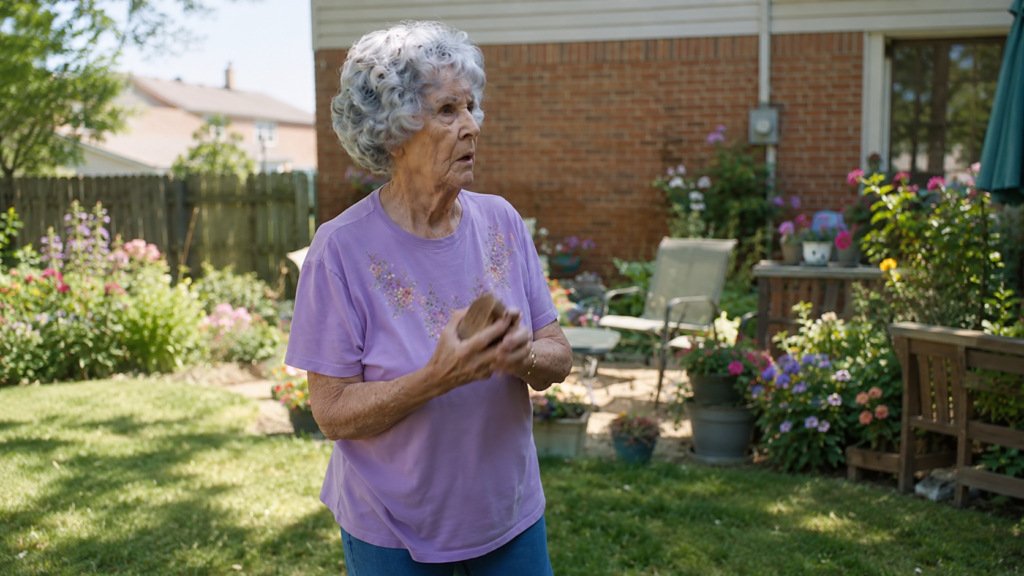
Through the jagged opening she saw an elderly woman in a pale yellow cardigan walking briskly toward the side fence. The woman kept her shoulders stiff and her head lowered. Mara knew her as Willa Fenwick, from two houses down, a retired school bus driver who rarely spoke to anyone without first checking whether they had parked across the sidewalk.
Mara started toward the patio, then stopped. Her phone was in her hand already. The gallery was open because she had been choosing pictures for the library reading. She swiped past a photograph of a blue paper kite, then another of a cardboard castle. The third showed the back of her house taken the previous evening.
She stared.
There was a small red wagon beside the garden shed in the photograph. Mara had never owned a red wagon. In the next image the wagon was gone, but a chalk arrow pointed toward the narrow gate. In the next, a young boy with a shaved head stood half behind the fence, looking directly at the camera. He wore a lime-green raincoat despite the clear evening.
Mara hadn’t taken those photographs. They had appeared in the shared album she used with the library’s volunteer photography group. Someone had uploaded them under her name.
A new photograph arrived as she watched. It showed Willa Fenwick on Mara’s patio at four twelve that afternoon, five minutes before the brick. Willa was looking toward the upstairs window, holding the brick at her side. Behind her, in the reflection of the intact glass, stood a man with a narrow black case. His face was outside the camera’s direct view.
Mara glanced at the shattered pane. The reflection was gone now.
Her security app chimed. The patio camera had recorded the impact. Mara opened the video, scrubbed back thirty seconds, and saw Willa cross the lawn. Nothing surprising yet. But when she slowed the image, Willa paused before throwing, looked deliberately toward the camera, and formed three words with her lips.
Mara watched three times.
“Look behind you.”
She turned slowly. The living room was empty. Yet from the hallway came the faintest sound of the front door’s latch being tested.
Mara did not shout. She took the brick from the floor only after wrapping it in a kitchen towel, stepped over the glass, and retreated into the kitchen, where the side door had a deadbolt. A shadow moved across the hallway wall. A second later the front door opened by an inch.
“Hello?” a man’s voice called. “Home security service. We received an alarm.”
Mara had never contracted a home security service. She held her breath.
“Mrs. Ellison?” he said. “I can see the damage. It’s safer to let me inside.”
The lock stopped moving. Footsteps went away. Mara waited until she heard a car engine pull away, then called the police. While she spoke, another image appeared in the album: the narrow black case resting on the hood of a white van. Along the side of the van, almost erased by a smear of mud, were three orange letters: ARC.
The dispatcher asked whether she was injured. Mara said no. Then she said something that sounded impossible even to her: “I think my neighbor broke the window to stop someone else getting in.”
Outside, Willa Fenwick hadn’t disappeared at all. She was standing behind the hedge beyond the gate, watching the street as if she were waiting for something to move.
Chapter Two: A Man Who Knew the Lock
Officer Denise Holt arrived first, a careful woman with a practical voice and an umbrella she carried even when the forecast promised sunshine. She looked at the broken pane, examined the brick, and listened without interruption as Mara described the man at the front door.
“He said he was from home security?”
“I don’t have home security. I have cameras I installed myself.”
“Do you know your neighbor?”
“Enough to recognize her. Not enough to explain this.”
Holt watched the footage once. Willa’s face was unmistakable. So was the brick leaving her hands. Holt asked why Mara hadn’t gone outside.
“Because she told me not to,” Mara said.
Holt played it again without sound, studying Willa’s mouth. “Maybe. I can’t be certain.”
A second officer arrived to examine the door. He found fresh scratches around the latch and a narrow strip of metal caught inside the frame. The supposed security technician hadn’t simply knocked. He had tried to open the lock.
That changed the conversation. Holt requested a second patrol car, then asked Mara about the mysterious photographs. Mara opened the shared album. It was labeled FERN STREET LIBRARY DAY, the title of a community project that had ended a month earlier. Its participants had used a tablet at the library to upload photos for a children’s exhibition. Usually their names showed beside their pictures. These new ones were marked MARA ELLISON.
“Could somebody still have access?” Holt asked.
“The librarian can. Four volunteers. And whoever has the old tablet if it wasn’t reset.”
The officer photographed the screen with her own device. “Don’t delete them.”
A message appeared beneath the newest image, written in ordinary text rather than embedded in the photograph: Please don’t tell anyone where the boy is.
Mara felt a cold tightening beneath her ribs. “What boy?”
She had worked with children for eleven years, first as a teacher and then as a part-time storyteller. Dozens came through the library. The boy in the raincoat could have been one of them, although his face was only partly visible. She searched her memory for the shaved head and the way he held his sleeve in one hand.
Then she remembered a boy named Eli, perhaps twelve, who had come to a library reading with a woman in a blue coat. He had asked whether stories ever became real if enough people repeated them. Mara had told him stories could make real people act differently. He had nodded as though she had answered a question she didn’t understand.
The woman in blue had kept one hand on his shoulder the entire time.
Holt took the phone. “We need to establish if the boy is missing. But we also need to know who is sending these images and why they’re being attributed to you.”
Across the street, a cream-colored hatchback stopped. A man climbed out carrying a roll of clear plastic and a tool bag. Mara recognized him as Tomas Vale, a window repairer she’d once hired when a storm broke the upstairs pane. He waved cautiously.
“Did you call somebody to board it up?” Holt asked.
“Not yet.”
Tomas came to the front path. “A woman named Willa called. Said you might need a temporary covering and that I shouldn’t enter until the police said it was all right.”
Holt considered that information. “Where is she now?”
“Didn’t say. She sounded upset.”
Tomas fixed the glass opening while Holt spoke to another officer outside. Mara watched the plastic sheet rise over the jagged frame. It snapped faintly in the breeze, making the room feel like a tent on a cold beach.
When the officers left, Holt gave Mara a direct number. “Don’t approach Willa on your own. We want to speak with her. If that man returns, call immediately.”
Mara thanked her. But an hour later, after the repairer drove away, Mara found a folded yellow receipt under the welcome mat. On its blank reverse Willa had written six words in shaky capitals: HE HAS ANOTHER WAY INSIDE.
Chapter Three: The Other Way
Mara locked every door and went upstairs. There were two windows facing the rear yard, one in the spare bedroom and one above the landing. Neither showed any obvious damage. The attic hatch was closed. The garage door was secured. She checked the bathroom cabinet because panic made people do absurd things, then forced herself to stand still and think.
The old house had belonged to her aunt, who had raised flowers and hated modern locks. Mara had spent six months replacing the worst of its plumbing and painting over floral wallpaper. There were no secret passages, no remarkable architectural features, nothing a stranger should know better than its owner.
Unless the warning referred to something ordinary.











