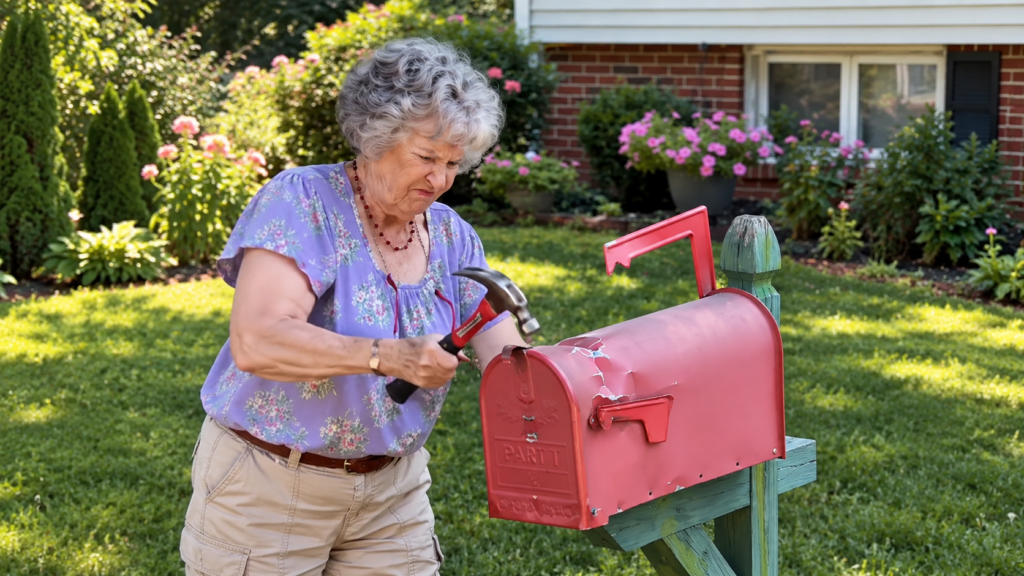
The first blow sounded like somebody had struck an empty cooking pot. The second was lower, heavier, and unmistakably deliberate.
Caleb Mercer looked up from the strip of yellow canvas in his hands. Through the front room window he saw Mrs. Odessa Vale standing beside his pink mailbox, a red-handled hammer lifted above her shoulder. She was seventy-one, narrow through the shoulders, and usually carried a folded shopping bag or a gardening trowel. She brought the hammer down a third time. The little metal door sprang loose. Another blow folded the left side inward until the box looked like an animal trying to hide its face.
Caleb dropped the canvas. He had painted that mailbox with his daughter Iris the spring before she left for college. It was the exact shade she called strawberry milk, brighter than anything on Larch Street. In the moment before he reached the door, he expected to feel anger. He felt it for perhaps half a second. Then he saw the way Odessa took her first step away.
Her left foot landed flat, too far across the center of her body. Her right shoulder sagged as though the hammer weighed twice what it should. More alarming, she did not turn toward her own house. She headed down the road toward Quarry Hill, where children were already wheeling homemade racing carts toward the annual Gravity Day starting line.
Caleb knew that walk. He had seen it in the old fairground yard, when Odessa was a mechanical inspector and a collapsing display had nearly pinned her against a fence. She had walked just like that while trying to hide a broken ankle. A person who knew her would understand what others might mistake for stubbornness: Odessa never slowed down when she was frightened.
He ran outside in a blue plaid shirt and unlaced work boots.
“Odessa!” he shouted.
She did not look back. The hammer swung at her side, its red handle bright against her gray cardigan. Caleb crossed the lawn without stopping at the ruined mailbox. He had not followed a person carrying a hammer to argue over forty dollars of folded sheet metal. He followed because of the direction she was going and because she had been at Quarry Hill twice already that week, watching the young racers with an expression he could not read.
“Stop a minute! You’re limping!”
That made her accelerate. She almost stumbled at the curb, recovered, and stepped into the narrow strip of shade cast by the parked delivery van.
“Go back inside, Caleb.”
“Not until you tell me what happened.”
“You saw what happened.”
“I saw you destroy a mailbox. I also saw you head for a street you won’t normally cross without checking the traffic twice.”
She turned then. Her face was flushed and her lips were pressed so tightly together that the skin around them had whitened. She pointed the hammer toward his house, not at him.
“You care so much about that pretty box? Good. Maybe you will care about something else I break before noon.”
A bicycle bell sounded behind them. Two boys rolled downhill, each steering a crude racing chassis with bare wooden sides. They recognized Caleb, shouted hello, and disappeared around the bend. Odessa watched them go. Her whole face changed, and Caleb finally understood that the children were not incidental to her attack.
“Is this about the race?” he asked.
“It’s about whether you can still tell the difference between a child being brave and a child being used.”
Caleb felt an unpleasant pressure behind his ribs. “Whose child?”
Instead of answering, Odessa turned toward Quarry Hill again. He stepped into her path and held out one hand, palm open.
“Give me the hammer. We can walk together.”
“No.”
“Then I walk beside you. But you won’t leave me guessing.”
Odessa stared past him at the pink wreck on his lawn. “Your mailbox made a lovely noise,” she said quietly. “The kind of noise people always hear. I tried every quieter way first.”
She resumed walking. Caleb matched her pace, glancing once over his shoulder. The mailbox was still crooked, its small painted flag caught beneath the crushed lid. Iris would be furious when she saw it. He would have to explain. But on the hill ahead, a row of bright banners snapped in the wind, and he heard the distant cheer of children testing their horns.
He followed Odessa toward the race, not knowing yet that the mailbox was the least expensive thing she meant to break.
CHAPTER TWO: THE HILL
Every October, the residents of Bellwether ran their Gravity Day races down Quarry Hill, a steep but broad section of abandoned service road beside the old municipal quarry. The rules were simple enough to fit on a poster: no engines, no motorized assistance, helmets always, and one child per cart. Nobody was allowed to race until a volunteer mechanic checked the brakes, steering, wheels, and seat restraints. The finish line ended before the road flattened into the public parking lot.
Caleb had served on the inspection team for nine years. He spent the rest of his weekdays restoring kitchen furniture in his garage, but Gravity Day was what brought neighbors to his door. Parents borrowed clamps; teenagers asked about bearings; elderly residents brought mismatched screws they had saved in jam jars. The race was never especially fast. It was supposed to make children proud of making something with their hands.
This year the committee had changed the format. Their new chair, Silas Dent, had convinced three shops to sponsor a separate exhibition run called the Lightning Class. Older teenagers could race on a longer route, with taller wheels and streamlined bodies, provided they received special approval. Silas claimed the exhibition would save the festival, which had been losing visitors and money for years. He also made a point of saying the old volunteer inspection system was quaint, a word Caleb did not enjoy.
Odessa had opposed the exhibition at every meeting. She had once designed brake systems for traveling amusement rides and believed the extension included a dangerous bend. Silas dismissed her as someone who could not accept a new generation of builders. Caleb had defended her right to speak but voted to allow the exhibition after inspecting a proposed route drawing.
By the time they reached the upper lot, families were already unloading carts. Someone had stretched colorful bunting between portable fences. A volunteer had set out buckets of chalk and water. A group of younger children painted their names on cardboard shields, while an older boy adjusted the front axle of a narrow black cart covered with silver lightning bolts.
Caleb recognized the boy: Leo Park, seventeen, a quiet student with an extraordinary ability to visualize mechanical motion. Leo’s father worked nights, and Caleb had helped the boy build his first cart when he was eleven. Leo was racing in the Lightning Class today. The black cart looked far more sophisticated than the one Caleb had seen in his garage two weeks earlier.
Odessa gripped Caleb’s forearm. “Look at the rear wheels.”
He looked. The wheels were polished, narrow, and mounted on an unfamiliar frame. “They’re new.”
“Yes. They were changed yesterday.”
“Who changed them?”
“Ask Silas.”
Near the sign-in table, Silas was speaking to the manager of a sporting goods store. He wore a branded vest, spotless boots, and an expression usually reserved for men standing beside large checks. When he saw Odessa, his smile cooled.
“We’re not opening another debate,” he said before they were close enough to greet him.
Caleb interrupted. “Did Leo change his rear wheels?”
“All Lightning Class carts are approved by our expert adviser.”
“Which expert?”
“A regional fabrication consultant.”
Odessa laughed once, without humor. “A consultant who has never pushed one of those carts around a corner?”
Silas stepped forward, lowering his voice. “You are not doing this again. The public safety plan is settled.”
“A plan doesn’t make hardware safe,” Odessa said.
“And smashing the neighbor’s mailbox does?” Silas asked.
Caleb turned. “How did you know about the mailbox?”
Silas’s expression flickered. He looked at the volunteer holding a clipboard. “News travels.”
But Caleb had not called anybody, and Odessa had walked straight here without speaking to another adult. Something was wrong with the timing.
A clear plastic display near the entrance showed the new race route. Caleb studied its sharp final corner. It was not simply longer. Instead of ending before the gravel loading apron, the exhibition would descend another sixty yards toward a temporary finish arch positioned on the apron itself. The roadway curved left. A row of hay bales protected a retaining wall. Beyond the bales lay a much steeper gravel bank.
“Why is the finish down there?” Caleb asked.
“Better sight lines,” Silas said. “The sponsors wanted the crowd to see the entire run.”
“Our earlier design ended before that corner.”
“Our earlier design was boring.”
Odessa looked at Caleb, and he hated that she was waiting to see whether he would excuse the change. “I need to inspect the black cart,” he said.











