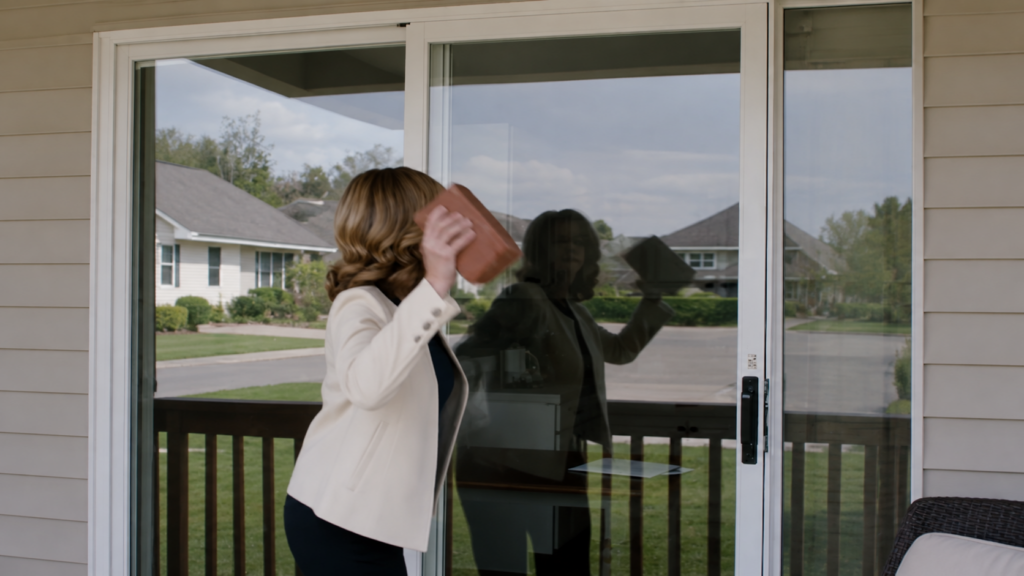
The first crack sounded like a plate breaking in the next room.
Mark Ellis turned from the stove and saw a brick hit his sliding door again.
Helen Parker stood on the patio in a cream jacket, holding the brick with both hands.
She was fifty-one, usually immaculate, and now looked as if she had been awake for three days.
Mark reached for his phone before he moved toward the kitchen.
Helen struck the glass a third time.
The pane collapsed inward, scattering bright pieces across the tile.
She pushed an arm through the opening and turned the lock.
Mark stepped between her and the kitchen table.
“Get out of my house, Helen.”
She looked past him at the padded envelope beside his coffee cup.
“That belongs to me.”
“It came from the Postal Inspection Service.”
Helen’s face drained of color.
She seized the fireplace poker from the stand beside the breakfast nook.
“Give it to me before you ruin everything.”
A man’s voice came from Mark’s phone.
“Mr. Ellis, do not let her touch that package.”
Mark kept the phone against his chest, the call already connected to Inspector David Keene.
“Federal agents are two minutes away,” Keene said.
Helen lowered the poker without releasing it.
“You don’t understand what happened that night.”
“Then explain it without a weapon,” Mark said.
Helen looked toward the driveway, where a dark sedan had turned the corner.
She dropped the poker.
The envelope had torn at one edge when Mark grabbed it.
A small memory card slid onto the floor.
Its paper sleeve bore a date from six months earlier.
That was the night Helen reported her husband missing.
Mark looked from the date to Helen.
“You knew this existed.”
Helen shook her head once.
“I knew someone would find it eventually.”
CHAPTER TWO: THE FIRST QUESTION
Inspector Keene entered through the shattered doorway with his colleague,
Inspector Ana Ruiz.
They asked Helen to sit at the kitchen table and keep her hands visible.
A patrol officer arrived behind them and checked the broken door.
Mark remained by the counter, unable to stop watching the scattered glass.
Keene placed the memory card inside a protective sleeve.
“Why did you come here today, Mrs. Parker?”
“Because Mark has something that was taken from my home.”
“What was taken?”
Helen stared at the sleeve.
“A recording.”
Ruiz leaned forward.
“Of what?”
Helen pressed her palms against her knees.
“Of the night my husband disappeared.”
Mark felt his throat tighten.
For six months, Helen had described Martin Parker as a man who walked away after an argument.
She had asked neighbors to watch for his blue pickup and his old leather jacket.
She had cried on Mark’s porch while holding a photograph of their wedding.
Now she sat beside a broken door and watched a memory card as though it were a live animal.
Keene spoke quietly.
“We recovered that card from a damaged camera submitted during an investigation into diverted checks.”
Helen lifted her head.
“Those checks have nothing to do with Martin.”
“You have not been told what the camera recorded,
” Ruiz said.
Helen closed her eyes.
“I know where the camera faced.”
CHAPTER THREE: SIX MONTHS EARLIER
Mark had installed the doorbell camera after a series of package thefts on the street.
It faced the sidewalk and a narrow strip of the Parkers’ driveway.
During a late autumn storm, the camera stopped working.
Mark assumed water had damaged the housing.
He replaced it and put the old unit in a drawer.
Two weeks later, he learned that several elderly neighbors had missed pension checks and insurance reimbursements.
A postal inspector visited the block and asked whether anyone had retained old cameras or mail-related footage.
Mark handed over the damaged device without expecting it to help.
He had almost forgotten about it when Keene called on Friday.
The inspector said a specialist had recovered part of a recording.
He asked Mark not to open the sealed envelope arriving the next morning until they spoke.
Mark agreed because he believed the evidence concerned stolen mail.
He did not imagine Helen would break his door to reach it.
CHAPTER FOUR: THE EMPTY DRIVEWAY
Six months earlier, Martin Parker had knocked on Mark’s door just after nine at night.
His blue pickup idled at the curb.
He asked whether Mark had seen a gray delivery van parked behind the community clinic.
Mark said he had not.
Martin looked toward his own house before speaking again.
“If anyone asks, I came here about a missing package.”
Mark frowned.
“Are you in trouble?”
Martin gave a tired smile.
“I’m trying not to make someone else pay for mine.”
He left before Mark could ask another question.
At dawn, Helen came to the door and said Martin was gone.
The pickup remained in the driveway, but his jacket and wallet were missing.
The police searched nearby streets and reviewed hospital admissions.
No one found him.
Mark had carried the memory of that brief conversation like a pebble in his shoe.
Now he wondered whether the camera had recorded Martin leaving with someone else.
CHAPTER FIVE: THE SECOND VEHICLE
Ruiz brought a laptop into Mark’s kitchen after the patrol officer secured Helen in the back of his car.
The recovered recording lasted less than four minutes.
Its picture jumped and blurred under streaks of rain.
Mark recognized the Parkers’ porch light and the rear of Martin’s pickup.
At 9:43 p.m., a white medical transport van rolled into view.
A man stepped out wearing a reflective jacket.
He was too far away for his face to be clear.
Martin emerged from the side of the house carrying a dark canvas bag.
He spoke to the driver for several seconds.
Then Helen appeared on the porch.
She did not run after Martin.
She handed him something flat and silver.
The driver opened the van’s side door.
A second passenger moved inside.
Martin climbed into the van willingly.
The van pulled away.
Helen stood in the rain until its lights disappeared.
Mark looked at Keene.
“She told us he walked away alone.”
Keene nodded.
“And she told the police she had been asleep.”
CHAPTER SIX: THE WRONG STORY
Helen was not allowed to return to Mark’s kitchen.
The inspectors interviewed her at the station while Mark replaced the shattered door with plywood.
A contractor named Luis worked beside him, carefully removing glass from the track.
“You knew them well?” Luis asked.
“I thought I did.”
Mark held the plywood steady while Luis drove a screw into the frame.
He kept remembering the silver object in Helen’s hand.
It had looked like a small metal case.
At four that afternoon, Keene called again.
“We need you to tell us everything Martin said on his last visit.”
Mark repeated the conversation about the gray van.
Keene asked whether Martin had mentioned a clinic, a driver, or a patient.
“Only that he didn’t want someone else paying for his trouble.”
Keene went silent for a moment.
“That may explain why he got into the van.”
CHAPTER SIX A: THE WOMAN IN THE PARKING LOT
On Monday, Mark returned to the hardware store for another roll of protective film.
The plywood over his kitchen door had made the house feel smaller, and he wanted the new glass installed before the weekend.
A woman in a green raincoat stood beside his car when he came out.
She held a receipt between two fingers as if she had found it on the pavement.
“You dropped this,” she said.
Mark glanced at the paper and saw that it was not his receipt.
It was a photocopy of a medical transport invoice with the patient’s name blacked out.
“I don’t know what this is,” he said.
“You will when you see the signature,” she replied.
A blue pen had marked a line at the bottom of the page.
The name was Martin Parker.
Mark stepped away from his car.
“Who are you?”
“Someone who used to approve invoices without reading them,” she said.
She turned toward the store before he could ask another question.
Mark did not follow her.
He photographed the paper where she had left it on his windshield and called Inspector Ruiz.
Ruiz told him to remain in the parking lot until a local officer could collect the document.
“Did she threaten you?” Ruiz asked.
“She acted like she was doing me a favor.”
“Those can be the hardest approaches to interpret,” Ruiz said.
Mark watched shoppers push carts across the wet asphalt.
He had expected the broken door to be the end of his involvement.
Instead, strangers were beginning to recognize his car.
When the officer arrived, Mark described the woman’s coat and the direction she had walked.
The officer asked whether Mark wanted an escort home.
Mark said no, then changed his mind after noticing a gray sedan pass the store for a second time.
He hated how quickly his own decisions had become calculations about danger.











