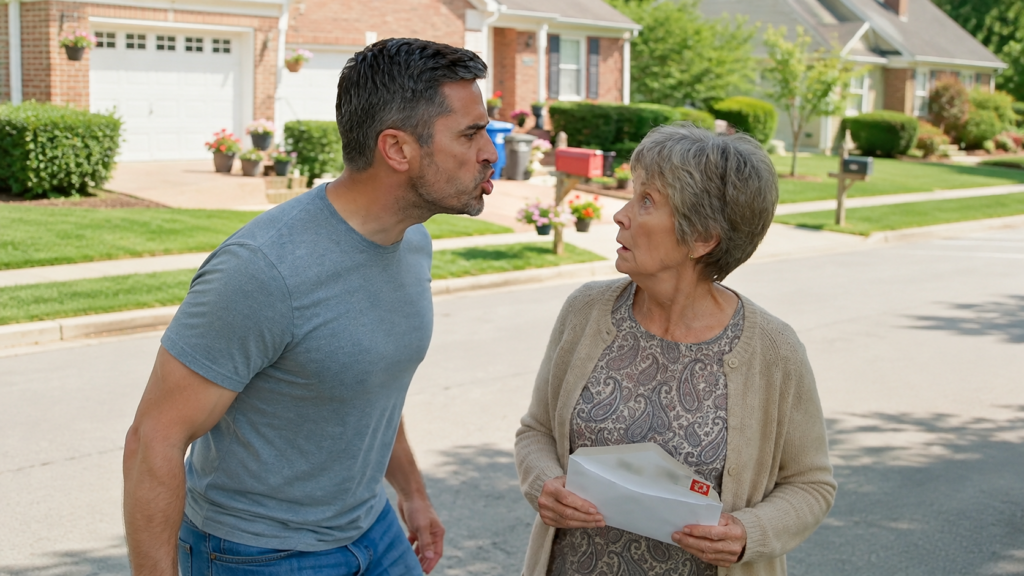
Trevor Nalin saw the envelope before he saw Evelyn Oakley.
Its white corner flashed above the hedge while he carried two bags of groceries from his car.
He recognized the orange stripe printed along the edge because the same organization had sent him a notice the previous week.
Evelyn stood beside his mailbox, bending the paper toward the afternoon light.
The flap was open.
Trevor stopped at the bottom of his driveway.
“What are you doing?” he asked.
Evelyn did not jump.
She straightened her shoulders and held the letter away from him as though she were examining something unpleasant.
“I’m checking what kind of trouble you’re bringing into this neighborhood.”
“That’s my mail.”
“Your name is on the outside, Trevor, but that doesn’t mean the contents don’t affect other people.”
He set down the groceries and extended his hand.
Evelyn looked at the envelope, then at his face.
For a moment, Trevor thought she might refuse.
She gave it back with a small, impatient movement.
The paper smelled faintly of the rose lotion she always wore.
“You should be more careful about the people you invite here,” she said.
“I haven’t invited anyone.”
“You will.”
Trevor watched her cross the street toward the narrow white house with its polished brass doorbell.
Her curtains moved before she reached the front steps.
Someone was watching from inside.
Trevor looked down at the letter.
The sender was the County Language Access Partnership, a small nonprofit that arranged interpreters for public meetings.
He had agreed to host a volunteer training session at the community library the following Saturday.
Nothing in the envelope mentioned his house or any neighborhood visitors.
He put the groceries away, photographed the torn flap, and called the organization.
The coordinator confirmed that the letter contained only a room reservation and a printed schedule.
“Has somebody been complaining?” she asked.
“Not to me,
” Trevor said.
He hung up and considered walking across the street.
Instead, he placed the envelope in a kitchen drawer.
He had lived on Calder Street for eleven months.
He knew that Evelyn had been called the neighborhood’s unofficial watchdog long before he arrived.
He also knew that people laughed when they used that phrase.
Their laughter had become less comfortable lately.
CHAPTER TWO: THE QUESTION
Three days later, a gray government sedan stopped outside Evelyn’s house.
Trevor was replacing a loose screen on his front window when two people stepped out.
The older inspector wore a dark coat despite the warm weather.
The younger woman carried a narrow case and a notebook.
They showed identification at Evelyn’s door.
Evelyn smiled until the older inspector spoke.
Trevor could not hear the first sentence.
He heard her reply clearly.
“This is about Trevor’s mail, isn’t it?”
“No, ma’am,” the inspector answered.
“His envelope is why we found you.”
Evelyn’s hand tightened around the doorframe.
The inspector opened a folder containing photographs of mailboxes on Calder, Birch, and Larch Streets.
Several addresses were marked in red.
He pointed to a page near the bottom.
“Why were you redirecting mail from houses whose owners never moved?”
Evelyn looked across the street.
Trevor was still holding the screen frame.
He did not pretend that he had missed her expression.
The younger inspector turned toward him and raised one finger, asking him to wait.
He waited.
After fifteen minutes, Evelyn let the inspectors inside.
The door closed softly.
Trevor put the screen down and called his friend Mara Bell, who worked as a nurse at the county clinic.
“Do you still have that envelope I told you about?” he asked.
“The one addressed to your old apartment?”
“Yes.”
“I kept it because I thought the clinic had made a mistake.”
“Don’t throw it away.
”
“Trevor, what’s happening?”
He watched the curtains in Evelyn’s front room.
“I think the mistakes have been happening to other people.”











