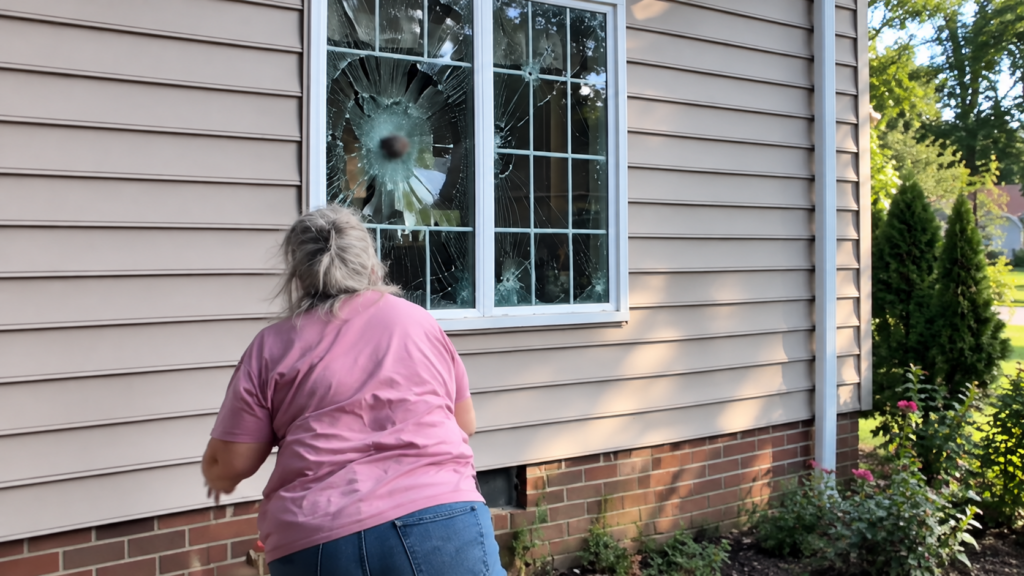
The folding chair struck Daniel Reed’s kitchen window at twelve seventeen on a Wednesday afternoon.
Daniel knew the time because the oven clock stopped when the chair hit the counter and pulled its plug from the wall.
He had been upstairs changing a bedsheet when glass burst across the tiles below him.
The crash sounded like a cupboard collapsing beneath a falling tree.
He ran down the stairs and found the red picnic chair lying among the broken glass.
One metal leg had pierced the wicker basket where he kept clean dishcloths.
Beyond the empty window frame stood Carol Mercer,
his sixty-five-year-old neighbor, looking as though she had come to collect something.
Her gray hair had escaped its clip, and a fresh scratch ran along her wrist.
Daniel shoved open the patio door and stepped into the hot sunlight.
“What the hell are you doing?” he demanded.
Carol pointed through the broken window toward the lower kitchen cabinets.
“You should have listened when I told you to stay out of this.”
“This is my house, and you broke into my yard.”
For one second her face looked frightened instead of angry.
“Don’t move the cabinet,” she said.
Daniel turned toward the window and saw the chair resting against a cupboard beside the refrigerator.
The cabinet had shifted two inches away from the plaster, revealing a dark seam he had never noticed.
Carol moved toward the broken window, but Daniel blocked her path.
“You’re not going inside,” he said.
“Then you go inside and leave that cabinet alone.”
“You just told me to leave it alone, and now you’re telling me to go inside.”
“I’m telling you not to open what’s behind it.”
Daniel stared at her.
For eight months Carol had complained about his backyard lights, the height of his fence, and where he parked his truck.
She had called his renovation project a danger to the street even though he had finished the work before moving in.
He had dismissed her as a difficult woman with too much free time.
Now she had broken his window to reach one particular part of the kitchen.
He went inside and pulled the damaged cabinet away from the wall.
A metal panel appeared behind it, roughly the size of a baking tray and held closed by two heavy latches.
The metal was newer than the plaster around it.
A strip of green tape covered a small opening at the bottom.
Daniel heard a noise from the other side.
It was not a scrape or a tap.
It was a thin,
persistent whistle, followed by the flutter of wings.
Carol climbed through the ruined window frame without waiting for permission.
“Step away from it,” she whispered.
“What is behind my wall?” Daniel asked.
Carol looked down at the green tape and began to shake.
“Something alive,” she said.
CHAPTER TWO: THE BREATHING WALL
Daniel moved toward the panel, but Carol seized his forearm.
“If you open it too quickly, they’ll scatter through the house,” she said.
He pulled free and stood between her and the opening.
“Who’s they?”
Carol did not answer.
The sound behind the metal became louder.
Daniel crouched and spotted three tiny feathers caught beneath the tape.
He had owned this house for nine months and had never heard birds in the kitchen wall before.
He reached for his phone and called the county animal services number saved from a previous encounter with a stray dog.
The dispatcher transferred him to a wildlife officer named Priya Santos.
Priya asked him to describe the sound, the panel, and the room.
She told him not to open the hatch until someone could inspect it safely.
“Keep the room closed and reduce noise,” she said.
“If there are animals inside, panic will make this harder.”
Carol stood with her back to the broken window.
Her hands shook so violently that she had to hold them together.
“You called wildlife services,” she said.
“There are birds behind my kitchen wall.”
“They’ll take everything.”
“Everything what?”
She stared at the cabinet as though it might answer for her.
Daniel pulled a sheet over the broken window to keep the house from filling with insects.
He placed the chair on the patio, where its bent frame scraped across the stones.
Carol watched every movement.
“My sister painted this kitchen,” he said, mostly to give himself something ordinary to think about.
“She complained that the wall behind that cabinet smelled of cedar.
”
“It’s a lining,” Carol replied automatically.
Daniel turned around.
“You know what’s behind there.”
She looked toward the alley separating their houses.
“Your contractor put in the panel.”
“The renovation was finished before I bought the place.”
“The contractor was my nephew, Lewis.”
The name sounded familiar.
Daniel remembered a young man in a clean blue jacket who had once stood on Carol’s porch carrying a narrow wooden crate.
He had introduced himself as Lewis Mercer and said he worked with injured birds.
He had asked Daniel to keep the patio floodlights off at night because bright light disturbed wildlife.
Daniel had refused after someone tried to open his garage door one evening.
“Lewis built an animal shelter in my wall?” he asked.
Carol took a breath.
“He said it was temporary.”
“When did he say that?”
“Before you moved in.”
Daniel stared at the newer screws holding the metal panel.
He remembered the rattling he sometimes heard near the refrigerator when the house was quiet.
He had blamed the ice maker.
“What birds are they?” he asked.
Carol opened her mouth, then closed it.
Outside, a white delivery van passed slowly along the alley.
Carol flinched so hard that Daniel noticed.
“Who’s in that van?” he asked.
“Don’t look,” she said.
Daniel looked anyway.
The driver wore a yellow cap and had no company markings on the doors.
The van continued without stopping.
When Daniel faced Carol again, her expression had changed from fear to calculation.
“I need to call Lewis,” she said.
“You can call him after you tell me what he did.”
“He isn’t going to answer me now.”
“Why not?”
“Because he knows I broke your window.”
CHAPTER THREE: THE OFFICER
Priya Santos arrived in a county truck twenty minutes later with a wildlife transport crate and a narrow inspection camera.
She wore a faded green uniform, practical boots, and the expression of someone who disliked surprises around frightened animals.
Her partner, Ben Kline, stayed outside to check the perimeter of the house.
Daniel showed Priya the panel without touching it.
Carol remained on the porch, where Daniel could see her through the doorway.
“Was this room part of a licensed rehabilitation facility?” Priya asked.
“It’s my kitchen,” Daniel said.
Priya knelt and inspected the edge of the panel.
She carefully lifted one corner of the green tape and looked into the gap with a flashlight.
“Those aren’t local sparrows,” she said.
Daniel felt a chill despite the summer heat.
“What are they?”
“I need a better look before identifying them.”
She inserted the camera through the gap and watched the image on a small screen.
Daniel stayed back at her request.
The screen revealed a row of narrow wooden compartments stacked behind the wall.
In the nearest compartment, a bird with bright green feathers clung to a perch.
Two smaller birds huddled beneath it.
Another cage sat farther back, its bottom littered with seed husks.
“These are parakeets,” Priya said.
“But this setup is completely unsuitable.”
“How many are there?”
“I can see six right now.
”
Priya shifted the camera and her mouth tightened.
“There may be more behind the second partition.”
The wall cavity was larger than Daniel had imagined.
It extended past the kitchen into the empty space behind the pantry, where the former owner had installed thick insulation.
Someone had converted that unused space into a concealed series of small cages.
The panel was an access door.
A thin flexible hose ran upward between the compartments.
Priya followed it on the screen until it disappeared toward an exterior vent.
“We need to make sure every animal has air before moving them,” she said.
She called her supervisor and requested assistance from a veterinary team familiar with confiscated birds.
Daniel went outside to find Carol talking rapidly on her phone.
“Tell Lewis to come here,” he said.
She covered the mouthpiece.
“He’s already coming.”
“With whose permission?”
“He’s responsible for the birds.”
“He’ll be speaking to the officers,” Daniel replied.
Carol’s voice dropped.
“If he gets here first, he’ll tell them you agreed to the installation.”
Daniel looked at her in disbelief.
“Why would he say that?”
“Because that’s what he says whenever someone asks where the birds came from.”
A new sound came from inside the house.
It was a sharp series of squawks, followed by Priya calling for a towel.
Carol tried to rush past Daniel, but he held up a hand.
“The officer knows what she’s doing.”
Carol stopped.
“You don’t understand,” she said.
“Some of them won’t survive being moved.”
“Then why did you wait until now to tell anyone?”
“Because I thought I could get them out without anyone knowing.”
Her eyes filled with tears.
Daniel saw genuine shame on her face for the first time.
He wanted to believe it meant something.
Then he noticed her phone was still connected.
He took a step away so she could not use him as an excuse for her next decision.
“Tell Lewis he’s not entering my house,” Daniel said.
Carol looked down at the call and whispered something into the receiver.
She ended it without explaining.











