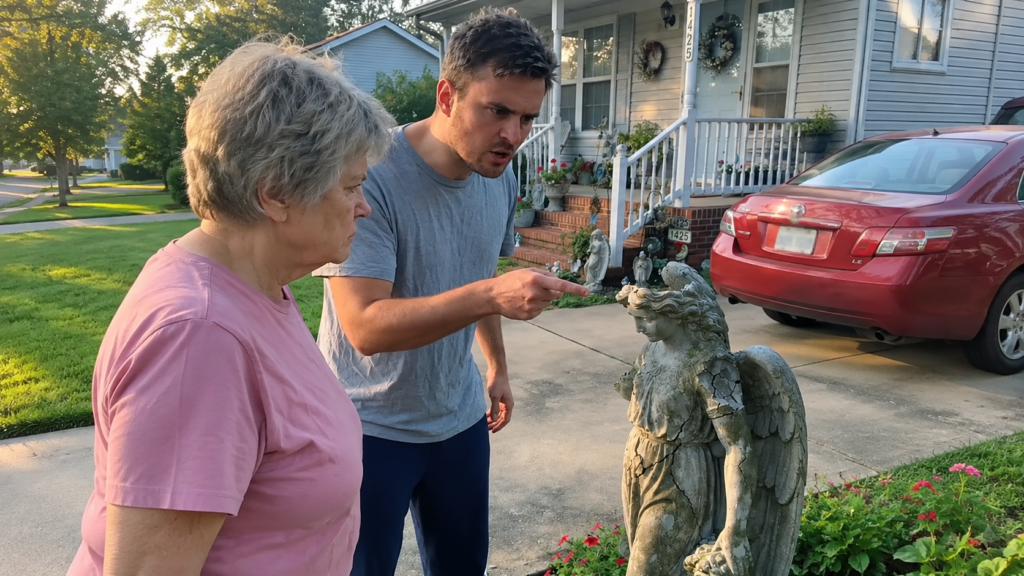
The first blow sounded like somebody striking a church bell with a brick.
Daniel Reed looked up from his breakfast and saw Carol Mercer standing beside the limestone statue at the edge of his driveway.
She had brought a carpenter’s hammer instead of the garden shears she usually carried when she marched over to complain about his hedges.
The figure was a small woman carrying a basket of pears, and its smooth face had greeted Daniel every morning since he bought the house six years earlier.
He had never particularly liked the expression, which looked less welcoming than suspicious, but the estate agent had called the statue valuable.
Carol raised the hammer again, and a pale fragment broke away from the basket.
Daniel abandoned his coffee and ran through the front door.
He reached the driveway as she struck the base for a third time.
He caught her wrist before the next swing landed, and the hammer dropped into the grass.
“What are you doing?” he demanded.
Carol pulled against his grip, then stopped when she saw the damage.
“That thing should never have been here,” she said.
“You could have knocked on my door.”
“I knocked three times last week.”
“You said my sprinklers were splashing your fence.”
“I said other things, too.”
Carol was sixty-five, narrow-shouldered and usually impossible to intimidate, but her hands were shaking hard enough that Daniel released her wrist.
He inspected the broken statue and saw a ragged crack running beneath the woman’s shoes.
A black sedan rolled to the curb before he could speak again.
A tall man in a charcoal suit climbed out with an overnight bag and walked directly toward the broken figure.
He looked at Carol, but he did not appear surprised to see her.
“Where did you get this?” he asked Daniel.
“It came with the house.”
“Who sold you the house?”
“Why should I tell you?”
The stranger crouched beside the base and gently lifted a loose wedge of limestone.
Beneath it lay a brass rectangle no larger than a matchbox, stamped with the number 04-17 and a tiny symbol resembling an open gate.
Carol made a noise like she had swallowed a mouthful of cold water.
The man took out his phone and compared the plate with a photograph showing several similar pieces.
“It’s one of the Eastmere Twelve,” he said.
Daniel had never heard the name.
Carol had, and she reached for the stone with a speed that startled both men.
The stranger intercepted her hand before she could touch the plate.
“My name is Julian Marr,” he said.
“I’ve spent eleven years trying to find this collection.”
Carol stared at him with open dislike.
“Then you’ve spent eleven years asking the wrong people,” she replied.
Julian stood and produced a business card showing a modest firm called Marr Object Research.
He explained that twelve limestone sculptures had vanished during the closure of a private sculpture garden thirty-four years earlier.
The collection had belonged to a wealthy industrialist named Arthur Bellweather, who had bought the figures from the sculptor shortly before the garden opened.
According to the story repeated in every art magazine, thieves had emptied Bellweather’s storage courtyard during a storm.
The figures had never resurfaced together, and only three uncertain photographs survived in public circulation.
Daniel looked at the damaged woman with the pears.
“You’re telling me that thing’s stolen?”
“I’m telling you it matches a missing object,” Julian said.
“Those are different claims.”
Carol laughed once, without humor.
“Congratulations, investigator, you’ve learned the difference between a story and the truth.”
She turned toward her house, but Julian called after her.
“I know about the night at the loading yard, Mrs. Mercer.”
She stopped so abruptly that Daniel could hear her shoes scrape against the sidewalk.
Julian lifted the brass plate,
still attached to a fragment of stone.
“I also know somebody is offering the entire collection for sale on Saturday.”
Carol turned around.
“That is impossible.”
“I thought so until this morning.”
Daniel looked between them as a city delivery truck rattled past.
“Somebody needs to explain why my neighbor just demolished my statue.”
Carol glanced at the hammer lying among the daisies.
“Because whoever comes for the others won’t stop at the statues,” she said.
“And if that number survives, he’ll know exactly where to begin.”
CHAPTER TWO — THE TWELVE SEASONS
Daniel insisted that everybody come inside before anyone moved another piece of stone.
Carol refused until Julian pointed out that people driving past could already see the shattered base.
They entered the kitchen through the side door, leaving the damaged sculpture under Daniel’s porch camera and a clean painter’s sheet.
Julian declined coffee and spread twelve printed photographs across the table.
Each picture showed a different person performing an ordinary task, with winter coats, gardening aprons, market baskets and work boots carved into the limestone.
Daniel saw a baker lifting a loaf, a young man repairing a bicycle, and a girl balancing a book on her head.
The woman carrying pears appeared in the fourth photograph.
The original photographs had been taken at the Eastmere Garden’s opening exhibition in 1989.
The garden had lasted barely eighteen months before Bellweather closed it without explanation.
Julian pointed to a photograph of the sculptures arranged along a circular path.
“The artist called them Twelve Ordinary Days,” he said.
“Bellweather renamed them the Eastmere Twelve because he believed his own name improved everything.”
Carol examined the photographs without touching them.
“The arrangement was never a circle,” she said.
Julian looked up sharply.
“The catalogue shows a circle.”
“The catalogue shows what Bellweather ordered the photographer to shoot.”
Daniel folded his arms.
“Is this what you’ve been arguing about for thirty years?”
Carol gave him a hard look.
“For thirty years I’ve been trying not to argue about it.”
Julian explained that the statues had been carved by a local stoneworker named Ada Venn, whose reputation had grown after her death.
Their surfaces were unusual because she left the tool marks visible instead of polishing them into lifeless perfection.
A collector in London had recently advertised a private viewing of all twelve figures, claiming they had been recovered from an anonymous estate.
The offer was being handled by a gallery owner named Conrad Vale,
who had a habit of finding artworks that ordinary people did not realize they possessed.
“Vale plans to sell the set Saturday night,” Julian said.
“His brochure calls it the art recovery event of the decade.”
Daniel studied the brochure on Julian’s phone.
It showed the twelve statues under bright lights, arranged in a perfect circle against black curtains.
Every figure looked remarkably clean for an object supposedly lost in a wet storage yard for decades.
Carol leaned forward when Daniel enlarged the baker’s hands.
“Those aren’t Ada’s pieces,” she whispered.
“How can you tell?”
“She carved the bread crust with her thumb,
not a chisel.”
Julian slid over a magnified image.
“I saw that difference too, but I couldn’t prove anything without examining an original.”
Carol went silent when his eyes moved to the broken statue outside.
Daniel finally understood that the visitor had known where to come before Carol attacked the stone.
“You were already on your way here,” he said.
“Yes,” Julian admitted.
“I sent Mrs. Mercer a photograph of the auction brochure yesterday.”
Daniel turned toward Carol.
“You didn’t tell me somebody wanted to buy my statue.”
“I wanted you to be angry enough to sell it quickly,” she answered.
“That was the only way I could keep you out of what comes next.”
“You decided to protect me by smashing my property?”
“I decided badly,” Carol said.
Her answer surprised him more than an excuse would have.
Julian opened another photograph showing the underside of a statue base.
The brass plate had been installed inside a shallow notch rather than on the outside, hidden by an additional stone layer.
He said the numbers appeared to correspond to a pattern, but the pattern had never been published.
Daniel glanced at Carol and saw that she was looking toward his back door.
“You know what the numbers mean,” he said.
Carol did not answer.
Julian repeated his question more gently.
“Who was working at the Eastmere loading yard when the statues disappeared?”
Carol looked at a spot on the table where an old scratch crossed the wood.
“My husband, my sister, and I were there,” she said.
“And so were nine people Bellweather refused to pay.”
Julian began to speak, but Carol stopped him.
“If you’re going to call them thieves, get out of this house first.”
CHAPTER THREE — THE MAN WHO BOUGHT SILENCE
Carol agreed to talk after Daniel promised not to let Julian remove the brass plate without his permission.
She took them to a narrow garage behind her house, where the smell of cut lumber mingled with dried lavender.
A workbench occupied the far wall, and dozens of little wooden boxes stood along shelves above it.
Julian examined a cabinet of old carving tools while Carol pulled a dusty folding table into the middle of the floor.
She told them that Ada Venn had originally designed the figures for a public walkway beside the abandoned railway station.
The project had been funded by donations from local shopkeepers, mechanics, teachers and factory workers.
Each figure represented a resident who had volunteered to sit for Ada while she sketched the shape and movement of ordinary work.
The statues were supposed to be placed along a winding path so children could encounter them one at a time.
Bellweather had offered to pay the remaining carving costs on the condition that his company manage the temporary exhibition.
Then he had moved the sculptures into his own garden and replaced the public installation with a plaque thanking himself.
Julian frowned.
“There are newspaper pictures of Ada celebrating the opening beside Bellweather.”
“There are pictures of her standing beside him,” Carol corrected.
“She spent the whole reception telling people where the statues were meant to go.”
Carol opened a wooden box containing a soft wax model of a little pear.
She said Ada kept one model from each figure as a reminder of the people who inspired her.
After Bellweather closed the garden, he told the workers that their final payments were being withheld because the exhibition had lost money.
Ada protested until she collapsed from exhaustion during an argument at his office.
She recovered physically but never carved another full figure.
Carol’s husband, Peter, had been responsible for lifting the twelve statues onto Bellweather’s trucks.
When he discovered that the sculptures would be shipped abroad before the workers received their wages, he refused to move them.
Bellweather threatened to blacklist every workshop that cooperated with Peter.
The following week, a storm struck the town, and the statues vanished.
“Peter stole them?” Daniel asked.
“Peter moved them,” Carol said.
“He wanted them somewhere Bellweather couldn’t quietly put them on a ship.”
Julian leaned against the workbench.
“Where?”
“That is the question everybody has asked me ever since.”
She showed them a small photograph of twelve adults standing beside a yellow flatbed truck.
Several held mugs and looked exhausted, while one young woman sat on the truck’s tailgate with her muddy boots hanging over the edge.
Carol was the woman on the tailgate.
Daniel recognized her only by the shape of her eyes.
“I didn’t know you worked with sculpture,” he said.
“I worked wherever there was a job,” Carol replied.
Peter and his coworkers had divided the pieces among trusted households instead of hiding them together.
They believed Bellweather would eventually have to settle with the workers, after which they could return the figures to the planned walkway.
He never settled, and the people holding the statues gradually moved, died or lost touch.
Carol had known where seven pieces went at the beginning, but she claimed she had stopped checking.
Daniel remembered the woman with the pears beside his driveway.
“Did you put mine there?”
Carol hesitated.
“I arranged for it to be there before you bought the place,” she said.
“The previous owner was one of Peter’s friends.”
Daniel felt a hot pulse of anger.
“You watched me spend six years cleaning it and protecting it while you knew somebody might come for it.”
“I hoped nobody would ever come.”
Julian stepped between them and asked whether the other eleven pieces could still be found.
Carol shook her head.
“Some can, but not the way Vale wants to find them.”
Julian’s phone rang before he could ask what she meant.
He answered, listened, and moved toward the open garage door.
Daniel heard only fragments from the caller, including the words delivery truck and replacement sculpture.
Julian ended the call and looked back at Carol.
“Vale has sent somebody to Daniel’s house,” he said.
“He says he’s offering to buy a piece of damaged garden ornament before it becomes worthless.”
Carol swore, grabbed her coat, and hurried out into the sunlight.











